Termo do glossário: Nebulosa
Descrição: Uma nebulosa é um objeto celeste distante que tem a aparência de uma nuvem. Normalmente, uma nebulosa é composta por gás e poeira interestelares. Historicamente, o termo “nebulosas” abrangia qualquer objeto extenso de aparência difusa, incluindo o que hoje reconhecemos como galáxias — sistemas estelares distantes, como a nossa própria Via Láctea. Hoje, o termo “nebulosa” se restringe a nuvens de gás e poeira que fazem parte do meio interestelar – o gás e a poeira entre as estrelas dentro de uma galáxia. A categoria inclui diversos tipos de objetos: as nuvens moleculares são comparativamente frias e escuras e consistem predominantemente em hidrogênio molecular; é no interior dessas nuvens que novas estrelas se formam. Nuvens moleculares gigantes podem conter até alguns milhões de massas solares de gás hidrogênio. Estrelas jovens frequentemente emitem jatos estreitos de gás ionizado; quando esses jatos excitam o gás circundante, o resultado é um tipo de nebulosa chamada objeto Herbig–Haro. Quando estrelas massivas se formam, sua radiação intensa faz com que o gás circundante emita uma luz avermelhada característica; o resultado são nebulosas de gás de hidrogênio quente e ionizado, chamadas de regiões HII. Algumas nebulosas são formadas durante os estágios finais da vida das estrelas. Quando estrelas de baixa massa, como o Sol, chegam ao fim de sua evolução, elas ejetam suas camadas externas para o espaço, criando envoltórios de gás em expansão conhecidos como nebulosas planetárias. Apesar do nome, essas nebulosas não têm relação com planetas; a denominação surgiu porque, em telescópios antigos, sua aparência lembrava pequenos discos planetários. Quando uma estrela de alta massa explode como uma supernova, o gás ejetado forma um tipo de nebulosa chamado de remanescente de supernova.
Termos relacionados:
Ver este termo em outros idiomas
Status do termo e da definição: A definição original deste termo em inglês foi aprovada por um astrônomo(a) pesquisador(a) e um(a) professor(a) A tradução deste termo e de sua definição ainda aguarda aprovação
O Glossário Multilíngue da OAE é um projeto do Escritório da IAU de Astronomia para a Educação (OAE) em colaboração com o Escritório da IAU para Divulgação da Astronomia (OAO). Os termos e definições foram selecionados, escritos e revisados por meio de um esforço coletivo da OAE, dos Centros e Nós da OAE, dos Coordenadores Nacionais de Educação em Astronomia (NAECs) da OAE e de outros voluntários. Você pode encontrar uma lista completa dos créditos aqui. Todos os termos do glossário e suas definições são disponibilizados sob uma licença Creative Commons CC BY-4.0 e devem ser creditados à "IAU OAE".
Se você notar algum erro factual ou de tradução neste termo do glossário ou em sua definição, por favor entre em contato.
Mídia relacionada

Nuvens de poeira e nebulosas perto de R Coronae Australis
Legenda: A imagem mostra uma nuvem escura e empoeirada e algumas nebulosas de reflexão brilhantes perto da estrela binária R Coronae Australis. A nuvem escura se estende por vários anos-luz e está localizada na constelação Corona Australis, perto da constelação de Sagitário, na direção do centro da Via Láctea. A nuvem parece engolir a luz de estrelas distantes atrás dela, pois as partículas de poeira nela contidas dispersam a luz que passa em todas as direções. Isso lhe dá a aparência de um vazio no céu. Esta nebulosa escura faz parte das Nuvens Moleculares de Corona Australis, uma região mais ampla. R Coronae Australis faz parte do Aglomerado Coronet, um conjunto de estrelas jovens que se formou em algum momento nos últimos dois milhões de anos.
Ao redor de R Coronae Australis, no centro da imagem, encontra-se a pequena nebulosa de reflexão NGC 6729, com duas nebulosas de reflexão azuladas NGC 6726 e NGC 6727 situadas no canto superior direito. Nessas nebulosas, a poeira dispersa a luz de estrelas brilhantes próximas, direcionando-a para um observador na Terra, fazendo-a brilhar nesta imagem.
Crédito: ESO
link do crédito
License: CC-BY-4.0 Creative Commons Attribution 4.0 International (CC BY 4.0) ícones

A Nebulosa Cabeça de Cavalo
Legenda: Esta imagem mostra a Nebulosa Cabeça de Cavalo, localizada a cerca de 1.300 anos-luz da Terra, na constelação de Órion, um dos exemplos mais emblemáticos de nebulosa escura. Uma nebulosa escura é uma densa nuvem de poeira interestelar e gás frio que absorve e dispersa a luz visível, impedindo que a luz das estrelas de fundo e de gás brilhante cheguem aos nossos olhos. Esta imagem em cor falsar combina dados obtidos por meio de múltiplos filtros de banda estreita, cada um isolando a luz de diferentes elementos na nebulosa. A silhueta escura em forma que lembra a cabeça de um cavalo aparece com contornos nítidos contra a nebulosa luminosa ao fundo, onde a radiação energética de estrelas jovens próximas faz com que o gás brilhe. A distribuição irregular das estrelas visíveis nesta imagem não é aleatória: regiões ricas em poeira na parte inferior da imagem parecem quase vazias, enquanto áreas mais claras revelam muitas estrelas de fundo. A poeira age como uma cortina cósmica, ocultando as estrelas que se encontram atrás dela, ao mesmo tempo que permite que as estrelas à frente da nuvem permaneçam visíveis. O estudo dessas regiões ajuda os astrônomos a compreender como as nebulosas servem de ambiente para a formação de novas estrelas.
Crédito: T.A. Rector (NOIRLab/NSF/AURA) e Equipe Hubble Heritage (STScI/AURA/NASA)
link do crédito
License: CC-BY-4.0 Creative Commons Attribution 4.0 International (CC BY 4.0) ícones
Diagramas relacionados
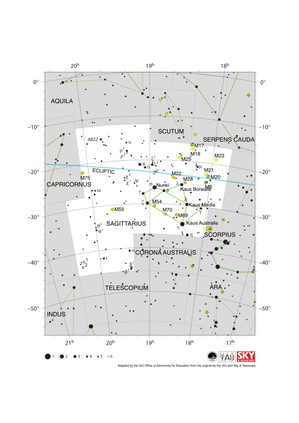
Sagittarius Constellation Map
Legenda: The constellation Sagittarius along with its bright stars and surrounding constellations. Sagittarius is surrounded by (going clockwise from the top) Aquila, Scutum, Serpens Cauda, Ophiuchus, Scorpius, Corona Australis, Telescopium, Microscopium and Capricornus. The brighter stars in Sagittarius form a distinctive teapot shape. Sagittarius lies on the ecliptic (shown here as a blue line), this is the path the Sun appears to take across the sky over the course of a year. The Sun is in Sagittarius from mid December to mid January. The other planets of the Solar System can often be found in Sagittarius.
Sagittarius lies south of the celestial equator. The famous teapot asterism is visible for all but the most arctic regions of the world but the most southerly parts of the constellation are not visible in northern parts of Asia, Europe and North America. Sagittarius is most visible in the evenings in the northern hemisphere summer and southern hemisphere winter.
The supermassive black hole Sagittarius A* which lies at the center of our Milky Way Galaxy is sits on the western (here right-hand) edge of Sagittarius. Due to it covering an area at the center of our Galaxy, Sagittarius is home to many star clusters including open clusters (marked here with yellow circles) and globular clusters (marked here with yellow circles with + signs superimposed on them). Three nebulae are also marked here with green squares.
The y-axis of this diagram is in degrees of declination with north as up and the x-axis is in hours of right ascension with east to the left. The sizes of the stars marked here relate to the star's apparent magnitude, a measure of its apparent brightness. The larger dots represent brighter stars. The Greek letters mark the brightest stars in the constellation. These are ranked by brightness with the brightest star being labeled alpha, the second brightest beta, etc., although this ordering is not always followed exactly. The dotted boundary lines mark the IAU's boundaries of the constellations and the solid green lines mark one of the common forms used to represent the figures of the constellations. Neither the constellation boundaries, nor the line marking the ecliptic, nor the lines joining the stars appear on the sky.
Crédito: Adapted by the IAU Office of Astronomy for Education from the original by IAU/Sky & Telescope
License: CC-BY-4.0 Creative Commons Attribution 4.0 International (CC BY 4.0) ícones
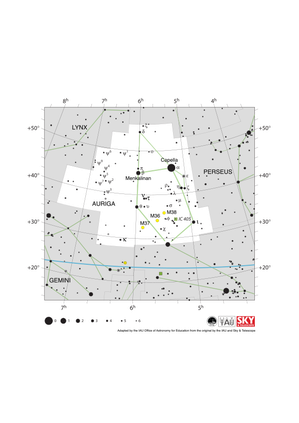
Auriga Constellation Map
Legenda: The constellation Auriga with its bright stars and surrounding constellations. Auriga is surrounded by (going clockwise from the top): Camelopardalis, Perseus, Taurus, Gemini and Lynx. Capella, the brightest star in Auriga, is the sixth brightest star in the night sky.
As a northern constellation, Auriga is visible from the whole of the northern hemisphere at some point in the year. The whole of the constellation is visible to equatorial regions of the southern hemisphere with parts of it visible to temperate southern regions. The whole constellation is circumpolar from arctic regions. The constellation is best viewed in the evening in the late northern hemisphere winter and late southern hemisphere summer.
Auriga lies in the plane of the Milky Way and thus hosts a number of open clusters. Of these M36, M37 and M38 are marked on this diagram with yellow circles. IC 405, also known as the flaming star nebula, is marked here with a green square.
The y-axis of this diagram is in degrees of declination with north as up and the x-axis is in hours of right ascension with east to the left. The sizes of the stars marked here relate to the star's apparent magnitude, a measure of its apparent brightness. The larger dots represent brighter stars. The Greek letters mark the brightest stars in the constellation. These are ranked by brightness with the brightest star being labeled alpha, the second brightest beta, etc., although this ordering is not always followed exactly. The dotted boundary lines mark the IAU's boundaries of the constellations and the solid green lines mark one of the common forms used to represent the figures of the constellations. The blue line at the bottom of the diagram marks the ecliptic. Neither the constellation boundaries, nor the line marking the ecliptic, nor the lines joining the stars appear on the sky.
Crédito: Adapted by the IAU Office of Astronomy for Education from the original by the IAU and Sky & Telescope
License: CC-BY-4.0 Creative Commons Attribution 4.0 International (CC BY 4.0) ícones
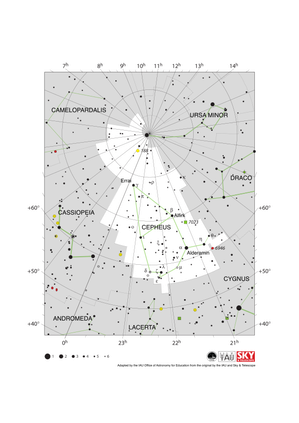
Cepheus Constellation Map
Legenda: The constellation Cepheus along with its bright stars and surrounding constellations. Cepheus is surrounded by (going clockwise from the top): Camelopardalis, Ursa Minor, Draco, Cygnus, Lacerta and Cassiopeia. Cepheus is a large constellation. Its most notable star is Delta Cephei, the prototype for the class of variable stars known as Cepheid variables. These are variable stars which can be used to estimate distances both within our galaxy and to nearby galaxies.
Cepheus lies close to the north celestial pole. As such it is circumpolar for arctic and temperate regions of the northern hemisphere. The whole of the constellation is also visible at some point in the year in equatorial regions of the northern hemisphere with parts of it visible in equatorial regions of the southern hemisphere. It is best viewed in the evening in the northern hemisphere late autumn and southern hemisphere late spring.
The open cluster NGC 188 lies in Cepheus and is marked here with a yellow circle. The nebula NGC 7023 also lies in the constellation and is marked with a green square. The red ellipse in the lower right marks the position of the spiral galaxy NGC 6946.
This diagram maps an area around the north celestial pole. Here lines of constant right ascension converge. The right ascension values of these lines are marked on the x-axis above and below the diagram. Some of the lines of constant declination are marked on the y-axis. The sizes of the stars marked here relate to the star's apparent magnitude, a measure of its apparent brightness. The larger dots represent brighter stars. The Greek letters mark the brightest stars in the constellation. Delta Cephei is marked with a circle around a dot as it is a variable star. Mu Cephei is also a variable star marked here as an open circle. These are ranked by brightness with the brightest star being labeled alpha, the second brightest beta, etc., although this ordering is not always followed exactly. The dotted boundary lines mark the IAU's boundaries of the constellations and the solid green lines mark one of the common forms used to represent the figures of the constellations. Neither the constellation boundaries, nor the lines joining the stars appear on the sky.
Crédito: Adapted by the IAU Office of Astronomy for Education from the original by the IAU and Sky & Telescope
License: CC-BY-4.0 Creative Commons Attribution 4.0 International (CC BY 4.0) ícones
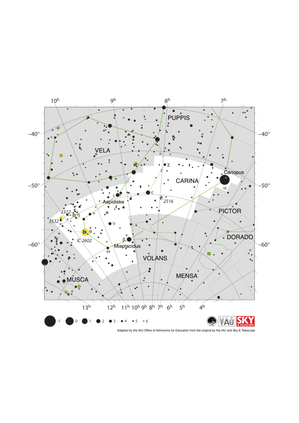
Carina Constellation Map
Legenda: The constellation Carina along with its bright stars and surrounding constellations. Carina is surrounded by (going clockwise from the top): Vela, Puppis, Pictor, Volans, Chamaeleon, Musca and Centaurus. Carina is notable for Canopus, the second brightest star in the night sky and for the famous variable star Eta Carinae. This latter object is a binary star system of two young very massive stars. Its brightness has varied greatly over the past few centuries. At one point it outshone Canopus before dimming by a factor of four thousand to become invisible to the naked eye. In recent years it has brightened enough to again be visible without the aid of a telescope.
Carina is a southern constellation and thus the whole constellation is visible at some point in the year to the entire southern hemisphere. The whole constellation is also visible from equatorial regions of the northern hemisphere with parts of the constellation visible from northern temperate regions.
The open clusters NGC 2516, NGC 3532 and IC 2602 lie in Carina. These are marked here by yellow circles. The Carina Nebula, also known as NGC 3372, lies in the constellation. This large nebula contains many massive young stars, including Eta Carinae.
This diagram maps an area around the south celestial pole. Here lines of constant right ascension converge. The right ascension values of these lines are marked on the x-axis above and below the diagram. Some of the lines of constant declination are marked on the y-axis. The sizes of the stars marked here relate to the star's apparent magnitude, a measure of its apparent brightness. The larger dots represent brighter stars. The Greek letters mark the brightest stars in the constellation. These are ranked by brightness with the brightest star being labeled alpha, the second brightest beta, etc., although this ordering is not always followed exactly. Carina was previously part of the larger Argo Navis constellation along with Vela and Puppis. As the letter designations for stars were created before this division took place, Greek letter designations are now divided between the three constellations with Carina having stars designated alpha and beta but no gamma or delta. The dotted boundary lines mark the IAU's boundaries of the constellations and the solid green lines mark one of the common forms used to represent the figures of the constellations. Neither the constellation boundaries, nor the lines joining the stars appear on the sky.
Crédito: Adapted by the IAU Office of Astronomy for Education from the original by the IAU and Sky & Telescope
License: CC-BY-4.0 Creative Commons Attribution 4.0 International (CC BY 4.0) ícones
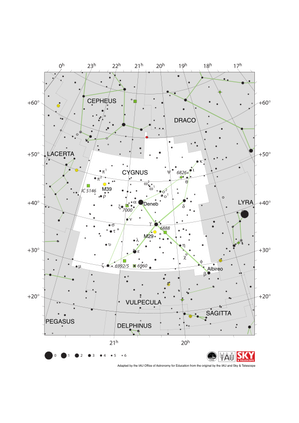
Cygnus Constellation Map
Legenda: The constellation Cygnus with its bright stars and surrounding constellations. Cygnus is surrounded by (going clockwise from the top): Cepheus, Draco, Lyra, Vulpecula, Pegasus and Lacerta. Cygnus is notable for its brightest star Deneb. This forms one vertex of the prominent Summer Triangle asterism that is visible in northern hemisphere summer evenings.
Cygnus is a northern constellation and thus the whole of the constellation is visible at some point in the year in the whole northern hemisphere. The whole constellation is also visible from equatorial regions of the southern hemisphere with parts of the constellation visible from temperate southern regions.
The plane of the Milky Way runs through Cygnus and thus the constellation is rich in nebulae and star clusters. These include the North America Nebula (NGC 7000) and the Crescent Nebula (NGC 6888). The Veil Nebula is a huge supernova remnant, parts of which are marked here as NGC 6960 and NGC 6992/5. All of the previously-mentioned nebulae are marked with green squares. The planetary nebula NGC 6826 is marked here with a green circle superimposed on a plus sign. The open star clusters M29 and M39 are marked here with yellow circles.
The y-axis of this diagram is in degrees of declination with north as up and the x-axis is in hours of right ascension with east to the left. The sizes of the stars marked here relate to the star's apparent magnitude, a measure of its apparent brightness. The larger dots represent brighter stars. The Greek letters mark the brightest stars in the constellation. These are ranked by brightness with the brightest star being labeled alpha, the second brightest beta, etc., although this ordering is not always followed exactly. The dotted boundary lines mark the IAU's boundaries of the constellations and the solid green lines mark one of the common forms used to represent the figures of the constellations. Neither the constellation boundaries, nor the lines joining the stars appear on the sky.
Crédito: Adapted by the IAU Office of Astronomy for Education from the original by the IAU and Sky & Telescope
License: CC-BY-4.0 Creative Commons Attribution 4.0 International (CC BY 4.0) ícones
Atividades relacionadas

Reading the Rainbow
astroEDU educational activity (links to astroEDU website) Description: By understanding how rainbows work, you can discover about light and its properties, learning about stars, nebulae, galaxies, and our Universe.
License: CC-BY-4.0 Creative Commons Attribution 4.0 International (CC BY 4.0) ícones
Faixas etárias:
14-16
, 16-19
, 19+
Nível de ensino:
Informal
, Ensino fundamental
, Médio
, Universidade
Áreas de aprendizagem:
Aula interativa
, Baseado em observação
, Aprendizagem por investigação estruturada
Custos:
Baixo custo
Duração:
1 hour 30 mins
Tamanho do grupo:
Grupo
Habilidades:
Analisar e interpretar dados
, Fazer perguntas
, Engajar-se em argumentação com base em evidências