Termo do glossário: Meio interestelar
Descrição: O meio interestelar (Interstellar Medium ou ISM em ingês) é um termo usado para descrever todo o gás e poeira que se encontram entre os sistemas estelares de uma galáxia. Nosso Sistema Solar está localizado no disco da Via Láctea, onde a maior parte do ISM é composta por hidrogênio atômico misturado com hélio atômico e poeira.
O ISM possui uma densidade muito baixa em comparação com as atmosferas planetárias, com uma densidade típica inferior a uma partícula por centímetro cúbico, sendo aproximadamente 50 bilhões de bilhões de vezes menos denso que a atmosfera da Terra.
Os maiores componentes em volume no disco galáctico são o gás atômico quente e o gás ionizado quente, ambos com temperaturas em torno de 8.000 kelvins (K) e densidades em torno de meio átomo ou íon por centímetro cúbico. Um volume menor apresenta-se na forma de gás atômico mais frio e mais denso, com temperatura em torno de 40 K. Um volume ainda menor do ISM apresenta-se na forma de nuvens mais densas (até um milhão de moléculas por centímetro cúbico) e mais frias (<20 K) de hidrogênio molecular. Algumas dessas nuvens moleculares entrarão em colapso sob sua própria gravidade, levando à formação de novas estrelas. As nuvens moleculares na Via Láctea são encontradas principalmente em seus braços espirais. O gás que circunda o disco da Via Láctea é muito quente (milhões de kelvins) e de densidade muito baixa.
As estrelas devolvem gás e poeira ao meio interestelar por meio de ventos estelares e supernovas. O gás e a poeira devolvidos ao meio interestelar apresentam uma fração maior de elementos pesados (metais), enriquecendo assim a galáxia ao longo do tempo. O gás e a poeira no meio interestelar são a principal causa da extinção interestelar.
Termos relacionados:
- Poeira
- Extinção
- Disco Galáctico
- Gás
- Via Láctea
- Nebulosa Planetária
- Sistema solar
- Vento solar
- Galáxia espiral
- Formação estelar
- Supernova
- Extinção interestelar
Ver este termo em outros idiomas
Status do termo e da definição: A definição original deste termo em inglês foi aprovada por um astrônomo(a) pesquisador(a) e um(a) professor(a) A tradução deste termo e de sua definição ainda aguarda aprovação
O Glossário Multilíngue da OAE é um projeto do Escritório da IAU de Astronomia para a Educação (OAE) em colaboração com o Escritório da IAU para Divulgação da Astronomia (OAO). Os termos e definições foram selecionados, escritos e revisados por meio de um esforço coletivo da OAE, dos Centros e Nós da OAE, dos Coordenadores Nacionais de Educação em Astronomia (NAECs) da OAE e de outros voluntários. Você pode encontrar uma lista completa dos créditos aqui. Todos os termos do glossário e suas definições são disponibilizados sob uma licença Creative Commons CC BY-4.0 e devem ser creditados à "IAU OAE".
Se você notar algum erro factual ou de tradução neste termo do glossário ou em sua definição, por favor entre em contato.
Em outros idiomas
- Árabe: الوسط بين النجمي
- Alemão: Interstellares Medium
- Inglês: Interstellar Medium
- Espanhol: Medio interestelar
- Francês: Milieu interstellaire
- Italiano: Mezzo interstellare
- Japonês: 星間媒質 (link externo)
- Chinês Simplificado: 星际介质
- Chinês Tradicional: 星際介質
Mídia relacionada
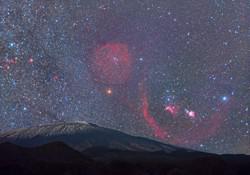
Orion Rises Over Mount Etna
Legenda: Honourable mention in the 2022 IAU OAE Astrophotography Contest, category Still images of celestial patterns.
Taken in February 2021, this image is a composite of an astronomy picture in the background and Mount Etna, the famous volcano in Sicily, Italy, in the foreground. Prominently, we see the red hydrogen clouds in space in the area of Orion. Barnard’s Loop is the gigantic bow with the Great Orion Nebula and the Horsehead Nebula in its centre. The deeper-coloured Horse Head is below the southernmost stars in Orion’s Belt, which is the line of white stars above the red nebula. Clearly visible is also the division between the Small and the Great Orion Nebula, the circular and the trapezium-shaped structure in light pink within which one of the nearest star-forming regions is located. The nebula is only a bit more than a thousand light-years away.
In the middle-left, close to the edge of the image, the small red structure is the Monkey Head Nebula still in the constellation Orion. It hosts a young star cluster and the deep red colour of this hydrogen cloud indicates its potential to build new stars in the future if the material is compressed again. All these reddish objects are strongly processed in this image, as they are not visible to the unaided eye.
Still, this image provides an interesting feature; the red supergiant star Betelgeuse lies in the middle of the image and it seems to be directly above the active volcano Mount Etna. At the foot of this volcano is an ancient settlement, the city of Catania. We consider both Betelgeuse and Mount Etna somehow dangerous — but which of them will erupt first?
Ok, we know that Etna occasionally erupts. Normally it exhibits only small eruptions, but the bigger ones happen every few centuries. We also know that Betelgeuse as a giant star will become a supernova in the future. Astronomers call the timescale for the potential supernova short, implying that it will be only 10 000 or maybe 100 000 years until this star explodes. This is “soon” for astronomers, meaning that on Earth, two to four precession cycles will pass by (with the consequence that the Sahara will turn green and dry again two to four times), continental drift will take Africa further north and cause the Alps to grow in height, the Niagara falls in America will wash the rock completely away and only after all this (and much more) happening on Earth will Betelgeuse explode as a supernova. Mount Etna is much more dangerous for the people in Sicily, and Catania in particular, because it will erupt sooner.
Crédito: Dario Giannobile/IAU OAE
License: CC-BY-4.0 Creative Commons Attribution 4.0 International (CC BY 4.0) ícones
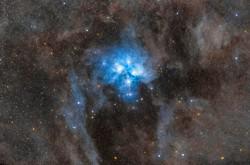
The Pleiades M45 with Majestic Dust
Legenda: Honourable mention in the 2022 IAU OAE Astrophotography Contest, category Still images of celestial patterns.
Taken in Dar Eid in Saint Catherine/Sinai, Egypt, in October 2021, this image shows the Pleiades, an open cluster also known as The Seven Sisters.
The Pleiades are located in the north-western part of the constellation Taurus, the Bull. This constellation originates from ancient Babylonian or even Sumerian belief, where it was designated the Bull of Heaven, a mighty creature owned by the sky god. In Late Babylonian times, the Pleiades were called The Bristle at the hunchback of The Bull. In China, the asterism is also called The Hair, but this does not necessarily imply any relationship between the East Asian and West Asian names of this asterism, although exchange is hypothesised with the establishment of the Silk Road.
In ancient Babylonian texts the term The Hair does not appear. Instead, the Pleiades are only called The Star Cluster in Sumerian, and the Sumerian term was used in later languages as a loanword. The Sumerian and early Babylonian religion associated all constellations with specific deities, including gods, demons, messengers of gods. The Star Cluster was associated with a deity of the Netherworld that was called The Seven and was considered an ensemble of seven speaking weapons or strongly armed gods. The later Greek name of the Seven Sisters might possibly have sprung from an intercultural misunderstanding of this older religious association, since, in fact, seven stars are not seen in this cluster.
The star cluster of the Pleiades is really prominent in the sky, and thus was used for several cultural purposes, such as determining the calendar and the spring equinox. However, its significance is frequently overstated in cultural astronomy. As the tradition of representing it with seven dots originates from an ancient Sumerian belief, we should be careful about interpreting any group of seven dots on cave walls and archaeological sites across Europe, Asia and America from the Stone Age onwards as a representation of the Pleiades.
Modern astrophysics has found that the star cluster of the Pleiades is extraordinarily young, so there was certainly not an additional star in ancient times. Furthermore, we know that the bright stars are only the core region of an open star cluster that consists of hundreds of stars scattered over an area of the sky which exceeds the bright core by one or two of its diameters in any direction. The photograph does not even show the whole cluster. The group is thought to be about 400 light-years away from Earth, which is relatively close in astronomical terms.
Crédito: Mohamed Usama/IAU OAE
License: CC-BY-4.0 Creative Commons Attribution 4.0 International (CC BY 4.0) ícones

A visão de Herschel de novas estrelas e nuvens moleculares
Legenda: Esta imagem mostra as regiões de formação estelar Westerhout 3, 4 e 5. Essa área contém enormes quantidades de gás e poeira. Esse gás e poeira ocultam os processos físicos que ocorrem nesta região de estudos que utilizam luz visível. Esta imagem foi captada em luz infravermelha pelo Observatório Espacial Herschel. Essa radiação infravermelha permitiu que o Herschel observasse profundamente o interior dessas regiões de formação estelar.
Em Westerhout 3, 4 e 5, enormes nuvens frias de hidrogênio molecular colapsaram em nós e filamentos densos. Dentro dessas novas estruturas, o gás é denso e frio o suficiente para colapsar e formar estrelas. Essas novas estrelas emitem poderosos ventos de partículas carregadas, como versões mais fortes do vento solar que nosso Sol emite. Esses ventos se combinaram para soprar bolhas enormes no gás e poeira ao redor. Elas são visíveis como grandes vazios mais escuros na imagem.
Crédito: ESA/Herschel/NASA/JPL-Caltech; agradecimento: R. Hurt (JPL-Caltech)
link do crédito
License: CC-BY-3.0-IGO Creative Commons Attribution 3.0 IGO ícones

Nuvens de poeira e nebulosas perto de R Coronae Australis
Legenda: A imagem mostra uma nuvem escura e empoeirada e algumas nebulosas de reflexão brilhantes perto da estrela binária R Coronae Australis. A nuvem escura se estende por vários anos-luz e está localizada na constelação Corona Australis, perto da constelação de Sagitário, na direção do centro da Via Láctea. A nuvem parece engolir a luz de estrelas distantes atrás dela, pois as partículas de poeira nela contidas dispersam a luz que passa em todas as direções. Isso lhe dá a aparência de um vazio no céu. Esta nebulosa escura faz parte das Nuvens Moleculares de Corona Australis, uma região mais ampla. R Coronae Australis faz parte do Aglomerado Coronet, um conjunto de estrelas jovens que se formou em algum momento nos últimos dois milhões de anos.
Ao redor de R Coronae Australis, no centro da imagem, encontra-se a pequena nebulosa de reflexão NGC 6729, com duas nebulosas de reflexão azuladas NGC 6726 e NGC 6727 situadas no canto superior direito. Nessas nebulosas, a poeira dispersa a luz de estrelas brilhantes próximas, direcionando-a para um observador na Terra, fazendo-a brilhar nesta imagem.
Crédito: ESO
link do crédito
License: CC-BY-4.0 Creative Commons Attribution 4.0 International (CC BY 4.0) ícones

The LDN 483 Dark Nebula
Legenda: This image shows a dark molecular cloud known as LDN 483, captured by the Wide Field Imager on the MPG/ESO 2.2-metre telescope at the La Silla Observatory in Chile. At first glance, the patch of sky looks like a region where stars are missing, but the effect is due to interstellar extinction — dust and gas within LDN 483 absorb and scatter light from background stars, making them appear faint or invisible to telescopes that observe visible light. Interstellar extinction is the dimming of light from distant objects caused by dust and gas between the object and the observer, a common phenomenon in astronomy that must be accounted for when measuring stellar brightness and color.
Dark nebulae like LDN 483 are dense concentrations of interstellar matter located within our Milky Way Galaxy. This particular cloud lies about 700 light-years from Earth in the constellation Serpens and contains enough material to block most visible light from stars behind it. Because dust grains preferentially scatter shorter (bluer) wavelengths of light, extinction can also make objects appear redder than they truly are — a related effect known as interstellar reddening. Understanding and correcting for extinction is essential for astronomers to reveal the true brightness, distance, and physical properties of celestial objects seen through dusty regions of space.
Crédito: ESO
link do crédito
License: CC-BY-4.0 Creative Commons Attribution 4.0 International (CC BY 4.0) ícones