Glossary term: Stellar Evolution
Description: Stellar evolution describes the aging of stars and how they change over their life cycle. Unlike in evolutionary biology, stellar evolution does not refer to changes in traits between different generations of stars.
Stars spend most of their life on the main sequence stage of stellar evolution, fusing hydrogen into helium in their cores and releasing energy. As a star ages and starts to run out of hydrogen in its core, the core will contract and may become hot enough to start helium fusion. Depending on the mass of the star, this can lead to the star evolving into a giant or supergiant. In some giants and supergiants, fusion produces heavier and heavier elements.
Stars with initial masses between a half and eight times the mass of our Sun will end up with cores of carbon, oxygen, and/or neon, while hydrogen and helium fusion continues in shells around the core, providing them with a layered onion-like structure. They will eventually lose their outer layers, which go on to form a planetary nebula, leaving only the core as a small, bright white dwarf.
Stars weighing more than eight solar masses continue fusing heavier elements until the nuclei in their core have fused to iron. Further fusion then can liberate no additional energy. This triggers a supernova explosion, which leaves behind either a very compact neutron star or, for very massive stars, a black hole.
Both planetary nebulae and supernova explosions eject matter from stars into the interstellar medium. At certain other phases of their evolution, many stars also eject mass by stellar winds, extreme pulsations, or explosions. The ejected matter has been enriched in heavy elements as a result of the nuclear fusion and, in the case of an explosion, nuclear reactions during the explosion itself. This enriched material may be incorporated into future generations of stars.
The evolution of stars throughout all these phases can be altered by interaction with a companion in a multiple star system.
Related Terms:
- Black Hole
- Main Sequence
- Neutron Star
- Nuclear Fusion
- Planetary Nebula
- Stellar Remnants
- Supernova
- White Dwarf
- Interstellar Medium
See this term in other languages
Term and definition status: This term and its definition have been approved by a research astronomer and a teacher
The OAE Multilingual Glossary is a project of the IAU Office of Astronomy for Education (OAE) in collaboration with the IAU Office of Astronomy Outreach (OAO). The terms and definitions were chosen, written and reviewed by a collective effort from the OAE, the OAE Centers and Nodes, the OAE National Astronomy Education Coordinators (NAECs) and other volunteers. You can find a full list of credits here. All glossary terms and their definitions are released under a Creative Commons CC BY-4.0 license and should be credited to "IAU OAE".
If you notice a factual error in this glossary definition then please get in touch.
In Other Languages
- Arabic: تطور النجوم
- German: Sternentwicklung
- Spanish: Evolución estelar
- French: Evolution stellaire
- Italian: Evoluzione stellare
- Japanese: 恒星の進化 (external link)
- Korean: 별의 진화
- Brazilian Portuguese: Evolução estelar
- Simplified Chinese: 恒星演化
- Traditional Chinese: 恆星演化
Related Diagrams
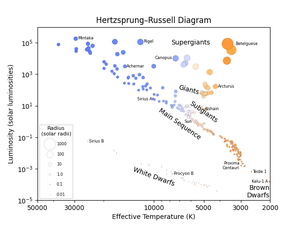
Hertzsprung-Russell diagram
Caption: This diagram shows the temperature and luminosity of different stars. The size of each point represents the star’s radius and its colour is the colour the human eye would see. The stars range in colour from a washed-out blue to a washed-out reddish-orange. No star has a pure colour like red, green or blue as stars’ spectra include light from lots of different colours. However the reddest stars are commonly referred to as red and the bluest stars as blue. The sample of stars used to make this diagram was chosen to show a wide range of stars of different types so the relative number of each type of star is not representative of how commonly each type is found.
From the top left to bottom right there is a long line of stars burning hydrogen in their cores. This is called the main sequence. On this line, one sees the stars Mintaka, Achernar, Sirius A, the Sun and Proxima Centauri. The objects around Proxima Centauri at the lower right end of the main sequence are known as red dwarfs. To the lower right of the red dwarfs are Teide 1 and Kelu-1 A. These two objects are brown dwarfs, objects too low in mass to have cores hot enough to fuse hydrogen for a sustained period of time. As they do not burn hydrogen, brown dwarfs are not considered main sequence stars. The name brown dwarf is unrelated to their colour.
Above the main sequence, we find subgiants, giants and supergiants. These are stars that have finished burning hydrogen in their core and have evolved into larger objects. A star’s brightness depends on its temperature and size so giant stars are brighter than stars with a smaller radius but the same temperature. In time these objects will move towards the end of their lives and undergo either a planetary nebula phase or become supernovae. Stars which end their lives with a planetary nebula phase become a type of stellar remnant called a white dwarf. Such objects are much smaller than stars of the same temperature and thus are fainter and are found significantly below the main sequence. Stars which end their lives as supernovae become either black holes or neutron stars. These are not shown on this plot.
Credit: IAU OAE/Niall Deacon
License: CC-BY-4.0 Creative Commons Attribution 4.0 International (CC BY 4.0) icons
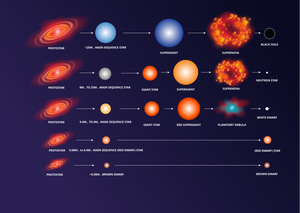
Stellar Evolution
Caption: This diagram shows the life cycle of stars of different masses. The mass of the different types of star increases from bottom to top with time going from left to right.
The life cycle of a star depends on its mass, with lower mass stars have longer lifetimes. All stars form from clouds of gas that collapse under their own gravity. As the star collapses, its core becomes hotter and denser. If the star has a mass greater than 0.08 solar masses (0.08 times the mass of the Sun), the pressure of the star’s mass pushing down on its core creates a high enough core temperature for hydrogen fusion to ignite. This burns hydrogen into helium in the star’s core, providing a heat source to power the star and to stop its core from collapsing further. If the collapsing object has a mass below 0.08 solar masses then it does not ignite hydrogen fusion in its core. It continues to cool and slowly contract. Such substellar objects are known as brown dwarfs, shown here in the lowest row.
After stars have formed, they burn hydrogen in their cores and begin their so-called main sequence phase. The most massive stars (>25 solar masses, shown here at the top) have very high core temperatures and thus burn through their hydrogen fuel more quickly. This means they may only spend a few million years on the main sequence burning hydrogen in their cores. Once the hydrogen in the core is exhausted the star’s core contracts, becomes hotter and helium burning starts in the core. While the core contracts, the outer layers of the star expand and it becomes a supergiant. For the most massive stars strong stellar winds strip off the cooler outer layers, leading to the star being very large and very hot, a blue supergiant. Once helium is exhausted in the core, carbon is burned, and then heavier elements. Eventually the star ends with an iron core. Fusing iron into heavier elements does not generate energy so at this point fusion stops in the core. Once this core of iron is massive enough, it and the surrounding matter suddenly collapses to form a black hole and the outer layers are flung off in a supernova explosion.
Slightly lower mass stars (between 8 and 25 solar masses, seen here second top) evolve in a similar way although they do not have strong enough winds to push their outer layers away and become blue supergiants, instead it evolves into a red supergiant. While such stars also collapse and create supernova explosions. The remnant of the star’s core is not massive enough to collapse into a black hole. Instead, its electrons and protons combine to form neutrons and it is supported by a quantum mechanical effect called neutron degeneracy pressure. This results in the remnant of the star being a tiny neutron star, several solar masses in mass but only a few kilometres across.
For stars similar in mass to the Sun (between 0.4 and 8 solar masses, seen here in the middle row), the star burns hydrogen in its core until the hydrogen in its core is exhausted. At this point a hydrogen burning shell forms around the core. Eventually the core will become hot enough to burn helium into carbon and oxygen. After this the star is left with a carbon and oxygen core surrounded by shells burning helium and hydrogen. These shells are unstable producing thermal pulsations that convulse the star. Eventually these pulsations become so extreme that the star’s outer layers are thrown off. This leaves the carbon and oxygen core as a white dwarf supported by electron degeneracy pressure. The outer layers of the star form what is known as a planetary nebula (which doesn’t actually have anything to do with planets despite the name).
The lowest mass stars (seen here in the second bottom row) are so low in mass that their evolutionary timescales are much longer than the age of the universe. This means that none have evolved beyond the main-sequence. Low mass stars are fully convective meaning material in the core is constantly being mixed with material above. This means that all the hydrogen in the star would eventually be burned in the core, but this will take trillions of years.
Credit: Danielle Futselaar/IAU OAE
License: CC-BY-4.0 Creative Commons Attribution 4.0 International (CC BY 4.0) icons
Related Activities

Star in a Box: Advanced
astroEDU educational activity (links to astroEDU website) Description: Explore the life-cycle of stars with Star in a Box activity.
License: CC-BY-4.0 Creative Commons Attribution 4.0 International (CC BY 4.0) icons
Tags:
Hands-on
, Interactive
, Software
Age Ranges:
10-12
, 12-14
, 14-16
, 16-19
Education Level:
Middle School
Areas of Learning:
Technology-based
Costs:
Low Cost
Group Size:
Group
Skills:
Communicating information
, Constructing explanations

Star in a Box: High School
astroEDU educational activity (links to astroEDU website) Description: Explore the life-cycle of stars with Star in a Box activity.
License: CC-BY-4.0 Creative Commons Attribution 4.0 International (CC BY 4.0) icons
Tags:
Hands-on
, Interactive
, Software
Age Ranges:
10-12
, 12-14
, 14-16
, 16-19
Education Level:
Middle School
Areas of Learning:
Technology-based
Costs:
Low Cost
Group Size:
Group
Skills:
Communicating information
, Constructing explanations