Termine del Glossario Evoluzione stellare
Descrizione L'evoluzione stellare descrive l'invecchiamento delle stelle e il modo in cui esse cambiano nel corso del loro ciclo di vita. A differenza della biologia evolutiva, l'evoluzione stellare non si riferisce ai cambiamenti dei tratti tra le diverse generazioni di stelle.
Come risultato dell'evoluzione stellare, l'idrogeno viene distrutto e altri elementi vengono creati ed espulsi nell'ambiente circostante la stella. Durante la cosiddetta fase di sequenza principale, le stelle fondono l'idrogeno in elio nel loro nucleo, generando energia. Quando una stella invecchia e comincia ad esaurire l'idrogeno nel suo nucleo, quest'ultimo si contrae e può diventare abbastanza caldo da avviare la fusione dell'elio. A seconda della massa della stella, questo processo continuerà con la fusione di elementi sempre più pesanti.
Le stelle con masse iniziali comprese tra 0,5 e 8 volte la massa del nostro Sole si ritroveranno con nuclei di carbonio, ossigeno e/o neon, mentre la fusione dell'idrogeno e dell'elio continuerà in gusci intorno al nucleo, dando alla stella una struttura stratificata a cipolla. Queste stelle finiranno per perdere i loro strati esterni, che andranno a formare una nebulosa planetaria, lasciando solo il nucleo come una piccola e luminosa stella detta Nana Bianca.
Le stelle di peso superiore a 8 masse solari continuano a fondere gli elementi più pesanti fino a quando i nuclei del loro centro si sono fusi in ferro. A quel punto, un'ulteriore fusione non può liberare altra energia. Ciò provoca una violenta esplosione di supernova, che lascia dietro di sé una stella di neutroni molto compatta o, nel caso di stelle particolarmente massicce, un buco nero.
L'evoluzione delle stelle in tutte queste fasi evolutive può essere alterata dall'interazione con una compagna in un sistema stellare multiplo.
Termini correlati
- Buco nero
- Sequenza principale
- Stella di neutroni
- Fusione nucleare
- Nebulosa planetaria
- Residui stellari
- Supernova
- Nana Bianca
- Mezzo interstellare
Vedi questo termine in altre lingue
status del termine e della definizione La definizione originale di questo termine in inglese é stata approvata da un ricercatore astronomo e da un docente La traduzione di questo termine e della sua definizione sono ancora in attesa di approvazione
Il Glossario Multilingue OAE é un progetto dell'Ufficio IAU per la didatticadell'astronomia (OAE) in collaborazione con l'ufficio IAU OAO per la DivulgazioneAstronomica (OAO). I termini e le definizioni sono stater scelte, scritte eriviste da un impegno collettivo da parte di OAE, i Centri e i Nodi OAE e iCoordinatori Nazionali per la Didattica dell'Astronomia e da altri volontari.Potete trovare una lista completa dei crediti, Tutti i termini del glossarioE le definizioni sono pubblicate su Creative Commons CC BY-4.0 licenza e dovrebbero essere accreditate ad IAU OAE.
Se noti un errore di fatto o di traduzione in questo termine del glossario, per favore contattaci.
In Altre Lingue
- Arabo: تطور النجوم
- Tedesco: Sternentwicklung
- Inglese: Stellar Evolution
- Spagnolo: Evolución estelar
- Francese: Evolution stellaire
- Giapponese: 恒星の進化 (external link)
- Coreano: 별의 진화
- Brasiliano Portoghese: Evolução estelar
- Cinese semplificato: 恒星演化
- Cinese tradizionale: 恆星演化
Diagrami correlati
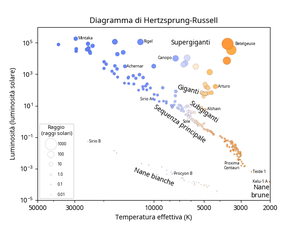
Diagramma di Hertzsprung-Russell
Didascalia: Questo diagramma mostra la temperatura e la luminosità di diverse stelle. La dimensione di ogni punto rappresenta il raggio della stella e il suo colore è il colore che l'occhio umano vedrebbe. Il colore delle stelle varia da un blu sbiadito a un arancione rossastro sbiadito. Nessuna stella ha un colore puro come il rosso, il verde o il blu, poiché gli spettri delle stelle includono la luce di molti colori diversi. Tuttavia, le stelle più rosse vengono comunemente chiamate rosse e quelle più blu blu. Il campione di stelle utilizzato per realizzare questo diagramma è stato scelto per mostrare un'ampia gamma di stelle di tipo diverso, quindi il numero relativo di ogni tipo di stella non è rappresentativo della frequenza di ciascun tipo.
Dall'alto a sinistra al basso a destra c'è una lunga fila di stelle che bruciano idrogeno nei loro nuclei. Questa è chiamata sequenza principale. Su questa linea si trovano le stelle Mintaka, Achernar, Sirio A, il Sole e Proxima Centauri. Gli oggetti intorno a Proxima Centauri, all'estremità inferiore destra della sequenza principale, sono noti come nane rosse. In basso a destra delle nane rosse si trovano Teide 1 e Kelu-1 A. Questi due oggetti sono nane brune, oggetti di massa troppo bassa per avere nuclei abbastanza caldi da fondere l'idrogeno per un periodo di tempo prolungato. Poiché non bruciano idrogeno, le nane brune non sono considerate stelle di sequenza principale. Il nome nana bruna non è legato al loro colore.
Al di sopra della sequenza principale troviamo le subgiganti, le giganti e le supergiganti. Si tratta di stelle che hanno finito di bruciare l'idrogeno nel loro nucleo e si sono evolute in oggetti più grandi. La luminosità di una stella dipende dalla sua temperatura e dalle sue dimensioni, quindi le stelle giganti sono più luminose di quelle con un raggio minore ma con la stessa temperatura. Col tempo questi oggetti si avviano verso la fine della loro vita e passano alla fase di nebulosa planetaria o diventano supernove. Le stelle che terminano la loro vita con una fase di nebulosa planetaria diventano un tipo di stella residua chiamato nana bianca. Questi oggetti sono molto più piccoli delle stelle della stessa temperatura, quindi sono più deboli e si trovano significativamente al di sotto della sequenza principale. Le stelle che terminano la loro vita come supernove diventano buchi neri o stelle di neutroni. Queste ultime non sono rappresentate in questo grafico.
Crediti: IAU OAE/Niall Deacon
License: CC-BY-4.0 Creative Commons Attribuzione 4.0 Internazionale (CC BY 4.0) icone
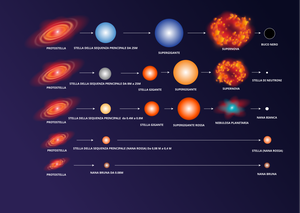
Evoluzione stellare
Didascalia: Questo diagramma illustra il ciclo di vita di stelle di massa diversa. La massa dei vari tipi di stelle aumenta dal basso verso l’alto con il passare del tempo, da sinistra a destra.
Il ciclo di vita di una stella dipende dalla sua massa: le stelle con massa inferiore hanno una durata di vita più lunga. Tutte le stelle si formano da nubi di gas che collassano sotto la propria gravità. Man mano che la stella collassa, il suo nucleo diventa più caldo e più denso. Se la stella ha una massa superiore a 0,08 masse solari (0,08 volte la massa del Sole), la pressione esercitata dalla massa della stella sul proprio nucleo crea una temperatura del nucleo sufficientemente elevata da innescare la fusione dell’idrogeno. In questo modo l’idrogeno viene bruciato nel nucleo della stella trasformandosi in elio, fornendo una fonte di calore che alimenta la stella e impedisce al suo nucleo di collassare ulteriormente. Se l’oggetto in collasso ha una massa inferiore a 0,08 masse solari, la fusione dell’idrogeno nel suo nucleo non si innesca. Continua quindi a raffreddarsi e a contrarsi lentamente. Tali oggetti substellari sono noti come nane brune, qui raffigurate nella riga più in basso.
Una volta formatesi, le stelle bruciano l’idrogeno nei loro nuclei e iniziano la cosiddetta fase della sequenza principale. Le stelle più massicce (>25 masse solari, qui raffigurate in alto) hanno temperature del nucleo molto elevate e quindi consumano il loro combustibile a base di idrogeno più rapidamente. Ciò significa che potrebbero trascorrere solo pochi milioni di anni sulla sequenza principale bruciando idrogeno nei loro nuclei. Una volta esaurito l’idrogeno nel nucleo, il nucleo della stella si contrae, diventa più caldo e nel nucleo ha inizio la combustione dell’elio. Mentre il nucleo si contrae, gli strati esterni della stella si espandono ed essa diventa una supergigante. Nel caso delle stelle più massicce, forti venti stellari spogliano la stella degli strati esterni più freddi, portando la stella a diventare molto grande e molto calda: una supergigante blu. Una volta esaurito l’elio nel nucleo, viene bruciato il carbonio e poi elementi più pesanti. Alla fine la stella termina con un nucleo di ferro. La fusione del ferro in elementi più pesanti non genera energia, quindi a questo punto la fusione nel nucleo si arresta. Quando questo nucleo di ferro raggiunge una massa sufficiente, esso e la materia circostante collassano improvvisamente formando un buco nero, mentre gli strati esterni vengono scagliati via in un’esplosione di supernova.
Le stelle di massa leggermente inferiore (tra 8 e 25 masse solari, qui visibili al secondo posto dall’alto) si evolvono in modo simile, sebbene non dispongano di venti sufficientemente intensi da espellere i propri strati esterni e diventare supergiganti blu; si evolvono invece in supergiganti rosse. Anche queste stelle collassano e generano esplosioni di supernova. Il residuo del nucleo della stella non è abbastanza massiccio da collassare in un buco nero. Al contrario, i suoi elettroni e protoni si combinano per formare neutroni ed è sostenuto da un effetto della meccanica quantistica chiamato pressione di degenerazione dei neutroni. Ciò fa sì che il residuo della stella sia una minuscola stella di neutroni, con una massa di diverse masse solari ma un diametro di soli pochi chilometri.
Per le stelle di massa simile a quella del Sole (tra 0,4 e 8 masse solari, visibili qui nella riga centrale), la stella brucia idrogeno nel proprio nucleo fino a esaurirlo. A questo punto, attorno al nucleo si forma un guscio in cui brucia l’idrogeno. Alla fine il nucleo diventerà abbastanza caldo da bruciare l’elio trasformandolo in carbonio e ossigeno. Successivamente, la stella si ritrova con un nucleo di carbonio e ossigeno circondato da gusci in cui bruciano elio e idrogeno. Questi gusci sono instabili e producono pulsazioni termiche che scuotono la stella. Alla fine queste pulsazioni diventano così intense che gli strati esterni della stella vengono espulsi. Ciò lascia il nucleo di carbonio e ossigeno come una nana bianca sostenuta dalla pressione di degenerazione degli elettroni. Gli strati esterni della stella formano quella che è nota come nebulosa planetaria (che in realtà non ha nulla a che vedere con i pianeti, nonostante il nome).
Le stelle di massa più bassa (visibili qui nella seconda riga dal basso) hanno una massa talmente ridotta che i loro tempi evolutivi sono molto più lunghi dell’età dell’universo. Ciò significa che nessuna di esse si è evoluta oltre la sequenza principale. Le stelle di bassa massa sono completamente convettive, il che significa che il materiale nel nucleo viene costantemente mescolato con quello sovrastante. Ciò implica che tutto l’idrogeno presente nella stella finirebbe per essere bruciato nel nucleo, ma questo processo richiederà trilioni di anni.
Crediti: Danielle Futselaar/IAU OAE
License: CC-BY-4.0 Creative Commons Attribuzione 4.0 Internazionale (CC BY 4.0) icone
Attività correlate

Star in a Box: Advanced
astroEDU educational activity (links to astroEDU website) Description: Explore the life-cycle of stars with Star in a Box activity.
License: CC-BY-4.0 Creative Commons Attribuzione 4.0 Internazionale (CC BY 4.0) icone
Etichette:
Hands-on
, Interactive
, Software
Fasce d'età
10-12
, 12-14
, 14-16
, 16-19
Livello di istruzione
Middle School
Aree di apprendimento
Technology-based
Costi:
Low Cost
Dimensione del Gruppo:
Group
Abilità:
Communicating information
, Constructing explanations

Star in a Box: High School
astroEDU educational activity (links to astroEDU website) Description: Explore the life-cycle of stars with Star in a Box activity.
License: CC-BY-4.0 Creative Commons Attribuzione 4.0 Internazionale (CC BY 4.0) icone
Etichette:
Hands-on
, Interactive
, Software
Fasce d'età
10-12
, 12-14
, 14-16
, 16-19
Livello di istruzione
Middle School
Aree di apprendimento
Technology-based
Costi:
Low Cost
Dimensione del Gruppo:
Group
Abilità:
Communicating information
, Constructing explanations