Glossar-Begriff: Sternentwicklung
Beschreibung: Die Sternentwicklung beschreibt, wie Sterne sich im Laufe ihres Lebenszyklus verändern und wie sie altern.
Sterne verbringen die meiste Zeit ihres Lebens in der Hauptreihenphase der Sternentwicklung. In dieser Phase fusionieren sie in ihrem Zentrum Wasserstoff zu Helium und setzen dadurch Energie frei. Wenn ein Stern altert und der Wasserstoff in seinem Inneren zur Neige geht, zieht sich der Kern zusammen und wird möglicherweise heiß genug, um die Heliumfusion zu starten. Je nach Masse des Sterns kann das dazu führen, dass sich der Stern zu einem Riesen- oder Überriesenstern entwickelt. In einigen Riesen und Überriesen werden durch Kernfusion immer schwerere Elemente erzeugt.
Es hängt von der anfänglichen Masse eines Sterns ab, was am Ende seiner Entwicklung mit ihm passiert: Sterne mit einer anfänglichen Masse zwischen dem 0,5- und 8-fachen der Masse unserer Sonne haben dann Kerne aus Kohlenstoff, Sauerstoff und/oder Neon, während die Fusion von Wasserstoff und Helium in Schalen um den Kern herum weiterläuft und dem Stern eine zwiebelartige Struktur verleiht. Diese Sterne verlieren schließlich ihre äußeren Schichten, die dann einen planetarischen Nebel bilden und nur den Kern als kleinen, hellen Weißen Zwerg übrig lassen.
Sterne mit mehr als 8 Sonnenmassen fusionieren in ihrem Inneren immer massereichere Elemente bis hin zu Eisen. Danach würde durch weitere Fusionsprozesse keine Energie mehr freigesetzt werden und die Kernfusion stoppt. Das löst eine heftige Supernova-Explosion aus, die entweder einen sehr kompakten Neutronenstern oder - bei besonders massereichen Sternen - ein Schwarzes Loch hinterlässt.
Sowohl bei planetarischen Nebeln als auch bei Supernovaexplosionen wird Materie von den Sternen hinaus ins interstellare Medium geschleudert. In einigen anderen Phasen ihrer Entwicklung stoßen viele Sterne auch Materie durch stellare Winde, extreme Pulsationen oder Explosionen aus. Die ausgestoßene Materie ist durch die Kernfusion und, im Falle einer Explosion, durch die Kernreaktionen während der Explosion selbst mit schweren Elementen angereichert worden. Dieses angereicherte Material kann in zukünftige Generationen von Sternen eingebaut werden.
Die Entwicklung von Sternen während all dieser Phasen kann durch die Wechselwirkung mit einem Begleiter in einem Mehrfachsternsystem verändert werden.
Ähnliche Begriffe:
- Schwarzes Loch
- Hauptreihe
- Neutronenstern
- Kernfusion
- Planetarischer Nebel
- Kompakte Objekte
- Supernova
- Weißer Zwerg
- Interstellares Medium
Dieser Begriff in anderen Sprachen
Begriffs- und Definitionsstatus Die Originaldefinition dieses Begriffes auf Englisch wurden von einem forschenden Astronom und einer Lehrkraft bestätigt Die Übersetzung dieses Begriffs und seiner Definition warten auf Prüfung und Bestätigung
The OAE Multilingual Glossary is a project of the IAU Office of Astronomy for Education (OAE) in collaboration with the IAU Office of Astronomy Outreach (OAO). The terms and definitions were chosen, written and reviewed by a collective effort from the OAE, the OAE Centers and Nodes, the OAE National Astronomy Education Coordinators (NAECs) and other volunteers. You can find a full list of credits here. All glossary terms and their definitions are released under a Creative Commons CC BY-4.0 license and should be credited to "IAU OAE".
Wenn dir ein inhaltlicher oder Übersetzungsfehler in diesem Glossarbegriff oder dieser Definition auffallen, bitte kontaktiere uns.
Auf anderen Sprachen
- Arabisch: تطور النجوم
- Englisch: Stellar Evolution
- Spanisch: Evolución estelar
- Französisch: Evolution stellaire
- Italienisch: Evoluzione stellare
- Japanisch: 恒星の進化 (externer Link)
- Koreanisch: 별의 진화
- Brasilianisches Portugiesisch: Evolução estelar
- Vereinfachtes Chinesisch: 恒星演化
- Traditionelles Chinesisch: 恆星演化
Ähnliche Diagramme
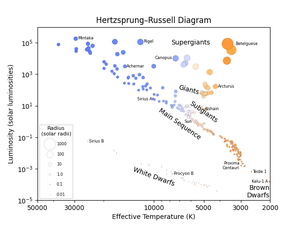
Hertzsprung-Russell diagram
Unterschrift: This diagram shows the temperature and luminosity of different stars. The size of each point represents the star’s radius and its colour is the colour the human eye would see. The stars range in colour from a washed-out blue to a washed-out reddish-orange. No star has a pure colour like red, green or blue as stars’ spectra include light from lots of different colours. However the reddest stars are commonly referred to as red and the bluest stars as blue. The sample of stars used to make this diagram was chosen to show a wide range of stars of different types so the relative number of each type of star is not representative of how commonly each type is found.
From the top left to bottom right there is a long line of stars burning hydrogen in their cores. This is called the main sequence. On this line, one sees the stars Mintaka, Achernar, Sirius A, the Sun and Proxima Centauri. The objects around Proxima Centauri at the lower right end of the main sequence are known as red dwarfs. To the lower right of the red dwarfs are Teide 1 and Kelu-1 A. These two objects are brown dwarfs, objects too low in mass to have cores hot enough to fuse hydrogen for a sustained period of time. As they do not burn hydrogen, brown dwarfs are not considered main sequence stars. The name brown dwarf is unrelated to their colour.
Above the main sequence, we find subgiants, giants and supergiants. These are stars that have finished burning hydrogen in their core and have evolved into larger objects. A star’s brightness depends on its temperature and size so giant stars are brighter than stars with a smaller radius but the same temperature. In time these objects will move towards the end of their lives and undergo either a planetary nebula phase or become supernovae. Stars which end their lives with a planetary nebula phase become a type of stellar remnant called a white dwarf. Such objects are much smaller than stars of the same temperature and thus are fainter and are found significantly below the main sequence. Stars which end their lives as supernovae become either black holes or neutron stars. These are not shown on this plot.
Bild: IAU OAE/Niall Deacon
License: CC-BY-4.0 Creative Commons Namensnennung 4.0 International (CC BY 4.0) Symbole
Sternentwicklung
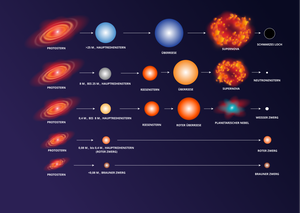
Unterschrift: Dieses Diagramm zeigt den Lebenszyklus von Sternen unterschiedlicher Masse. Die Masse der verschiedenen Sterntypen nimmt im Diagramm von unten nach oben zu, während die Zeit von links nach rechts verläuft.
Der Lebenszyklus eines Sterns hängt von seiner Masse ab, wobei Sterne mit geringerer Masse eine längere Lebensdauer haben. Alle Sterne entstehen aus Gaswolken, die unter dem Einfluss ihrer eigenen Schwerkraft kollabieren. Während der Stern kollabiert, wird sein Kern heißer und dichter. Hat der Stern eine Masse von mehr als 0,08 Sonnenmassen (das 0,08-Fache der Masse der Sonne), erzeugt der Druck, den die Masse des Sterns auf seinen Kern ausübt, eine Kerntemperatur, die hoch genug ist, um die Wasserstofffusion in Gang zu setzen. Dabei wird im Kern des Sterns Wasserstoff zu Helium verbrannt, was eine Wärmequelle liefert, die den Stern mit Energie versorgt und einen weitere Kollaps des Kerns verhindert. Hat das kollabierende Objekt eine Masse von weniger als 0,08 Sonnenmassen, zündet die Wasserstofffusion in seinem Kern nicht an. Es kühlt weiter ab und zieht sich langsam zusammen. Solche substellaren Objekte werden als Braune Zwerge bezeichnet und sind hier in der untersten Reihe dargestellt.
Nachdem sich Sterne gebildet haben, verbrennen sie Wasserstoff in ihrem Kern und beginnen ihre Existenz auf der Hauptreihe. Die massereichsten Sterne (>25 Sonnenmassen, oben dargestellt) weisen sehr hohe Kerntemperaturen auf und verbrauchen daher ihren Wasserstoffvorrat schneller. Das bedeutet, dass sie möglicherweise nur wenige Millionen Jahre auf der Hauptreihe verbringen und Wasserstoff in ihren Kernen verbrennen. Sobald der Wasserstoff im Kern aufgebraucht ist, zieht sich der Kern des Sterns zusammen, wird heißer und die Heliumverbrennung im Kern beginnt. Während sich der Kern zusammenzieht, dehnen sich die äußeren Schichten des Sterns aus und er wird zu einem Überriesen. Bei den massereichsten Sternen reißen starke Sternwinde die kühleren äußeren Schichten ab, was dazu führt, dass der Stern sehr groß und sehr heiß wird – ein blauer Überriese. Sobald das Helium im Kern aufgebraucht ist, wird Kohlenstoff verbrannt, gefolgt von schwereren Elementen. Schließlich endet der Stern mit einem Eisenkern. Die Fusion von Eisen zu schwereren Elementen erzeugt keine Energie, sodass die Fusion im Kern an diesem Punkt zum Stillstand kommt. Sobald dieser reaktionsträge Eisenkern massereich genug ist, kollabieren er und die ihn umgebende Materie plötzlich und bilden ein Schwarzes Loch, während die äußeren Schichten in einer Supernova-Explosion weggeschleudert werden.
Sterne mit etwas geringerer Masse (zwischen 8 und 25 Sonnenmassen, hier als zweite Zeile von oben zu sehen) entwickeln sich auf ähnliche Weise, obwohl sie keine ausreichend starken Winde hervorbringen, um ihre äußeren Schichten wegzuschleudern und zu blauen Überriesen zu werden. Stattdessen entwickeln sie sich zu roten Überriesen. Auch solche Sterne kollabieren und verursachen Supernova-Explosionen. Der Überrest des Sternkerns ist jedoch nicht massereich genug, um zu einem Schwarzen Loch zu kollabieren. Stattdessen verbinden sich seine Elektronen und Protonen zu Neutronen und der Kern wird durch einen quantenmechanischen Effekt stabilisiert, der als Neutronen-Entartungsdruck bezeichnet wird. Als Überrest des Sterns bleibt ein winziger Neutronenstern übrig, dessen Masse mehrere Sonnenmassen beträgt, der aber nur wenige Kilometer Durchmesser hat.
Bei Sternen mit einer Masse, die der Sonne ähnelt (zwischen 0,4 und 8 Sonnenmassen, in der mittleren Reihe zu sehen) verbrennt der Stern Wasserstoff in seinem Kern, bis der Wasserstoffvorrat im Kern aufgebraucht ist. Anschließend bildet sich um den Kern herum eine Wasserstoff verbrennende Hülle. Schließlich wird der Kern heiß genug, um Helium zu Kohlenstoff und Sauerstoff zu verbrennen. Danach bleibt dem Stern ein Kern aus Kohlenstoff und Sauerstoff, umgeben von Hüllen, in denen Helium und Wasserstoff verbrennen. Diese Hüllen sind instabil und erzeugen thermische Pulsationen, die den Stern erschüttern. Diese Pulsationen werden schließlich so extrem, dass die äußeren Schichten des Sterns abgestoßen werden. Zurück bleibt der Kohlenstoff- und Sauerstoffkern als Weißer Zwerg, der durch den Entartungsdruck der Elektronen gestützt wird. Die äußeren Schichten des Sterns bilden einen sogenannten planetarischen Nebel (der trotz seines Namens nichts mit Planeten zu tun hat).
Die Sterne mit der geringsten Masse (hier in der zweiten unteren Reihe zu sehen) sind so massearm, dass ihre Entwicklungszeiträume weitaus länger sind als das Alter des Universums. Das bedeutet, dass bisher keiner von ihnen über die Hauptreihe hinaus entwickelt ist. Sterne mit geringer Masse sind vollständig konvektiv, was bedeutet, dass sich das Material im Kern ständig mit dem darüber liegenden Material vermischt. Daher wird letztlich der gesamte Wasserstoff des Sterns im Kern verbrannt, was jedoch Billionen von Jahren dauern wird.
Bild: Danielle Futselaar/IAU OAE
License: CC-BY-4.0 Creative Commons Namensnennung 4.0 International (CC BY 4.0) Symbole
Ähnliche Aktivitäten

Star in a Box: Advanced
astroEDU educational activity (links to astroEDU website) Description: Explore the life-cycle of stars with Star in a Box activity.
License: CC-BY-4.0 Creative Commons Namensnennung 4.0 International (CC BY 4.0) Symbole
Schlagworte
Hands-on
, Interactive
, Software
Altersgruppen:
10-12
, 12-14
, 14-16
, 16-19
Bildungsniveau:
Middle School
Lernbereiche:
Technology-based
Kosten:
Low Cost
Gruppengröße:
Group
Fähigkeiten:
Communicating information
, Constructing explanations

Star in a Box: High School
astroEDU educational activity (links to astroEDU website) Description: Explore the life-cycle of stars with Star in a Box activity.
License: CC-BY-4.0 Creative Commons Namensnennung 4.0 International (CC BY 4.0) Symbole
Schlagworte
Hands-on
, Interactive
, Software
Altersgruppen:
10-12
, 12-14
, 14-16
, 16-19
Bildungsniveau:
Middle School
Lernbereiche:
Technology-based
Kosten:
Low Cost
Gruppengröße:
Group
Fähigkeiten:
Communicating information
, Constructing explanations
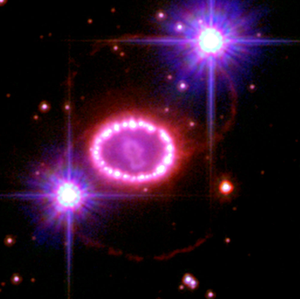
Supernovae – Großes Finale und Neuanfang
astroEDU educational activity (links to astroEDU website) Description: Manche Sterne explodieren am Ende ihrer Lebenszeit. Ein solches Ereignis bezeichnen Astrophysiker-Innen als eine Supernova. Diese kurze Erklärung wirft zweifelsohne einige Fragen auf: Was sind die genauen Voraussetzungen dafür, dass ein Stern sich selbst in einem letzten, hellen Aufleuchten vernichtet? Wird die Sonne am Ende ihres Lebens auch zur Supernova?
Altersgruppen: 16-19 Bildungsniveau: Secundaria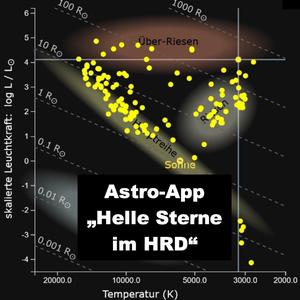
Die HRD-App für Sterne
astroEDU educational activity (links to astroEDU website) Description: So wichtig, wie der Baum des Lebens (ein Baumdiagramm) für die Erforschung der Evolution des Lebens ist, so bedeutsam ist das Hertzsprung-Russell-Diagramm (HRD) für die Erforschung des Aufbaus und der Entwicklung der Sterne. Entsprechend gilt es, das HRD dem Schüler auch als wichtiges Forschungswerkzeug nahezubringen. Im Fokus des folgenden WIS-Beitrags steht die App „Helle Sterne im HRD“ https://www.haus-der-astronomie.de/vis/astroapps, die es dem Schüler ermöglicht, das HRD aktiv kennenzulernen. Besonders ist dabei die gleichzeitige Visualisierung der Sterne am Himmel und als Zustandspunkt im Diagramm. Das WIS-Material gibt dem Nutzer Aufgaben an die Hand, um in die App tiefer einzusteigen.
Altersgruppen: 16-19 Bildungsniveau: Secundaria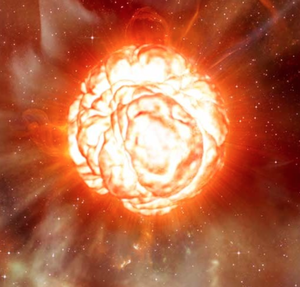
Beteigeuze - Ein Riese mit Tücken
astroEDU educational activity (links to astroEDU website) Description: Bei Berechnungen mit dem Taschenrechner neigen Schülerinnen und Schüler gerne dazu, das Ergebnis bis auf die letzte Kommastelle genau anzugeben, die der Taschenrechner ausspuckt. Dass das in der Regel nicht sinnvoll ist, lässt sich meist nur schwer vermitteln. Dafür muss man sich klar machen, dass die Genauigkeit, mit der man einen berechneten Wert angeben kann, maßgeblich davon abhängt, wie genau die Messwerte ermittelt werden konnten, die der Berechnung zugrunde liegen. Ein gutes Beispiel dafür ist der Riesenstern Beteigeuze (Abb. 1). Er gehört zu den größten bekannten Sternen und steht uns vergleichsweise nahe. Daher ist es nicht verwunderlich, dass er der erste Stern ist, abgesehen von der Sonne, bei dem es gelang, die Oberfläche mit Teleskopen räumlich aufzulösen. Auch sonst wurde und wird er von vielen Forschungsgruppen eingehend untersucht. Dennoch ist es bisher nicht gelungen, Größen wie seine Entfernung oder seinen Radius hinreichend genau zu bestimmen. Entsprechende Angaben in der Literatur unterscheiden sich bisweilen beträchtlich. Ein Stern wie Beteigeuze, der viele Tücken aufweist, eignet sich daher gut als Beispiel für die Erörterung der Frage, wie genau man Messwerte bzw. die daraus berechneten Ergebnisse sinnvollerweise angeben sollte.
Altersgruppen: 14-16 , 16-19 Bildungsniveau: Secundaria