Glossary term: 恆星演化
Description: 恆星演化描述了恆星的衰老以及它們在生命週期中的變化。與生物進化不同,恆星演化並不是指不同代恆星之間性狀的變化。
恆星一生中的大部分時間都處於恆星演化的主序階段,在其內核中將氫聚變成氦並釋放能量。隨著恆星年齡的增長,其內核中的氫開始耗盡,內核會收縮,並變得足夠熱以開始氦聚變。根據恆星的質量,這可能會導致其演化為巨星或超巨星。在一些巨星和超巨星中,核聚變會產生越來越重的元素。
初始質量介於0.5到8倍太陽質量之間的恆星最終會形成碳、氧和(或)氖的內核,而氫和氦的聚變會在內核周圍的外殼中繼續進行,從而形成洋蔥狀的分層結構。它們最終會失去外層,形成行星狀星雲,只剩下內核,成為一顆又小又亮的白矮星。
質量超過 8 個太陽質量的恆星會繼續燃燒更重的元素,直到核心的原子核聚變成鐵。此時,進一步的核聚變已無法釋放額外的能量。這就引發了超新星爆發,留下的要麼是一顆非常緻密的中子星,要麼是一顆質量非常大的黑洞。
行星狀星雲和超新星爆發都會把恆星中的物質噴射到星際介質中。在演化的某些階段,許多恆星也會通過恆星風、極端脈動或爆發噴射出物質。由於核聚變,以及爆發時本身的核反應,噴出的物質富含重元素。這些富集的物質可能會進入下一代恆星中。
恆星在所有這些階段的演化都可能因與多恆星系統中的伴星相互作用而改變。
Related Terms:
See this term in other languages
Term and definition status: The original definition of this term in English have been approved by a research astronomer and a teacher The translation of this term and its definition is still awaiting approval
This is an automated transliteration of the simplified Chinese translation of this term
The OAE Multilingual Glossary is a project of the IAU Office of Astronomy for Education (OAE) in collaboration with the IAU Office of Astronomy Outreach (OAO). The terms and definitions were chosen, written and reviewed by a collective effort from the OAE, the OAE Centers and Nodes, the OAE National Astronomy Education Coordinators (NAECs) and other volunteers. You can find a full list of credits here. All glossary terms and their definitions are released under a Creative Commons CC BY-4.0 license and should be credited to "IAU OAE".
If you notice a factual or translation error in this glossary term or definition then please get in touch.
In Other Languages
- 阿拉伯語: تطور النجوم
- 德語: Sternentwicklung
- 英語: Stellar Evolution
- 西班牙語: Evolución estelar
- 法語: Evolution stellaire
- 義大利語: Evoluzione stellare
- 日語: 恒星の進化 (external link)
- 韓語: 별의 진화
- 巴西葡萄牙語: Evolução estelar
- 簡體中文: 恒星演化
Related Diagrams
赫羅圖
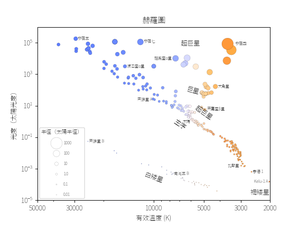
Caption: 這張圖展示了不同恆星溫度和亮度。每個點的大小代表恆星的半徑,顏色代表人眼所看到的顏色。恆星的顏色從淡藍色到淡橙紅色不等,沒有恆星具有像紅、綠或藍這樣的純顏色,因為恆星的光譜包含了許多不同顏色的光。然而,最紅的恆星通常被稱為紅恆星,最藍的恆星被稱為藍恆星。為了展示不同類型的恆星,製作這個圖表的恆星樣本選擇上並沒有反映出每種類型恆星的實際數量比例。
從左上到右下是一條長長的恆星帶,這些恆星在其核心燃燒氫氣,這被稱為主序。在這條線上,我們可以看到參宿三(Mintaka)、波江座α星(Achernar)、天狼星A(Sirius A)、太陽和比鄰星(Proxima Centauri)等恆星。在主序線右下方的比鄰星週圍的天體被稱為紅矮星。在紅矮星的右下方是Teide 1和Kelu-1 A。這兩個天體是褐矮星,它們的質量太低,核心沒有足夠的熱量來持續地進行氫融合。由於它們不燃燒氫,褐矮星不被認為是主序星。"褐矮星"這個名字與它們的顏色無關。
在主序星的上方,我們發現次巨星、巨星和超巨星。這些是已經完成了核心的氫燃燒並演化成更大天體的恆星。恆星的亮度取決於其溫度和大小,因此巨星比具有較小半徑但相同溫度的恆星更亮。隨著時間的推移,這些天體將走向生命的盡頭,經歷行星狀星雲階段或變成超新星。以行星狀星雲階段結束生命的恆星會形成一種叫做白矮星的恆星殘骸。這種天體比相同溫度的恆星小得多,因此更暗淡,並且位於主序星帶的顯著下方。以超新星結束生命的恆星會成為黑洞或中子星。這些在這個圖表上沒有顯示。
Credit: IAU OAE/Niall Deacon
License: CC-BY-4.0 Creative Commons 姓名標示 4.0 國際 (CC BY 4.0) icons
Stellar Evolution
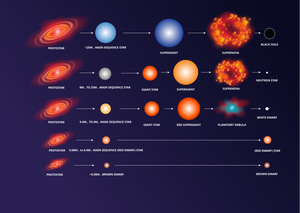
Caption: This diagram shows the life cycle of stars of different masses. The mass of the different types of star increases from bottom to top with time going from left to right.
The life cycle of a star depends on its mass, with lower mass stars have longer lifetimes. All stars form from clouds of gas that collapse under their own gravity. As the star collapses, its core becomes hotter and denser. If the star has a mass greater than 0.08 solar masses (0.08 times the mass of the Sun), the pressure of the star’s mass pushing down on its core creates a high enough core temperature for hydrogen fusion to ignite. This burns hydrogen into helium in the star’s core, providing a heat source to power the star and to stop its core from collapsing further. If the collapsing object has a mass below 0.08 solar masses then it does not ignite hydrogen fusion in its core. It continues to cool and slowly contract. Such substellar objects are known as brown dwarfs, shown here in the lowest row.
After stars have formed, they burn hydrogen in their cores and begin their so-called main sequence phase. The most massive stars (>25 solar masses, shown here at the top) have very high core temperatures and thus burn through their hydrogen fuel more quickly. This means they may only spend a few million years on the main sequence burning hydrogen in their cores. Once the hydrogen in the core is exhausted the star’s core contracts, becomes hotter and helium burning starts in the core. While the core contracts, the outer layers of the star expand and it becomes a supergiant. For the most massive stars strong stellar winds strip off the cooler outer layers, leading to the star being very large and very hot, a blue supergiant. Once helium is exhausted in the core, carbon is burned, and then heavier elements. Eventually the star ends with an iron core. Fusing iron into heavier elements does not generate energy so at this point fusion stops in the core. Once this core of iron is massive enough, it and the surrounding matter suddenly collapses to form a black hole and the outer layers are flung off in a supernova explosion.
Slightly lower mass stars (between 8 and 25 solar masses, seen here second top) evolve in a similar way although they do not have strong enough winds to push their outer layers away and become blue supergiants, instead it evolves into a red supergiant. While such stars also collapse and create supernova explosions. The remnant of the star’s core is not massive enough to collapse into a black hole. Instead, its electrons and protons combine to form neutrons and it is supported by a quantum mechanical effect called neutron degeneracy pressure. This results in the remnant of the star being a tiny neutron star, several solar masses in mass but only a few kilometres across.
For stars similar in mass to the Sun (between 0.4 and 8 solar masses, seen here in the middle row), the star burns hydrogen in its core until the hydrogen in its core is exhausted. At this point a hydrogen burning shell forms around the core. Eventually the core will become hot enough to burn helium into carbon and oxygen. After this the star is left with a carbon and oxygen core surrounded by shells burning helium and hydrogen. These shells are unstable producing thermal pulsations that convulse the star. Eventually these pulsations become so extreme that the star’s outer layers are thrown off. This leaves the carbon and oxygen core as a white dwarf supported by electron degeneracy pressure. The outer layers of the star form what is known as a planetary nebula (which doesn’t actually have anything to do with planets despite the name).
The lowest mass stars (seen here in the second bottom row) are so low in mass that their evolutionary timescales are much longer than the age of the universe. This means that none have evolved beyond the main-sequence. Low mass stars are fully convective meaning material in the core is constantly being mixed with material above. This means that all the hydrogen in the star would eventually be burned in the core, but this will take trillions of years.
Credit: Danielle Futselaar/IAU OAE
License: CC-BY-4.0 Creative Commons 姓名標示 4.0 國際 (CC BY 4.0) icons
Related Activities

Star in a Box: Advanced
astroEDU educational activity (links to astroEDU website) Description: Explore the life-cycle of stars with Star in a Box activity.
License: CC-BY-4.0 Creative Commons 姓名標示 4.0 國際 (CC BY 4.0) icons
Tags:
Hands-on
, Interactive
, Software
Age Ranges:
10-12
, 12-14
, 14-16
, 16-19
Education Level:
Middle School
Areas of Learning:
Technology-based
Costs:
Low Cost
Group Size:
Group
Skills:
Communicating information
, Constructing explanations

Star in a Box: High School
astroEDU educational activity (links to astroEDU website) Description: Explore the life-cycle of stars with Star in a Box activity.
License: CC-BY-4.0 Creative Commons 姓名標示 4.0 國際 (CC BY 4.0) icons
Tags:
Hands-on
, Interactive
, Software
Age Ranges:
10-12
, 12-14
, 14-16
, 16-19
Education Level:
Middle School
Areas of Learning:
Technology-based
Costs:
Low Cost
Group Size:
Group
Skills:
Communicating information
, Constructing explanations