Glossary term: 中子星
Description: 中子星是一個非常密集和緊湊的恆星殘骸,形成於大質量恆星核心的坍塌。質量約為八倍太陽質量或更多的恆星在其恆星演化的最後,核心會坍塌,觸發超新星爆炸。坍塌的核心密度大於大多數原子核,並主要由中子組成。這一點的原因是,在大質量恆星極熱和極密的坍塌核心中,質子和電子結合形成中子。中子星的下限質量為1.4倍太陽質量,上限約為3倍太陽質量——超過這個質量,物體將坍塌為黑洞。高度磁化的中子星被稱為磁星。已知的絕大多數中子星以射電脈衝星的形式被觀測到。
Related Terms:
See this term in other languages
Term and definition status: The original definition of this term in English have been approved by a research astronomer and a teacher The translation of this term and its definition is still awaiting approval
This is an automated transliteration of the simplified Chinese translation of this term
The OAE Multilingual Glossary is a project of the IAU Office of Astronomy for Education (OAE) in collaboration with the IAU Office of Astronomy Outreach (OAO). The terms and definitions were chosen, written and reviewed by a collective effort from the OAE, the OAE Centers and Nodes, the OAE National Astronomy Education Coordinators (NAECs) and other volunteers. You can find a full list of credits here. All glossary terms and their definitions are released under a Creative Commons CC BY-4.0 license and should be credited to "IAU OAE".
If you notice a factual or translation error in this glossary term or definition then please get in touch.
In Other Languages
- 阿拉伯語: النجم النيوتروني
- 德語: Neutronenstern
- 英語: Neutron Star
- 西班牙語: Estrella de neutrones
- 波斯語: ستاره نوترونی
- 法語: Étoile à neutrons
- 義大利語: Stella di neutroni
- 日語: 中性子星 (external link)
- 巴西葡萄牙語: Estrela de nêutrons
- 簡體中文: 中子星
Related Media
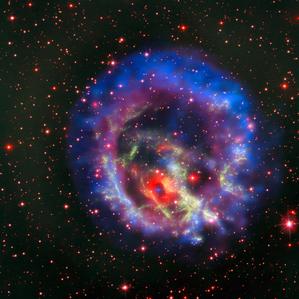
大質量恆星的死亡
Caption: 用地球上和太空中的望遠鏡拍攝到的鄰近小麥哲倫雲星系中一顆中子星的多波段圖像。中子星(在這裡被看作是被紅色環包圍的藍色斑點)是大質量恆星引力坍縮、壓縮和爆炸的最終產物,被嵌入其超新星殘餘物(綠色)中。
Credit: ESO/NASA, ESA and Hubble Heritage Team (STScI/AURA)/F.Vogt et al.
credit link
License: CC-BY-4.0 Creative Commons 姓名標示 4.0 國際 (CC BY 4.0) icons

蟹狀星雲脈衝星
Caption: 在距地球約6500光年、位於金牛座的蟹狀星雲中心,存在著蟹狀星雲脈衝星。它是一顆大質量恆星生命終結時爆發後留下的殘骸。雖然恆星爆炸發生於數千年前,但這次爆發產生的光芒直到公元1054年才抵達地球。這次天體事件曾被全球多地民眾觀測到,許多文明都在其歷史文獻中留下了相關記錄。
蟹狀星雲脈衝星每秒約旋轉30周,並發射包括可見光在內的多波段光線。其質量約為太陽的1.5倍,但在它形成時的爆發產生了龐大力量,將如此巨大的質量壓縮在半徑僅約十公裡的極小的空間內。
這張圖像由美國夏威夷雙子北座天文臺的多張觀測圖像合成而成,脈衝星清晰可見於畫面中央。構建圖像的觀測數據採集時間跨度達五年,其中2009年的數據以藍色標示,2014年的數據以紅色標示。在此期間,拋射物質持續遠離脈衝星,形成了圖中的彩色漣漪效果。需要說明的是,顏色並非真實色調,波紋顯示的是沖擊波遠離脈衝星並撞擊到周圍氣體時的位置。
Credit: 國際雙子座天文臺/NOIRLab/NSF/AUR、Jen Miller、Travis Rector、Mahdi Zamani 和 Davide de Martin
credit link
License: CC-BY-4.0 Creative Commons 姓名標示 4.0 國際 (CC BY 4.0) icons
Related Diagrams
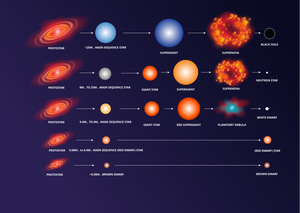
Stellar Evolution
Caption: This diagram shows the life cycle of stars of different masses. The mass of the different types of star increases from bottom to top with time going from left to right.
The life cycle of a star depends on its mass, with lower mass stars have longer lifetimes. All stars form from clouds of gas that collapse under their own gravity. As the star collapses, its core becomes hotter and denser. If the star has a mass greater than 0.08 solar masses (0.08 times the mass of the Sun), the pressure of the star’s mass pushing down on its core creates a high enough core temperature for hydrogen fusion to ignite. This burns hydrogen into helium in the star’s core, providing a heat source to power the star and to stop its core from collapsing further. If the collapsing object has a mass below 0.08 solar masses then it does not ignite hydrogen fusion in its core. It continues to cool and slowly contract. Such substellar objects are known as brown dwarfs, shown here in the lowest row.
After stars have formed, they burn hydrogen in their cores and begin their so-called main sequence phase. The most massive stars (>25 solar masses, shown here at the top) have very high core temperatures and thus burn through their hydrogen fuel more quickly. This means they may only spend a few million years on the main sequence burning hydrogen in their cores. Once the hydrogen in the core is exhausted the star’s core contracts, becomes hotter and helium burning starts in the core. While the core contracts, the outer layers of the star expand and it becomes a supergiant. For the most massive stars strong stellar winds strip off the cooler outer layers, leading to the star being very large and very hot, a blue supergiant. Once helium is exhausted in the core, carbon is burned, and then heavier elements. Eventually the star ends with an iron core. Fusing iron into heavier elements does not generate energy so at this point fusion stops in the core. Once this core of iron is massive enough, it and the surrounding matter suddenly collapses to form a black hole and the outer layers are flung off in a supernova explosion.
Slightly lower mass stars (between 8 and 25 solar masses, seen here second top) evolve in a similar way although they do not have strong enough winds to push their outer layers away and become blue supergiants, instead it evolves into a red supergiant. While such stars also collapse and create supernova explosions. The remnant of the star’s core is not massive enough to collapse into a black hole. Instead, its electrons and protons combine to form neutrons and it is supported by a quantum mechanical effect called neutron degeneracy pressure. This results in the remnant of the star being a tiny neutron star, several solar masses in mass but only a few kilometres across.
For stars similar in mass to the Sun (between 0.4 and 8 solar masses, seen here in the middle row), the star burns hydrogen in its core until the hydrogen in its core is exhausted. At this point a hydrogen burning shell forms around the core. Eventually the core will become hot enough to burn helium into carbon and oxygen. After this the star is left with a carbon and oxygen core surrounded by shells burning helium and hydrogen. These shells are unstable producing thermal pulsations that convulse the star. Eventually these pulsations become so extreme that the star’s outer layers are thrown off. This leaves the carbon and oxygen core as a white dwarf supported by electron degeneracy pressure. The outer layers of the star form what is known as a planetary nebula (which doesn’t actually have anything to do with planets despite the name).
The lowest mass stars (seen here in the second bottom row) are so low in mass that their evolutionary timescales are much longer than the age of the universe. This means that none have evolved beyond the main-sequence. Low mass stars are fully convective meaning material in the core is constantly being mixed with material above. This means that all the hydrogen in the star would eventually be burned in the core, but this will take trillions of years.
Credit: Danielle Futselaar/IAU OAE
License: CC-BY-4.0 Creative Commons 姓名標示 4.0 國際 (CC BY 4.0) icons