Terme du glossaire : Étoile à neutrons
Description : Une étoile à neutrons est un vestige stellaire très dense et compact résultant de l'effondrement du cœur d'une étoile massive. Les étoiles d'une masse égale ou supérieure à huit masses solaires terminent leur évolution stellaire par l'effondrement de leur cœur, ce qui déclenche l'explosion d'une supernova. Le noyau effondré a une densité supérieure à celle de la plupart des noyaux atomiques et se compose principalement de neutrons. Ce dernier point est dû au fait que les protons et les électrons se combinent pour former des neutrons dans le cœur effondré extrêmement chaud et dense de l'étoile massive. La limite inférieure de la masse d'une étoile à neutrons est de 1,4 masse solaire, et la limite supérieure d'environ 3 masses solaires. Les étoiles à neutrons fortement magnétiques sont appelées magnétars. La grande majorité des étoiles à neutrons connues sont observées sous forme de pulsars radio.
Termes associés :
Voir ce terme dans d'autres langues
Statut du terme et de sa définition : La définition initiale de ce terme en anglais a été aprouvée par un·e spécialiste de la recherche en astronomie et un·e spécialiste de l’éducation La traduction de ce terme et de sa définition n'ont pas encore été aprouvées
Le glossaire multilangue de l'OAE est un projet du Bureau de l'IAU de l'Astronomie pour l'Education (OAE) en collaboration avec le Bureau de l'IAU de diffusion de l'Astronomie (OAO). Les termes et définitions ont été choisis, écrits et relues grâce à un effort collectif de l'OAE, les Centres et les Noeuds de l'OAE, les Coordinateurs Nationaux de l'Astronomie pour l'Education de l'OAE(NAECs) et d'autres volontaires. La liste complète des crédits pour ce projet est disponible ici . Tous les termes du glossaire et leur définition sont déposés sous licence Creative Commons CC BY-4.0 et doivent être créditées au nom de "IAU OAE".
Si vous constatez une erreur dans ce terme ou sa définition, veuillez nous contacter .
Dans d'autres langues
- Arabe: النجم النيوتروني
- Allemand: Neutronenstern
- Anglais: Neutron Star
- Espagnol: Estrella de neutrones
- Perse: ستاره نوترونی
- Italien: Stella di neutroni
- Japonais: 中性子星 (Liens externes)
- Portugais brésilien: Estrela de nêutrons
- Chinois simplifié: 中子星
- Chinois traditionnel: 中子星
Media associé
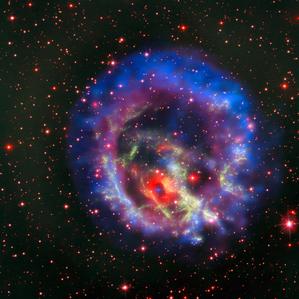
Death of a massive star
Légende : A multi-wavelength image taken with telescopes on the Earth and in space of a neutron star within our neighbouring Small Magellanic Cloud galaxy. A neutron star (seen here as the blue spot surrounded by a red ring) is the final product of gravitational collapse, compression and explosion of a massive star, left embedded in its supernova remnant (in green).
Crédit : ESO/NASA, ESA and the Hubble Heritage Team (STScI/AURA)/F. Vogt et al.
Lien vers les crédits
License: CC-BY-4.0 Creative Commons (CC) Attribution 4.0 International (CC BY 4.0) Icônes

The Crab Pulsar
Légende : At the heart of the Crab Nebula, situated approximately 6,500 light-years away in the constellation of Taurus, lies the Crab Nebula Pulsar. This is remnant of a massive star that exploded at the end of its life. This happened several thousand years ago but the light from this explosion only reached the Earth in the year 1054. This celestial event was viewed by people across the world with many different societies noting it in their records.
The Crab Nebula Pulsar rotates about 30 times per second and emits light in many different wavelengths, including the visible spectrum. It is roughly one and a half times the mass of the sun but the force of the explosion that formed it crammed this mass into a tiny space, roughly ten kilometres in radius.
This image is a composite of several observations conducted by the Gemini North observatory in Hawaii, USA. The pulsar can be seen at the center. The observations that this image was created from were taken over a period of five years. Data from 2009 is shown in blue and data from 2014 is shown in red. Over this time material has flowed away from the pulsar resulting in this colored ripple effect. Again the colors do not show real colors in the image, the ripples show the positions of the shockwaves as they moved away from the pulsar and hit into the surrounding gas.
Crédit : International Gemini Observatory/NOIRLab/NSF/AUR, Jen Miller, Travis Rector, Mahdi Zamani & Davide de Martin
Lien vers les crédits
License: CC-BY-4.0 Creative Commons (CC) Attribution 4.0 International (CC BY 4.0) Icônes
Diagrammes associés
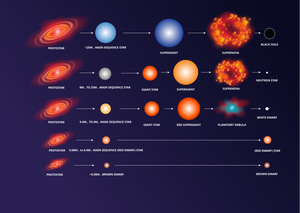
Stellar Evolution
Légende : This diagram shows the life cycle of stars of different masses. The mass of the different types of star increases from bottom to top with time going from left to right.
The life cycle of a star depends on its mass, with lower mass stars have longer lifetimes. All stars form from clouds of gas that collapse under their own gravity. As the star collapses, its core becomes hotter and denser. If the star has a mass greater than 0.08 solar masses (0.08 times the mass of the Sun), the pressure of the star’s mass pushing down on its core creates a high enough core temperature for hydrogen fusion to ignite. This burns hydrogen into helium in the star’s core, providing a heat source to power the star and to stop its core from collapsing further. If the collapsing object has a mass below 0.08 solar masses then it does not ignite hydrogen fusion in its core. It continues to cool and slowly contract. Such substellar objects are known as brown dwarfs, shown here in the lowest row.
After stars have formed, they burn hydrogen in their cores and begin their so-called main sequence phase. The most massive stars (>25 solar masses, shown here at the top) have very high core temperatures and thus burn through their hydrogen fuel more quickly. This means they may only spend a few million years on the main sequence burning hydrogen in their cores. Once the hydrogen in the core is exhausted the star’s core contracts, becomes hotter and helium burning starts in the core. While the core contracts, the outer layers of the star expand and it becomes a supergiant. For the most massive stars strong stellar winds strip off the cooler outer layers, leading to the star being very large and very hot, a blue supergiant. Once helium is exhausted in the core, carbon is burned, and then heavier elements. Eventually the star ends with an iron core. Fusing iron into heavier elements does not generate energy so at this point fusion stops in the core. Once this core of iron is massive enough, it and the surrounding matter suddenly collapses to form a black hole and the outer layers are flung off in a supernova explosion.
Slightly lower mass stars (between 8 and 25 solar masses, seen here second top) evolve in a similar way although they do not have strong enough winds to push their outer layers away and become blue supergiants, instead it evolves into a red supergiant. While such stars also collapse and create supernova explosions. The remnant of the star’s core is not massive enough to collapse into a black hole. Instead, its electrons and protons combine to form neutrons and it is supported by a quantum mechanical effect called neutron degeneracy pressure. This results in the remnant of the star being a tiny neutron star, several solar masses in mass but only a few kilometres across.
For stars similar in mass to the Sun (between 0.4 and 8 solar masses, seen here in the middle row), the star burns hydrogen in its core until the hydrogen in its core is exhausted. At this point a hydrogen burning shell forms around the core. Eventually the core will become hot enough to burn helium into carbon and oxygen. After this the star is left with a carbon and oxygen core surrounded by shells burning helium and hydrogen. These shells are unstable producing thermal pulsations that convulse the star. Eventually these pulsations become so extreme that the star’s outer layers are thrown off. This leaves the carbon and oxygen core as a white dwarf supported by electron degeneracy pressure. The outer layers of the star form what is known as a planetary nebula (which doesn’t actually have anything to do with planets despite the name).
The lowest mass stars (seen here in the second bottom row) are so low in mass that their evolutionary timescales are much longer than the age of the universe. This means that none have evolved beyond the main-sequence. Low mass stars are fully convective meaning material in the core is constantly being mixed with material above. This means that all the hydrogen in the star would eventually be burned in the core, but this will take trillions of years.
Crédit : Danielle Futselaar/IAU OAE
License: CC-BY-4.0 Creative Commons (CC) Attribution 4.0 International (CC BY 4.0) Icônes
Ceci pourrait vous intéresser également








- Ressources
- Moteur de recherche des ressources pédagogiques
- Parcourir les ressources pédagogiques par Sujet
- Parcourir les images
- AstroEdu - Activités en classe
- Grandes Idées - Littéracie en astronomie
- Glossaire
- Rapports de l'OAE
- L'astronomie pour l'Education à travers le monde
- Sélection de ressources externes