Término del glosario: Estrella tipo M
Descripción: Una estrella de tipo espectral «M». Los astrónomos identifican las estrellas de tipo M por la presencia en sus espectros de bandas de absorción molecular, principalmente de óxido de titanio. Tienen temperaturas (efectivas) típicas que oscilan entre los 2500 kelvin (K) y 3700 K. En comparación con otras estrellas, a simple vista parecen rojas. Las estrellas de la secuencia principal de tipo espectral M se conocen como enanas rojas. Las estrellas de tipo M también pueden ser gigantes rojas o supergigantes rojas; estas clases están compuestas en su mayoría por estrellas M, pero incluyen algunas estrellas de tipo K, así como algunos tipos más exóticos de estrellas con fuertes características espectrales del carbono. Betelgeuse, en Orión, es una supergigante de tipo M.
Términos relacionados:
- Secuencia principal
- Molécula
- Enana Roja
- Gigante roja
- Supergigante roja
- Tipo espectral
- Espectro
- Enrojecimiento
- Temperatura efectiva
- Clase de luminosidad
Ver este término en otros idiomas
Estado del término y la definición: La definición original de este término en inglés ha sido aprobada por unastrónomo o astrónoma investigadora y un docente La traducción de este término y su definición aún están pendientes de aprobación
El Glosario multilingüe de la OAE es un proyecto de la Oficina de Astronomía para la Educación de la UAI (OAE) en colaboración con la Oficina de Divulgación de Astronomía de la UAI (OAO). Los términos y definiciones fueron seleccionados, redactados y revisados gracias al esfuerzo colectivo de la OAE, los Centros y Nodos de la OAE, los Coordinadores Nacionales de Educación Astronómica (NAECs) y otros voluntarios. Puedes encontrar una lista completa de créditos aquí. Todos los términos del glosario y sus definiciones se publican bajo la licencia Creative Commons CC BY-4.0 y deben atribuirse a la "IAU OAE".
Si detectas algún error de contenido o de traducción en este término del glosario o en ladefinición, ponte en contacto con nosotros.
En otros idiomas
- Árabe: نجمة من النوع M
- Alemán: M-Stern
- Inglés: M-type Star
- Francés: Étoile de type M
- Italiano: Stella di tipo M
- Japonés: M型星 (enlace externo)
- Coreano: M형 별
- Portugués de Brasil: Estrela tipo M
- Chino simplificado: M 型星
- Chino tradicional: M 型星
Contenidos relacionados

The red supergiant Betelgeuse
Pie de foto: The image shows Betelgeuse, a red supergiant in the constellation Orion, observed by the Atacama Large Millimeter/submillimeter Array (ALMA). ALMA consists of many antennae spread across a plain in Northern Chile. The observations from all of these receivers is synthesised together by a central computer to form an image. The wide distances between the antennae mean that is can resolve very fine details.
Most stars we observe are just seen as points of light, but Betelgeuse is so large (with a radius about 1,400 times larger than the Sun) and is sufficiently nearby that it is one of the few stars to have been resolved to show it as an extended object.
Betelgeuse is a massive star, more than 14 times the mass of the Sun and is relatively young for a star (less than 14 million years old). However, its high mass led to it having a very hot core which burned through its hydrogen fuel quickly. It has since evolved through many stages and now appears as a red supergiant, it's final stage before exploding as a supernova. When such an explosion will happen is not known for certain, but it could be in around 100,000 years. Such an explosion would be visible from Earth, even during the day.
Crédito: ALMA (ESO/NAOJ/NRAO)/E. O’Gorman/P. Kervella
enlace de crédito
License: CC-BY-4.0 Creative Commons Reconocimiento 4.0 Internacional (CC BY 4.0) íconos
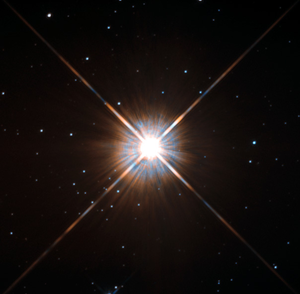
Proxima Centauri, Our Closest Stellar Neighbor
Pie de foto: Hubble's view of Proxima Centauri, a M-type dwarf and the nearest star to our Solar System. While this is the nearest star to the Sun, it was not discovered until 1915 due to its inherent faintness. Despite its proximity, it remains a point-like object in this image as even the closest stars to the Sun are very far away when compared to their physical size.
Crédito: ESA/Hubble & NASA
enlace de crédito
License: CC-BY-4.0 Creative Commons Reconocimiento 4.0 Internacional (CC BY 4.0) íconos
Diagramas relacionados
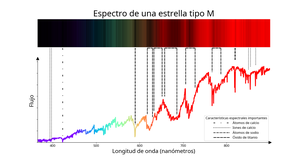
Espectro de una estrella tipo M
Pie de foto: Espectro de la estrella tipo M 2MASS J15581272+8457104. El color de la línea entre 400 nm y 700 nm corresponde aproximadamente al color en que el ojo humano vería la luz de esa longitud de onda. Por debajo de 400 nm y por encima de 700 nm, donde el ojo humano puede ver poca o ninguna luz, las líneas son de color azul y rojo, respectivamente.
Las líneas negras muestran las líneas de absorción espectral causadas por átomos, iones y moléculas de diferentes elementos de la atmósfera de la estrella. Estos átomos, iones y moléculas absorben en longitudes de onda específicas, provocando líneas nítidas y oscuras en el espectro. La intensidad de estas líneas depende de la temperatura de la atmósfera de la estrella. Dos estrellas formadas por la misma mezcla de elementos pueden tener espectros con conjuntos de líneas muy diferentes si sus atmósferas tienen temperaturas distintas. Las atmósferas de las estrellas tipo M son lo suficientemente frías como para que se formen algunos compuestos químicos. En astronomía, estos compuestos suelen denominarse moléculas, aunque no lo sean estrictamente en química. Estas moléculas producen tantas líneas en el espectro de una estrella tipo M que las líneas parecen fusionarse en enormes bandas que suprimen grandes trozos del espectro. En las estrellas tipo M, el óxido de titanio presenta un gran número de estas bandas en la luz visible, dominando enormes regiones del espectro.
Crédito: IAU OAE/SDSS/Niall Deacon
License: CC-BY-4.0 Creative Commons Reconocimiento 4.0 Internacional (CC BY 4.0) íconos