Glossary term: M 型星
Description: 光譜類型為 "M" 的恆星。天文學家通過光譜中是否存在分子吸收帶(主要來自鈦氧化物)來識別 M 型星。它們的典型(有效)溫度大約在 2500 K 到 3700 K 之間。與其他恆星相比,它們在人眼中呈現紅色。光譜類型為 M 的主序星被稱為紅矮星。M型星也可以是紅巨星或紅超巨星;這些類型的恆星大多是 M 型星,但也包括一些 K 型星以及一些具有強烈的碳光譜特徵的更奇特的恆星類型。獵戶座的參宿四就是一顆 M 型超巨星。
Related Terms:
See this term in other languages
Term and definition status: The original definition of this term in English have been approved by a research astronomer and a teacher The translation of this term and its definition is still awaiting approval
This is an automated transliteration of the simplified Chinese translation of this term
The OAE Multilingual Glossary is a project of the IAU Office of Astronomy for Education (OAE) in collaboration with the IAU Office of Astronomy Outreach (OAO). The terms and definitions were chosen, written and reviewed by a collective effort from the OAE, the OAE Centers and Nodes, the OAE National Astronomy Education Coordinators (NAECs) and other volunteers. You can find a full list of credits here. All glossary terms and their definitions are released under a Creative Commons CC BY-4.0 license and should be credited to "IAU OAE".
If you notice a factual or translation error in this glossary term or definition then please get in touch.
In Other Languages
- 阿拉伯語: نجمة من النوع M
- 德語: M-Stern
- 英語: M-type Star
- 西班牙語: Estrella tipo M
- 法語: Étoile de type M
- 義大利語: Stella di tipo M
- 日語: M型星 (external link)
- 韓語: M형 별
- 巴西葡萄牙語: Estrela tipo M
- 簡體中文: M 型星
Related Media

The red supergiant Betelgeuse
Caption: The image shows Betelgeuse, a red supergiant in the constellation Orion, observed by the Atacama Large Millimeter/submillimeter Array (ALMA). ALMA consists of many antennae spread across a plain in Northern Chile. The observations from all of these receivers is synthesised together by a central computer to form an image. The wide distances between the antennae mean that is can resolve very fine details.
Most stars we observe are just seen as points of light, but Betelgeuse is so large (with a radius about 1,400 times larger than the Sun) and is sufficiently nearby that it is one of the few stars to have been resolved to show it as an extended object.
Betelgeuse is a massive star, more than 14 times the mass of the Sun and is relatively young for a star (less than 14 million years old). However, its high mass led to it having a very hot core which burned through its hydrogen fuel quickly. It has since evolved through many stages and now appears as a red supergiant, it's final stage before exploding as a supernova. When such an explosion will happen is not known for certain, but it could be in around 100,000 years. Such an explosion would be visible from Earth, even during the day.
Credit: ALMA (ESO/NAOJ/NRAO)/E. O’Gorman/P. Kervella
credit link
License: CC-BY-4.0 Creative Commons 姓名標示 4.0 國際 (CC BY 4.0) icons
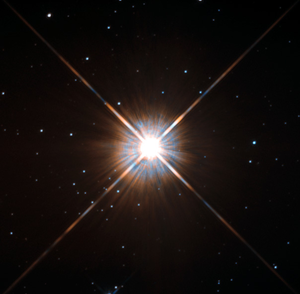
Proxima Centauri, Our Closest Stellar Neighbor
Caption: Hubble's view of Proxima Centauri, a M-type dwarf and the nearest star to our Solar System. While this is the nearest star to the Sun, it was not discovered until 1915 due to its inherent faintness. Despite its proximity, it remains a point-like object in this image as even the closest stars to the Sun are very far away when compared to their physical size.
Credit: ESA/Hubble & NASA
credit link
License: CC-BY-4.0 Creative Commons 姓名標示 4.0 國際 (CC BY 4.0) icons
Related Diagrams

一顆 M 型恒星的光譜
Caption: M 型恒星 2MASS J15581272+8457104 的光譜。波長在 400 納米到 700 納米之間的光譜綫的顔色大緻與人眼看到的該波長光綫的顔色一緻。波長低於 400 納米和高於 700 納米時,人眼幾乎看不到光,這兩條綫分彆被染成藍色和紅色。
黑綫顯示的是恒星大氣中不同元素的原子、離子和分子造成的光譜吸收綫。這些原子、離子和分子會吸收特定波長的光綫,從而在光譜中形成尖銳的暗綫。這些綫條的強度取決於恒星大氣層的溫度。如果兩顆恒星的大氣層溫度不同,那麼由相同元素混閤而成的兩顆恒星的光譜中可能會齣現截然不同的光譜綫。M 型恒星的大氣層足夠冷,可以形成一些化閤物。這些化閤物通常在天文學中被稱為分子,盡管它們在化學中並不是嚴格意義上的分子。這些分子會在 M 型恒星的光譜中産生如此之多的譜綫,以至於這些譜綫看起來會閤並成巨大的條帶,從而從光譜中去除一大塊。在 M 型恒星中,氧化鈦在可見光中有大量這樣的波段,占據瞭光譜的大部分區域。
Credit: IAU OAE/SDSS/Niall Deacon
License: CC-BY-4.0 Creative Commons 姓名標示 4.0 國際 (CC BY 4.0) icons