Glossary term: M형 별
Description: 분광형이 "M"형인 별. 스펙트럼에서 주로 산화티타늄 분자 흡수띠가 나타나기 때문에 천문학자들이 쉽게 구분할 수 있습니다. 이 별들의 표면 (유효)온도는 약 2500켈빈(K)에서 3700켈빈(K) 사이입니다. 다른 별들과 비교하면, M형 별들은 인간의 눈에 붉게 보입니다. 분광형이 M인 주계열성은 적색왜성이라고 합니다. M형 별은 적색거성이나 적색초거성일 수도 있습니다. 적색거성이나 적색초거성 대부분은 M형 별이지만, K형 별이나 스펙트럼에서 탄소 분광선이 강하게 나타나는 특이한 유형의 별들도 있습니다. 대표적인 예로, 오리온자리에 있는 베텔게우스는 M형 초거성입니다.
Related Terms:
- Main Sequence
- 분자
- 적색왜성
- Red Giant
- Red Supergiant
- Spectral Type
- Spectrum
- 적색화
- Effective Temperature
- 광도계급
See this term in other languages
Term and definition status: The original definition of this term in English have been approved by a research astronomer and a teacher The translation of this term and its definition is still awaiting approval
The OAE Multilingual Glossary is a project of the IAU Office of Astronomy for Education (OAE) in collaboration with the IAU Office of Astronomy Outreach (OAO). The terms and definitions were chosen, written and reviewed by a collective effort from the OAE, the OAE Centers and Nodes, the OAE National Astronomy Education Coordinators (NAECs) and other volunteers. You can find a full list of credits here. All glossary terms and their definitions are released under a Creative Commons CC BY-4.0 license and should be credited to "IAU OAE".
If you notice a factual or translation error in this glossary term or definition then please get in touch.
In Other Languages
- 아랍어: نجمة من النوع M
- 독일어: M-Stern
- 영어: M-type Star
- 스페인어: Estrella tipo M
- 프랑스어: Étoile de type M
- 이탈리아어: Stella di tipo M
- 일본어: M型星 (external link)
- 브라질 포르투갈어: Estrela tipo M
- 중국어 간체: M 型星
- 중국어 번체: M 型星
Related Media

The red supergiant Betelgeuse
Caption: The image shows Betelgeuse, a red supergiant in the constellation Orion, observed by the Atacama Large Millimeter/submillimeter Array (ALMA). ALMA consists of many antennae spread across a plain in Northern Chile. The observations from all of these receivers is synthesised together by a central computer to form an image. The wide distances between the antennae mean that is can resolve very fine details.
Most stars we observe are just seen as points of light, but Betelgeuse is so large (with a radius about 1,400 times larger than the Sun) and is sufficiently nearby that it is one of the few stars to have been resolved to show it as an extended object.
Betelgeuse is a massive star, more than 14 times the mass of the Sun and is relatively young for a star (less than 14 million years old). However, its high mass led to it having a very hot core which burned through its hydrogen fuel quickly. It has since evolved through many stages and now appears as a red supergiant, it's final stage before exploding as a supernova. When such an explosion will happen is not known for certain, but it could be in around 100,000 years. Such an explosion would be visible from Earth, even during the day.
Credit: ALMA (ESO/NAOJ/NRAO)/E. O’Gorman/P. Kervella
credit link
License: CC-BY-4.0 Creative Commons 저작자표시 4.0 국제 (CC BY 4.0) icons
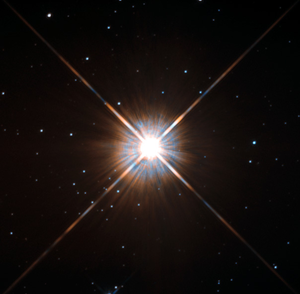
Proxima Centauri, Our Closest Stellar Neighbor
Caption: Hubble's view of Proxima Centauri, a M-type dwarf and the nearest star to our Solar System. While this is the nearest star to the Sun, it was not discovered until 1915 due to its inherent faintness. Despite its proximity, it remains a point-like object in this image as even the closest stars to the Sun are very far away when compared to their physical size.
Credit: ESA/Hubble & NASA
credit link
License: CC-BY-4.0 Creative Commons 저작자표시 4.0 국제 (CC BY 4.0) icons
Related Diagrams
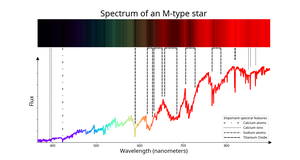
Spectrum of an M-type star
Caption: The spectrum of the M-type star 2MASS J15581272+8457104. The colour of the line between 400 nm and 700 nm roughly corresponds to the colour the human eye would see light of that wavelength. Below 400 nm and above 700 nm, where the human eye can see little to no light, the lines are coloured blue and red respectively.
The black lines show spectral absorption lines caused by atoms, ions and molecules of different elements in the star’s atmosphere. These atoms, ions and molecules absorb at specific wavelengths, causing sharp, dark lines in the spectra. How strong these lines are depends on the temperature of the star’s atmosphere. Two stars made from the same mix of elements could have spectra with vastly different sets of lines in their spectra if they have different temperatures in their atmospheres. The atmospheres of M-type stars are cool enough for some chemical compounds to form. These are often referred to as molecules in astronomy, even if they are not strictly molecules in chemistry. These molecules produce so many lines in an M-type star’s spectrum that the lines appear to merge together in huge bands that remove large chunks from the spectrum. In M-type stars, titanium oxide has a large number of these bands in visible light, dominating huge regions of the spectrum.
Credit: IAU OAE/SDSS/Niall Deacon
License: CC-BY-4.0 Creative Commons 저작자표시 4.0 국제 (CC BY 4.0) icons