Término del glosario: Mancha solar
Descripción: Una mancha solar es una región temporal y fría, provocada por un fuerte campo magnético en la fotosfera del Sol. Las manchas solares son zonas en las que afloran tubos de flujo magnético procedentes de las capas más profundas del Sol. El intenso campo magnético aumenta la presión magnética en estas regiones. Para mantener la misma presión que el entorno, la presión del gas y del plasma en la mancha solar debe disminuir, lo que hace que sea más fría que su entorno. Al ser más frías que la fotosfera circundante, las manchas solares pueden verse a través de un telescopio como manchas oscuras en la superficie del Sol. Las manchas solares varían en tamaño, pueden tener un diámetro que va desde unas decenas de kilómetros hasta más de cien mil kilómetros. Pueden persistir durante periodos de tiempo que van desde unos pocos días hasta varios meses. El número y la ubicación de las manchas solares en el Sol varían a lo largo del ciclo solar. Se cree que otras estrellas también tienen manchas causadas por sus campos magnéticos.
Términos relacionados:
Ver este término en otros idiomas
Estado del término y la definición: La definición original de este término en inglés ha sido aprobada por unastrónomo o astrónoma investigadora y un docente La traducción de este término y su definición aún están pendientes de aprobación
El Glosario multilingüe de la OAE es un proyecto de la Oficina de Astronomía para la Educación de la UAI (OAE) en colaboración con la Oficina de Divulgación de Astronomía de la UAI (OAO). Los términos y definiciones fueron seleccionados, redactados y revisados gracias al esfuerzo colectivo de la OAE, los Centros y Nodos de la OAE, los Coordinadores Nacionales de Educación Astronómica (NAECs) y otros voluntarios. Puedes encontrar una lista completa de créditos aquí. Todos los términos del glosario y sus definiciones se publican bajo la licencia Creative Commons CC BY-4.0 y deben atribuirse a la "IAU OAE".
Si detectas algún error de contenido o de traducción en este término del glosario o en ladefinición, ponte en contacto con nosotros.
En otros idiomas
- Árabe: بقعة شمسية
- Alemán: Sonnenfleck
- Inglés: Sunspot
- Persa: لکه خورشیدی
- Francés: Tache solaire
- Italiano: Macchia solare
- Japonés: 黒点 (enlace externo)
- Coreano: 태양흑점
- Portugués de Brasil: Mancha solar
- Chino simplificado: 太阳黑子
- Chino tradicional: 太陽黑子
Contenidos relacionados
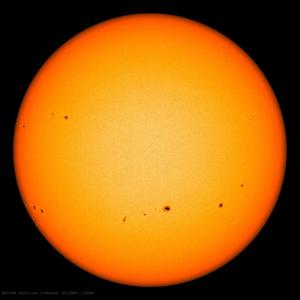
Sunspots
Pie de foto: In this image the sun peppered with groups of sunspots over almost nine days between July and August 2012. The sunspots seen in this image have been sources of the solar flares and coronal mass ejections (CME). In this image particulary, the sun is approaching solar maximum in its cycle (solar cycle), where we see many spots forming along the suns' equator. These sunspots and activity are seen in the southern hemisphere, before then most of the activity was on the northern hemisphere.
Crédito: NASA/SDO/HMI
enlace de crédito
License: PD Dominio público íconos

Close-up view of a sunspot
Pie de foto: This image of a sunspot was taken by the Daniel K Inouye Solar Telescope (DKIST), operated by the U.S. National Science Foundation. It was taken only in light with a wavelength of 530 nanometers, within the greenish-yellow part of the visible spectrum.
The picture reveals the detail of the spot's structure and the Sun’s photosphere. The dark central region, known as the umbra, is surrounded by a lighter area called the penumbra with radially elongated features stretching towards the umbra. Note that the umbra and penumbra here are not the same as the umbra and penumbra that occur during an eclipse.
The sunspot measures approximately 5000 kilometres in diameter, roughly equivalent to the east-west span of China. While the umbra appears black, it is actually hot and bright. It only appears dark because it is a few thousand kelvin cooler than the surrounding solar photosphere. Surrounding the sunspot, granulation patterns of plasma are visible on the photospheric surface of the Sun.
Crédito: NSO/NSF/AURA
enlace de crédito
License: CC-BY-4.0 Creative Commons Reconocimiento 4.0 Internacional (CC BY 4.0) íconos
Actividades relacionadas

Measure the Sun's Rotation Period
astroEDU educational activity (links to astroEDU website) Description: Find out the Sun’s rotation period, applying the simple equation of average speed to a real astronomical case.
License: CC-BY-4.0 Creative Commons Reconocimiento 4.0 Internacional (CC BY 4.0) íconos
Etiquetas:
Hands-on
, History
, Experiment
, Galileo
, average speed
Rango de edades:
16-19
Nivel educativo:
Secondary
Áreas de aprendizaje:
Aprendizaje basado en la investigación estructurada
Costos:
Bajo coste
Duración:
1 hora y 30 minutos
Tamaño del grupo:
Grupo
Competencias:
Analizar e interpretar datos
, Participar en debates basados en pruebas
, Planificar y llevar a cabo investigaciones
, Utilizar las matemáticas y el pensamiento computacional
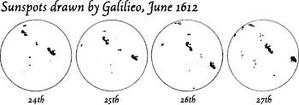
Is the Sun rotating? Follow the sunspots!
astroEDU educational activity (links to astroEDU website) Description: Like a "modern" Galileo, use true astronomical satellite observations to discover if the Sun (and other celestial objects) are rotating!
License: CC-BY-4.0 Creative Commons Reconocimiento 4.0 Internacional (CC BY 4.0) íconos
Etiquetas:
Hands-on
, History
, Experiment
, Galileo
Rango de edades:
12-14
, 14-16
, 16-19
Nivel educativo:
Educación secundaria
, Secondary
Áreas de aprendizaje:
Aprendizaje basado en la investigación estructurada
Costos:
Bajo coste
Duración:
1 hora
Tamaño del grupo:
Grupo
Competencias:
Analizar e interpretar datos
, Planificar y llevar a cabo investigaciones