词条 太阳黑子
描述: 太阳黑子是由于太阳光球层中的强磁场引起的暂时性冷区。太阳黑子是磁通管从太阳深处涌出的区域。强磁场增加了这些区域的磁压力。为了保持与周围环境相同的压力,太阳黑子中的气体和等离子体压力必须下降,这就使其温度低于周围环境。由于太阳黑子比周围的光球温度低,因此可以通过望远镜看到太阳黑子,是太阳表面的暗斑/斑点。太阳黑子的大小从几十公里到十几万公里不等。持续时间从几天到几个月不等。太阳黑子的数量和位置随太阳周期而变化。其他恒星也被认为有由其磁场引起的黑子。
相关词条
用其他语言查看该词条
词条和定义状态: 该术语的英文原始定义已通过天文研究人员和教师的审核 该术语及其定义的译文仍待审核
OAE 多语言词汇表是由国际天文学联合会(IAU) 天文教育办公室(OAE) 和 国际天文学联合会(IAU) 天文推广办公室(OAO)合作的项目。. 术语和定义由 OAE中心, OAE 国家天文教育协调员(NAECs) 以及其他志愿者共同选择、撰写和审阅。您可以在 找到完整的致谢列表。所有词汇表术语及其定义均根据 Creative Commons CC BY-4.0许可证发布 且版权归属于 "IAU OAE"。
如果您发现此词汇术语或定义中的事实或翻译错误, 请向 发邮件 联系.
其他语言版本
- 阿拉伯语: بقعة شمسية
- 德语: Sonnenfleck
- 英语: Sunspot
- 西班牙语: Mancha solar
- 波斯语: لکه خورشیدی
- 法语: Tache solaire
- 意大利语: Macchia solare
- 日语: 黒点 (外部链接)
- 韩语: 태양흑점
- 巴西葡萄牙语: Mancha solar
- 繁体中文: 太陽黑子
相关媒体
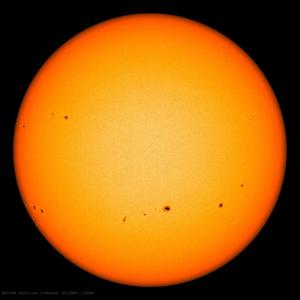
太阳黑子
图注: 在这张图片中,太阳在2012年7月至8月的近九天里布满了成群的太阳黑子。这张图片中看到的太阳黑子是太阳耀斑和日冕物质抛射(CME)的源头。特别是,在这张图片中,太阳正接近其周期(太阳周期)中的太阳活动最大值,我们可以看到许多黑子沿着太阳赤道形成。这些太阳黑子和活动出现在太阳的南半球,在此之前,大部分活动都发生在北半球。
来源: NASA/SDO/HMI
来源链接
License: PD 公共领域 图标

Close-up view of a sunspot
图注: This image of a sunspot was taken by the Daniel K Inouye Solar Telescope (DKIST), operated by the U.S. National Science Foundation. It was taken only in light with a wavelength of 530 nanometers, within the greenish-yellow part of the visible spectrum.
The picture reveals the detail of the spot's structure and the Sun’s photosphere. The dark central region, known as the umbra, is surrounded by a lighter area called the penumbra with radially elongated features stretching towards the umbra. Note that the umbra and penumbra here are not the same as the umbra and penumbra that occur during an eclipse.
The sunspot measures approximately 5000 kilometres in diameter, roughly equivalent to the east-west span of China. While the umbra appears black, it is actually hot and bright. It only appears dark because it is a few thousand kelvin cooler than the surrounding solar photosphere. Surrounding the sunspot, granulation patterns of plasma are visible on the photospheric surface of the Sun.
来源: NSO/NSF/AURA
来源链接
相关活动

Measure the Sun's Rotation Period
astroEDU educational activity (links to astroEDU website) Description: Find out the Sun’s rotation period, applying the simple equation of average speed to a real astronomical case.
License: CC-BY-4.0 知识共享许可协议 署名 4.0 国际 (CC BY 4.0) 图标
标签:
Hands-on
, History
, Experiment
, Galileo
, average speed
年龄段:
16-19
受教育等级:
中学
学习领域:
结构化探究式学习
费用:
低成本
时间跨度:
1 小时 30 分钟
组别大小:
小组
技能:
分析和解读数据
, 从证据中进行论证
, 规划并开展调查
, 使用数学和计算思维
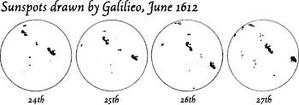
Is the Sun rotating? Follow the sunspots!
astroEDU educational activity (links to astroEDU website) Description: Like a "modern" Galileo, use true astronomical satellite observations to discover if the Sun (and other celestial objects) are rotating!
License: CC-BY-4.0 知识共享许可协议 署名 4.0 国际 (CC BY 4.0) 图标
标签:
Hands-on
, History
, Experiment
, Galileo
年龄段:
12-14
, 14-16
, 16-19
受教育等级:
初中
, 中学
学习领域:
结构化探究式学习
费用:
低成本
时间跨度:
1 小时
组别大小:
小组
技能:
分析和解读数据
, 规划并开展调查