Glossary term: Sunspot
Description: A sunspot is a temporary, cool region, caused by a strong magnetic field in the Sun's photosphere. Sunspots are areas where tubes of magnetic flux emerge from deeper in the Sun. The high magnetic field increases the magnetic pressure in these regions. To stay at the same pressure as their surroundings, the gas and plasma pressure in the sunspot must drop, making it cooler than its surroundings. As they are cooler than the surrounding photosphere, sunspots can be seen through a telescope as dark patches/blotches on the surface of the Sun. Sunspots range in size from tens of kilometers across to over a hundred thousand kilometers across. They can persist for timescales between a few days and a few months. The number and location of sunspots on the Sun varies over the solar cycle. Other stars are also thought to have spots caused by their magnetic fields.
Related Terms:
See this term in other languages
Term and definition status: This term and its definition have been approved by a research astronomer and a teacher
The OAE Multilingual Glossary is a project of the IAU Office of Astronomy for Education (OAE) in collaboration with the IAU Office of Astronomy Outreach (OAO). The terms and definitions were chosen, written and reviewed by a collective effort from the OAE, the OAE Centers and Nodes, the OAE National Astronomy Education Coordinators (NAECs) and other volunteers. You can find a full list of credits here. All glossary terms and their definitions are released under a Creative Commons CC BY-4.0 license and should be credited to "IAU OAE".
If you notice a factual error in this glossary definition then please get in touch.
In Other Languages
- Arabic: بقعة شمسية
- German: Sonnenfleck
- Spanish: Mancha solar
- Persian: لکه خورشیدی
- French: Tache solaire
- Italian: Macchia solare
- Japanese: 黒点 (external link)
- Korean: 태양흑점
- Brazilian Portuguese: Mancha solar
- Simplified Chinese: 太阳黑子
- Traditional Chinese: 太陽黑子
Related Media
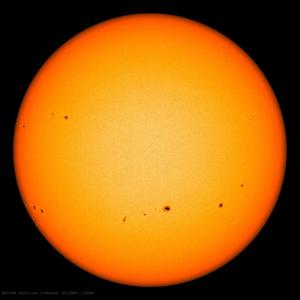
Sunspots
Caption: In this image the sun peppered with groups of sunspots over almost nine days between July and August 2012. The sunspots seen in this image have been sources of the solar flares and coronal mass ejections (CME). In this image particulary, the sun is approaching solar maximum in its cycle (solar cycle), where we see many spots forming along the suns' equator. These sunspots and activity are seen in the southern hemisphere, before then most of the activity was on the northern hemisphere.
Credit: NASA/SDO/HMI
credit link
License: PD Public Domain icons

Close-up view of a sunspot
Caption: This image of a sunspot was taken by the Daniel K Inouye Solar Telescope (DKIST), operated by the U.S. National Science Foundation. It was taken only in light with a wavelength of 530 nanometers, within the greenish-yellow part of the visible spectrum.
The picture reveals the detail of the spot's structure and the Sun’s photosphere. The dark central region, known as the umbra, is surrounded by a lighter area called the penumbra with radially elongated features stretching towards the umbra. Note that the umbra and penumbra here are not the same as the umbra and penumbra that occur during an eclipse.
The sunspot measures approximately 5000 kilometres in diameter, roughly equivalent to the east-west span of China. While the umbra appears black, it is actually hot and bright. It only appears dark because it is a few thousand kelvin cooler than the surrounding solar photosphere. Surrounding the sunspot, granulation patterns of plasma are visible on the photospheric surface of the Sun.
Credit: NSO/NSF/AURA
credit link
License: CC-BY-4.0 Creative Commons Attribution 4.0 International (CC BY 4.0) icons
Related Activities

Measure the Sun's Rotation Period
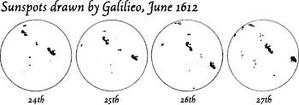
astroEDU educational activity (links to astroEDU website) Description: Find out the Sun’s rotation period, applying the simple equation of average speed to a real astronomical case.
License: CC-BY-4.0 Creative Commons Attribution 4.0 International (CC BY 4.0) icons
Tags:
Hands-on
, History
, Experiment
, Galileo
, average speed
Age Ranges:
16-19
Education Level:
Secondary
Areas of Learning:
Structured-inquiry learning
Costs:
Low Cost
Duration:
1 hour 30 mins
Group Size:
Group
Skills:
Analysing and interpreting data
, Engaging in argument from evidence
, Planning and carrying out investigations
, Using mathematics and computational thinking
Is the Sun rotating? Follow the sunspots!
astroEDU educational activity (links to astroEDU website) Description: Like a "modern" Galileo, use true astronomical satellite observations to discover if the Sun (and other celestial objects) are rotating!
License: CC-BY-4.0 Creative Commons Attribution 4.0 International (CC BY 4.0) icons
Tags:
Hands-on
, History
, Experiment
, Galileo
Age Ranges:
12-14
, 14-16
, 16-19
Education Level:
Middle School
, Secondary
Areas of Learning:
Structured-inquiry learning
Costs:
Low Cost
Duration:
1 hour
Group Size:
Group
Skills:
Analysing and interpreting data
, Planning and carrying out investigations