Término del glosario: Gravedad
Descripción: La gravedad es la atracción mutua entre objetos que tienen masa. En la mecánica clásica, cualquier objeto con masa ejerce siempre una fuerza de atracción sobre otro objeto con masa. Esta fuerza de atracción es lo que conocemos como gravedad. La teoría de la relatividad general de Einstein redefine la gravedad como una curvatura del espacio-tiempo en lugar de como una fuerza. Sin embargo, la aproximación clásica de la gravedad sigue siendo válida en la mayoría de los casos. Cuanto mayor es la masa de un objeto, mayor es su fuerza gravitatoria o distorsión del espacio-tiempo y, por lo tanto, mayor es la fuerza con la que atrae a otros objetos.
Términos relacionados:
Ver este término en otros idiomas
Estado del término y la definición: La definición original de este término en inglés ha sido aprobada por unastrónomo o astrónoma investigadora y un docente La traducción de este término y su definición aún están pendientes de aprobación
El Glosario multilingüe de la OAE es un proyecto de la Oficina de Astronomía para la Educación de la UAI (OAE) en colaboración con la Oficina de Divulgación de Astronomía de la UAI (OAO). Los términos y definiciones fueron seleccionados, redactados y revisados gracias al esfuerzo colectivo de la OAE, los Centros y Nodos de la OAE, los Coordinadores Nacionales de Educación Astronómica (NAECs) y otros voluntarios. Puedes encontrar una lista completa de créditos aquí. Todos los términos del glosario y sus definiciones se publican bajo la licencia Creative Commons CC BY-4.0 y deben atribuirse a la "IAU OAE".
Si detectas algún error de contenido o de traducción en este término del glosario o en ladefinición, ponte en contacto con nosotros.
En otros idiomas
- Árabe: الجاذبية
- Alemán: Schwerkraft
- Inglés: Gravity
- Francés: Gravité
- Hindi: गुरुत्वाकर्षण
- Italiano: Gravità
- Japonés: 重力 (enlace externo)
- Maratí: गुरुत्वाकर्षण
- Portugués de Brasil: Gravidade
- Chino simplificado: 万有引力
- Chino tradicional: 萬有引力
Contenidos relacionados

Apparatus for determining the gravitional constant
Pie de foto: Observations of the motions of the planets around the Sun, or the Moon around the Earth, could not yield the gravitational constant, as in those cases, the mass of the central body is not initially known. Measuring the gravitational constant required a situation where the masses involved had been determined independent of measuring their gravitational attraction. The device shown here was built by John Michell (1724–1793), but Michell died before he could perform the experiment. Henry Cavendish (1731–1810) inherited the device, modified it so as to suppress external disturbances, and successfully completed the experiment. Cavendish's report to the Royal Society was under the title of "Experiments to determine the density of the Earth" as, from knowledge of the gravitational constant, the gravitational acceleration at Earth's surface and the Earth's radius, one can determine the Earth's mass and its mean density. From the modern perspective, what is now known as the "Cavendish experiment" is seen as a way of determining Newton's gravitational constant G.
The image shows a cross-section of the apparatus, which Cavendish had further isolated from environmental influences by putting it into a separate room and inside a wooden box. The devices allowing Cavendish to illuminate, observe and manipulate the experiment from the outside are pictured as well. The core of the experiment is a torsion balance using two small lead spheres. The restoring force of the torsion pendulum is deduced from its natural oscillation frequency in the absence of the large masses. The gravitational attraction of the small lead spheres to their larger counterparts can then be determined by measuring how far it makes the torsion pendulum masses deviate from their null position.
The image is a slightly modified (cropped, contrast and brightness adjusted) version of Fig. 1 in Cavendish's article in the Philosophical Transactions of the Royal Society, Volume 88 (December 1798), pp. 469–526 [DOI: 10.1098/rstl.1798.0022]. The permission of the Royal Society to publish this image under a CC BY licenses gratefully acknowledged.
Crédito: Henry Cavendish in Philosophical Transactions of the Royal Society, DOI: 10.1098/rstl.1798.0022
enlace de crédito
License: CC-BY-4.0 Creative Commons Reconocimiento 4.0 Internacional (CC BY 4.0) íconos
Actividades relacionadas
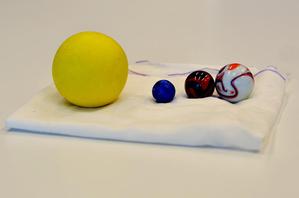
Model of a Black Hole
astroEDU educational activity (links to astroEDU website) Description: Understand the mystery of black holes through a hands-on activity.
License: CC-BY-4.0 Creative Commons Reconocimiento 4.0 Internacional (CC BY 4.0) íconos
Etiquetas:
Hands-on
, Model
, Interactive
, Space-time
, Black holes
Rango de edades:
8-10
, 10-12
Nivel educativo:
Primaria
, Secondary
Áreas de aprendizaje:
Modelización
, Aprendizaje basado en la investigación estructurada
Costos:
Coste medio
Duración:
1 hora
Tamaño del grupo:
Grupo
Competencias:
Plantear preguntas
, Desarrollar y utilizar modelos
Levitating Astronaut
astroEDU educational activity (links to astroEDU website) Description: Levitate an astronaut with the power of magnetism.
License: CC-BY-4.0 Creative Commons Reconocimiento 4.0 Internacional (CC BY 4.0) íconos
Etiquetas:
Hands-on
, Levitation
, Magnets
, Magnetism
, Force
, Charge
Rango de edades:
8-10
, 10-12
Nivel educativo:
Educación secundaria
, Primaria
, Secondary
Áreas de aprendizaje:
Modelización
Costos:
Bajo coste
Tamaño del grupo:
Grupo
Competencias:
Plantear preguntas
, Elaborar explicaciones
, Desarrollar y utilizar modelos
, Planificar y llevar a cabo investigaciones
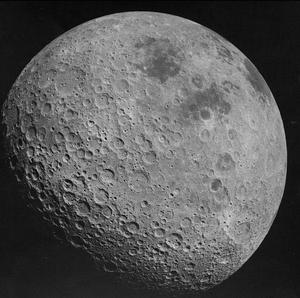
Impact Craters
astroEDU educational activity (links to astroEDU website) Description: A literal Earth-Shattering experiment
License: CC-BY-4.0 Creative Commons Reconocimiento 4.0 Internacional (CC BY 4.0) íconos
Etiquetas:
History
, Impact
, Experiment
Rango de edades:
10-12
, 12-14
, 14-16
Nivel educativo:
Educación secundaria
, Primaria
, Secondary
Áreas de aprendizaje:
Aprendizaje por descubrimiento guiado
, Modelización
, Experimento científico tradicional
Costos:
Bajo coste
Duración:
1 hora
Tamaño del grupo:
Grupo
Competencias:
Analizar e interpretar datos
, Plantear preguntas
, Elaborar explicaciones
, Participar en debates basados en pruebas
, Utilizar las matemáticas y el pensamiento computacional
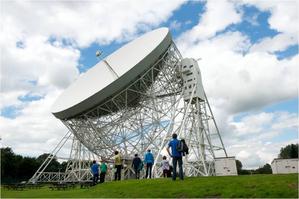
Big Telescopes: Gravity
astroEDU educational activity (links to astroEDU website) Description: Observing what gravity is doing to the Universe
License: CC-BY-4.0 Creative Commons Reconocimiento 4.0 Internacional (CC BY 4.0) íconos
Etiquetas:
Experiment
Rango de edades:
12-14
, 14-16
Nivel educativo:
Educación secundaria
, Secondary
Áreas de aprendizaje:
Aprendizaje por descubrimiento guiado
, Clase interactiva
, Modelización
Costos:
Alto coste
Duración:
1 hora y 30 minutos
Tamaño del grupo:
Grupo
Competencias:
Analizar e interpretar datos
, Plantear preguntas
, Desarrollar y utilizar modelos
, Planificar y llevar a cabo investigaciones

Dark matter & dark energy (Part 2) – Understanding the nature of dark matter and dark energy
astroEDU educational activity (links to astroEDU website) Description: Let's investigate the nature of dark matter and energy with gravitational lensing!
License: CC-BY-4.0 Creative Commons Reconocimiento 4.0 Internacional (CC BY 4.0) íconos
Etiquetas:
Experiment
, Invisible
Rango de edades:
12-14
, 14-16
, 16-19
, 19+
Nivel educativo:
Educación no forma
, Educación secundaria
Áreas de aprendizaje:
Aprendizaje por descubrimiento guiado
, Clase interactiva
, Modelización
, Resolución de problemas
Costos:
Coste medio
Duración:
45 minutos
Tamaño del grupo:
Grupo
Competencias:
Elaborar explicaciones
, Desarrollar y utilizar modelos
, Participar en debates basados en pruebas