بلغات أخرى
- الألمانيّة: Schwerkraft
- الإنجليزيّة: Gravity
- الإسبانيّة: Gravedad
- الفرنسيّة: Gravité
- الهندية: गुरुत्वाकर्षण
- الإيطاليّة: Gravità
- اليابانيّة: 重力 (رابط خارجي)
- المهاراتية: गुरुत्वाकर्षण
- البرتغاليّة البرازيليّة: Gravidade
- الصينيّة المبسطة: 万有引力
- الصينيّة التقليدية: 萬有引力
وسائط ذات صلة

Apparatus for determining the gravitional constant
الشرح: Observations of the motions of the planets around the Sun, or the Moon around the Earth, could not yield the gravitational constant, as in those cases, the mass of the central body is not initially known. Measuring the gravitational constant required a situation where the masses involved had been determined independent of measuring their gravitational attraction. The device shown here was built by John Michell (1724–1793), but Michell died before he could perform the experiment. Henry Cavendish (1731–1810) inherited the device, modified it so as to suppress external disturbances, and successfully completed the experiment. Cavendish's report to the Royal Society was under the title of "Experiments to determine the density of the Earth" as, from knowledge of the gravitational constant, the gravitational acceleration at Earth's surface and the Earth's radius, one can determine the Earth's mass and its mean density. From the modern perspective, what is now known as the "Cavendish experiment" is seen as a way of determining Newton's gravitational constant G.
The image shows a cross-section of the apparatus, which Cavendish had further isolated from environmental influences by putting it into a separate room and inside a wooden box. The devices allowing Cavendish to illuminate, observe and manipulate the experiment from the outside are pictured as well. The core of the experiment is a torsion balance using two small lead spheres. The restoring force of the torsion pendulum is deduced from its natural oscillation frequency in the absence of the large masses. The gravitational attraction of the small lead spheres to their larger counterparts can then be determined by measuring how far it makes the torsion pendulum masses deviate from their null position.
The image is a slightly modified (cropped, contrast and brightness adjusted) version of Fig. 1 in Cavendish's article in the Philosophical Transactions of the Royal Society, Volume 88 (December 1798), pp. 469–526 [DOI: 10.1098/rstl.1798.0022]. The permission of the Royal Society to publish this image under a CC BY licenses gratefully acknowledged.
المصدر: Henry Cavendish in Philosophical Transactions of the Royal Society, DOI: 10.1098/rstl.1798.0022
رابط المصدر
License: CC-BY-4.0 المشاع الإبداعي نَسب المُصنَّف 4.0 دولي (CC BY 4.0) أيقونات
الأنشطة المرتبطة
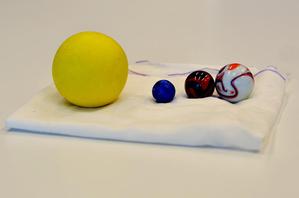
Model of a Black Hole
astroEDU educational activity (links to astroEDU website) Description: Understand the mystery of black holes through a hands-on activity.
License: CC-BY-4.0 المشاع الإبداعي نَسب المُصنَّف 4.0 دولي (CC BY 4.0) أيقونات
وسوم:
Hands-on
, Model
, Interactive
, Space-time
, Black holes
الفئات العمرية:
8-10
, 10-12
المرحلة التعليمية:
المرحلة الابتدائية
, المرحلة الثانوية
مجالات التعلم:
النمذجة
, تعلم منظم قائم على الاستقصاء
التكاليف:
تكلفة متوسطة
المدة:
ساعة واحدة
حجم المجموعة:
جماعي
المهارات:
طرح الأسئلة
, تطوير النماذج واستخدامها
Levitating Astronaut
astroEDU educational activity (links to astroEDU website) Description: Levitate an astronaut with the power of magnetism.
License: CC-BY-4.0 المشاع الإبداعي نَسب المُصنَّف 4.0 دولي (CC BY 4.0) أيقونات
وسوم:
Hands-on
, Levitation
, Magnets
, Magnetism
, Force
, Charge
الفئات العمرية:
8-10
, 10-12
المرحلة التعليمية:
المرحلة المتوسطة
, المرحلة الابتدائية
, المرحلة الثانوية
مجالات التعلم:
النمذجة
التكاليف:
تكلفة منخفضة
حجم المجموعة:
جماعي
المهارات:
طرح الأسئلة
, صياغة التفسيرات
, تطوير النماذج واستخدامها
, تخطيط وتنفيذ التحقيقات
Impact Craters
astroEDU educational activity (links to astroEDU website) Description: A literal Earth-Shattering experiment
License: CC-BY-4.0 المشاع الإبداعي نَسب المُصنَّف 4.0 دولي (CC BY 4.0) أيقونات
وسوم:
History
, Impact
, Experiment
الفئات العمرية:
10-12
, 12-14
, 14-16
المرحلة التعليمية:
المرحلة المتوسطة
, المرحلة الابتدائية
, المرحلة الثانوية
مجالات التعلم:
تعلم استكشافي موجه
, النمذجة
, تجربة علمية تقليدية
التكاليف:
تكلفة منخفضة
المدة:
ساعة واحدة
حجم المجموعة:
جماعي
المهارات:
تحليل البيانات وتفسيرها
, طرح الأسئلة
, صياغة التفسيرات
, بناء حجج استنادًا إلى الأدلة
, استخدام الرياضيات والتفكير الحاسوبي
Big Telescopes: Gravity
astroEDU educational activity (links to astroEDU website) Description: Observing what gravity is doing to the Universe
License: CC-BY-4.0 المشاع الإبداعي نَسب المُصنَّف 4.0 دولي (CC BY 4.0) أيقونات
وسوم:
Experiment
الفئات العمرية:
12-14
, 14-16
المرحلة التعليمية:
المرحلة المتوسطة
, المرحلة الثانوية
مجالات التعلم:
تعلم استكشافي موجه
, محاضرة تفاعلية
, النمذجة
التكاليف:
تكلفة عالية
المدة:
ساعة ونصف
حجم المجموعة:
جماعي
المهارات:
تحليل البيانات وتفسيرها
, طرح الأسئلة
, تطوير النماذج واستخدامها
, تخطيط وتنفيذ التحقيقات

Dark matter & dark energy (Part 2) – Understanding the nature of dark matter and dark energy
astroEDU educational activity (links to astroEDU website) Description: Let's investigate the nature of dark matter and energy with gravitational lensing!
License: CC-BY-4.0 المشاع الإبداعي نَسب المُصنَّف 4.0 دولي (CC BY 4.0) أيقونات
وسوم:
Experiment
, Invisible
الفئات العمرية:
12-14
, 14-16
, 16-19
, 19+
المرحلة التعليمية:
غير رسمي
, المرحلة المتوسطة
مجالات التعلم:
تعلم استكشافي موجه
, محاضرة تفاعلية
, النمذجة
, حل المشكلات
التكاليف:
تكلفة متوسطة
المدة:
45 دقيقة
حجم المجموعة:
جماعي
المهارات:
صياغة التفسيرات
, تطوير النماذج واستخدامها
, بناء حجج استنادًا إلى الأدلة