Termo do glossário: Gravidade
Descrição: A gravidade é a atração mútua entre objetos que possuem massa. Na mecânica clássica, qualquer objeto com massa sempre exerce uma força de atração sobre outro objeto com massa. Essa força de atração é o que conhecemos como gravidade. A teoria da relatividade geral de Einstein reformula a gravidade como uma curvatura do espaço-tempo, em vez de uma força. No entanto, a aproximação clássica da gravidade ainda é precisa na maioria dos cenários. Quanto mais massivo é um objeto, mais forte é sua força gravitacional/distorção do espaço-tempo e, portanto, maior é a atração sobre outros objetos.
Termos relacionados:
Ver este termo em outros idiomas
Status do termo e da definição: A definição original deste termo em inglês foi aprovada por um astrônomo(a) pesquisador(a) e um(a) professor(a) A tradução deste termo e de sua definição ainda aguarda aprovação
O Glossário Multilíngue da OAE é um projeto do Escritório da IAU de Astronomia para a Educação (OAE) em colaboração com o Escritório da IAU para Divulgação da Astronomia (OAO). Os termos e definições foram selecionados, escritos e revisados por meio de um esforço coletivo da OAE, dos Centros e Nós da OAE, dos Coordenadores Nacionais de Educação em Astronomia (NAECs) da OAE e de outros voluntários. Você pode encontrar uma lista completa dos créditos aqui. Todos os termos do glossário e suas definições são disponibilizados sob uma licença Creative Commons CC BY-4.0 e devem ser creditados à "IAU OAE".
Se você notar algum erro factual ou de tradução neste termo do glossário ou em sua definição, por favor entre em contato.
Em outros idiomas
- Árabe: الجاذبية
- Alemão: Schwerkraft
- Inglês: Gravity
- Espanhol: Gravedad
- Francês: Gravité
- Hindi: गुरुत्वाकर्षण
- Italiano: Gravità
- Japonês: 重力 (link externo)
- Marathi: गुरुत्वाकर्षण
- Chinês Simplificado: 万有引力
- Chinês Tradicional: 萬有引力
Mídia relacionada

Apparatus for determining the gravitional constant
Legenda: Observations of the motions of the planets around the Sun, or the Moon around the Earth, could not yield the gravitational constant, as in those cases, the mass of the central body is not initially known. Measuring the gravitational constant required a situation where the masses involved had been determined independent of measuring their gravitational attraction. The device shown here was built by John Michell (1724–1793), but Michell died before he could perform the experiment. Henry Cavendish (1731–1810) inherited the device, modified it so as to suppress external disturbances, and successfully completed the experiment. Cavendish's report to the Royal Society was under the title of "Experiments to determine the density of the Earth" as, from knowledge of the gravitational constant, the gravitational acceleration at Earth's surface and the Earth's radius, one can determine the Earth's mass and its mean density. From the modern perspective, what is now known as the "Cavendish experiment" is seen as a way of determining Newton's gravitational constant G.
The image shows a cross-section of the apparatus, which Cavendish had further isolated from environmental influences by putting it into a separate room and inside a wooden box. The devices allowing Cavendish to illuminate, observe and manipulate the experiment from the outside are pictured as well. The core of the experiment is a torsion balance using two small lead spheres. The restoring force of the torsion pendulum is deduced from its natural oscillation frequency in the absence of the large masses. The gravitational attraction of the small lead spheres to their larger counterparts can then be determined by measuring how far it makes the torsion pendulum masses deviate from their null position.
The image is a slightly modified (cropped, contrast and brightness adjusted) version of Fig. 1 in Cavendish's article in the Philosophical Transactions of the Royal Society, Volume 88 (December 1798), pp. 469–526 [DOI: 10.1098/rstl.1798.0022]. The permission of the Royal Society to publish this image under a CC BY licenses gratefully acknowledged.
Crédito: Henry Cavendish in Philosophical Transactions of the Royal Society, DOI: 10.1098/rstl.1798.0022
link do crédito
License: CC-BY-4.0 Creative Commons Attribution 4.0 International (CC BY 4.0) ícones
Atividades relacionadas
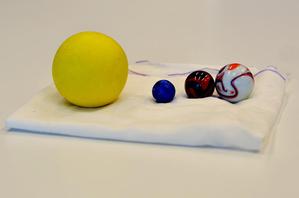
Model of a Black Hole
astroEDU educational activity (links to astroEDU website) Description: Understand the mystery of black holes through a hands-on activity.
License: CC-BY-4.0 Creative Commons Attribution 4.0 International (CC BY 4.0) ícones
Tags:
Hands-on
, Model
, Interactive
, Space-time
, Black holes
Faixas etárias:
8-10
, 10-12
Nível de ensino:
Básico
, Médio
Áreas de aprendizagem:
Modelagem
, Aprendizagem por investigação estruturada
Custos:
Custo médio
Duração:
1 hour
Tamanho do grupo:
Grupo
Habilidades:
Fazer perguntas
, Desenvolver e usar modelos
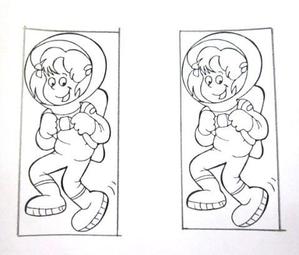
Levitating Astronaut
astroEDU educational activity (links to astroEDU website) Description: Levitate an astronaut with the power of magnetism.
License: CC-BY-4.0 Creative Commons Attribution 4.0 International (CC BY 4.0) ícones
Tags:
Hands-on
, Levitation
, Magnets
, Magnetism
, Force
, Charge
Faixas etárias:
8-10
, 10-12
Nível de ensino:
Ensino fundamental
, Básico
, Médio
Áreas de aprendizagem:
Modelagem
Custos:
Baixo custo
Tamanho do grupo:
Grupo
Habilidades:
Fazer perguntas
, Construir explicações
, Desenvolver e usar modelos
, Planejar e realizar pesquisas
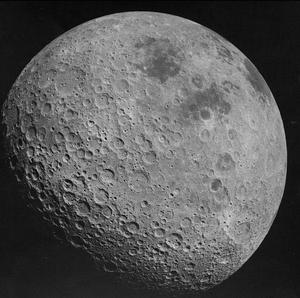
Impact Craters
astroEDU educational activity (links to astroEDU website) Description: A literal Earth-Shattering experiment
License: CC-BY-4.0 Creative Commons Attribution 4.0 International (CC BY 4.0) ícones
Tags:
History
, Impact
, Experiment
Faixas etárias:
10-12
, 12-14
, 14-16
Nível de ensino:
Ensino fundamental
, Básico
, Médio
Áreas de aprendizagem:
Aprendizagem por descoberta guiada
, Modelagem
, Experimento científico tradicional
Custos:
Baixo custo
Duração:
1 hour
Tamanho do grupo:
Grupo
Habilidades:
Analisar e interpretar dados
, Fazer perguntas
, Construir explicações
, Engajar-se em argumentação com base em evidências
, Usar matemática e pensamento computacional
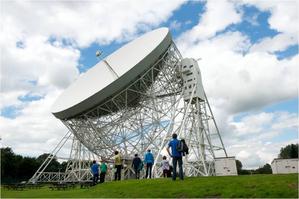
Big Telescopes: Gravity
astroEDU educational activity (links to astroEDU website) Description: Observing what gravity is doing to the Universe
License: CC-BY-4.0 Creative Commons Attribution 4.0 International (CC BY 4.0) ícones
Tags:
Experiment
Faixas etárias:
12-14
, 14-16
Nível de ensino:
Ensino fundamental
, Médio
Áreas de aprendizagem:
Aprendizagem por descoberta guiada
, Aula interativa
, Modelagem
Custos:
Alto custo
Duração:
1 hour 30 mins
Tamanho do grupo:
Grupo
Habilidades:
Analisar e interpretar dados
, Fazer perguntas
, Desenvolver e usar modelos
, Planejar e realizar pesquisas

Dark matter & dark energy (Part 2) – Understanding the nature of dark matter and dark energy
astroEDU educational activity (links to astroEDU website) Description: Let's investigate the nature of dark matter and energy with gravitational lensing!
License: CC-BY-4.0 Creative Commons Attribution 4.0 International (CC BY 4.0) ícones
Tags:
Experiment
, Invisible
Faixas etárias:
12-14
, 14-16
, 16-19
, 19+
Nível de ensino:
Informal
, Ensino fundamental
Áreas de aprendizagem:
Aprendizagem por descoberta guiada
, Aula interativa
, Modelagem
, Resolução de problemas
Custos:
Custo médio
Duração:
45 mins
Tamanho do grupo:
Grupo
Habilidades:
Construir explicações
, Desenvolver e usar modelos
, Engajar-se em argumentação com base em evidências