词条 万有引力
描述: 万有引力是具有质量的物体之间的相互吸引力。在经典力学中,任何具有质量的物体总会对另一个具有质量的物体产生吸引力,这种吸引力就是我们所知的万有引力。爱因斯坦的广义相对论将万有引力重新解释为一种时空曲率,而不是一种力。然而,万有引力的经典近似值在大多数情况下仍然是准确的。物体的质量越大,其万有引力/时空扭曲就越强,因此对其他物体的牵拉作用也就越大。
相关词条
用其他语言查看该词条
词条和定义状态: 该术语的英文原始定义已通过天文研究人员和教师的审核 该术语及其定义的译文仍待审核
OAE多语言词汇表是由国际天文学联合会(IAU) 天文教育办公室(OAE) 和 国际天文学联合会(IAU) 天文推广办公室(OAO)合作的项目。. 术语和定义由 OAE中心, OAE 国家天文教育协调员(NAECs) 以及其他志愿者共同选择、撰写和审阅。您可以在 找到完整的致谢列表。所有词汇表术语及其定义均根据 Creative Commons CC BY-4.0许可证发布 且版权归属于 “IAU OAE”。
如果您发现此词汇术语或定义中的事实或翻译错误, 请向 发邮件 联系.
其他语言版本
- 阿拉伯语: الجاذبية
- 德语: Schwerkraft
- 英语: Gravity
- 西班牙语: Gravedad
- 法语: Gravité
- 北印度语: गुरुत्वाकर्षण
- 意大利语: Gravità
- 日语: 重力 (外部链接)
- 马拉地语: गुरुत्वाकर्षण
- 巴西葡萄牙语: Gravidade
- 繁体中文: 萬有引力
相关媒体

Apparatus for determining the gravitional constant
图注: Observations of the motions of the planets around the Sun, or the Moon around the Earth, could not yield the gravitational constant, as in those cases, the mass of the central body is not initially known. Measuring the gravitational constant required a situation where the masses involved had been determined independent of measuring their gravitational attraction. The device shown here was built by John Michell (1724–1793), but Michell died before he could perform the experiment. Henry Cavendish (1731–1810) inherited the device, modified it so as to suppress external disturbances, and successfully completed the experiment. Cavendish's report to the Royal Society was under the title of "Experiments to determine the density of the Earth" as, from knowledge of the gravitational constant, the gravitational acceleration at Earth's surface and the Earth's radius, one can determine the Earth's mass and its mean density. From the modern perspective, what is now known as the "Cavendish experiment" is seen as a way of determining Newton's gravitational constant G.
The image shows a cross-section of the apparatus, which Cavendish had further isolated from environmental influences by putting it into a separate room and inside a wooden box. The devices allowing Cavendish to illuminate, observe and manipulate the experiment from the outside are pictured as well. The core of the experiment is a torsion balance using two small lead spheres. The restoring force of the torsion pendulum is deduced from its natural oscillation frequency in the absence of the large masses. The gravitational attraction of the small lead spheres to their larger counterparts can then be determined by measuring how far it makes the torsion pendulum masses deviate from their null position.
The image is a slightly modified (cropped, contrast and brightness adjusted) version of Fig. 1 in Cavendish's article in the Philosophical Transactions of the Royal Society, Volume 88 (December 1798), pp. 469–526 [DOI: 10.1098/rstl.1798.0022]. The permission of the Royal Society to publish this image under a CC BY licenses gratefully acknowledged.
来源: Henry Cavendish in Philosophical Transactions of the Royal Society, DOI: 10.1098/rstl.1798.0022
来源链接
相关活动
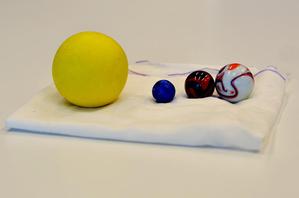
Model of a Black Hole
astroEDU educational activity (links to astroEDU website) Description: Understand the mystery of black holes through a hands-on activity.
License: CC-BY-4.0 知识共享许可协议 署名 4.0 国际 (CC BY 4.0) 图标
标签:
Hands-on
, Model
, Interactive
, Space-time
, Black holes
年龄段:
8-10
, 10-12
受教育等级:
Primary
, 中学
学习领域:
建模
, 结构化探究式学习
费用:
中等成本
时间跨度:
1 小时
组别大小:
小组
技能:
提出问题
, 开发和使用模型
Levitating Astronaut
astroEDU educational activity (links to astroEDU website) Description: Levitate an astronaut with the power of magnetism.
License: CC-BY-4.0 知识共享许可协议 署名 4.0 国际 (CC BY 4.0) 图标
标签:
Hands-on
, Levitation
, Magnets
, Magnetism
, Force
, Charge
年龄段:
8-10
, 10-12
受教育等级:
初中
, Primary
, 中学
学习领域:
建模
费用:
低成本
组别大小:
小组
技能:
提出问题
, 构建解释
, 开发和使用模型
, 规划并开展调查
Impact Craters
astroEDU educational activity (links to astroEDU website) Description: A literal Earth-Shattering experiment
License: CC-BY-4.0 知识共享许可协议 署名 4.0 国际 (CC BY 4.0) 图标
标签:
History
, Impact
, Experiment
年龄段:
10-12
, 12-14
, 14-16
受教育等级:
初中
, Primary
, 中学
学习领域:
引导式发现学习
, 建模
, 传统科学实验
费用:
低成本
时间跨度:
1 小时
组别大小:
小组
技能:
分析和解读数据
, 提出问题
, 构建解释
, 从证据中进行论证
, 使用数学和计算思维
Big Telescopes: Gravity
astroEDU educational activity (links to astroEDU website) Description: Observing what gravity is doing to the Universe
License: CC-BY-4.0 知识共享许可协议 署名 4.0 国际 (CC BY 4.0) 图标
标签:
Experiment
年龄段:
12-14
, 14-16
受教育等级:
初中
, 中学
学习领域:
引导式发现学习
, 互动讲座
, 建模
费用:
高成本
时间跨度:
1 小时 30 分钟
组别大小:
小组
技能:
分析和解读数据
, 提出问题
, 开发和使用模型
, 规划并开展调查

Dark matter & dark energy (Part 2) – Understanding the nature of dark matter and dark energy
astroEDU educational activity (links to astroEDU website) Description: Let's investigate the nature of dark matter and energy with gravitational lensing!
License: CC-BY-4.0 知识共享许可协议 署名 4.0 国际 (CC BY 4.0) 图标
标签:
Experiment
, Invisible
年龄段:
12-14
, 14-16
, 16-19
, 19+
受教育等级:
非正式
, 初中
学习领域:
引导式发现学习
, 互动讲座
, 建模
, 问题解决
费用:
中等成本
时间跨度:
45 分钟
组别大小:
小组
技能:
构建解释
, 开发和使用模型
, 从证据中进行论证