بلغات أخرى
- الألمانيّة: Roter Überriese
- الإنجليزيّة: Red Supergiant
- الإسبانيّة: Supergigante roja
- الفرنسيّة: Supergéante rouge
- الهندية: रेड सुपरजायंट
- الإيطاليّة: Supergigante rossa
- اليابانيّة: 赤色超巨星 (رابط خارجي)
- المهاراتية: रेड सुपरजायंट
- النيبالية: रातो महाकाय तारा
- البرتغاليّة البرازيليّة: Supergigante Vermelha
- الصينيّة المبسطة: 红超巨星
- الصينيّة التقليدية: 紅超巨星
وسائط ذات صلة
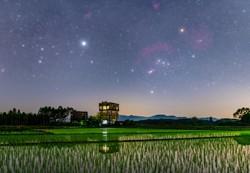
برج المراقبة وحقول الأرز تحت السماء المرصعة بالنجوم
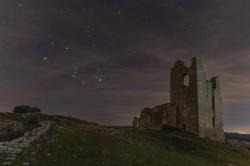
The Kingdom of Orion
الشرح: Winner in the 2022 IAU OAE Astrophotography Contest, category Still images of celestial patterns.
This image, taken in January 2022, pictures a landscape from Navarra, a province in the north of Spain with ruins from old civilizations in the foreground. Above that, we see a partially cloudy and starry sky with the most prominent stars belonging to the star pattern Orion. Composed of many bright stars with several interesting deep sky objects within its boundaries, Orion is one of the 88 officially recognised IAU constellations. It originates from Greek mythology where the hero Orion is the son of the sea god Poseidon. Orion is characterised as a giant hunter lurking just before he attacks an animal (it is unclear which animal he attacks, but, in the original Babylonian version of the Gilgamesh saga, it is the Bull of Heaven depicted as the constellation Taurus). The modern planetarium interpretation depicts him as a Roman warrior raising up his shield, but the two accompanying dogs, represented by the constellations of Canis Major and Canis Minor, are reminiscent of the Greek hunter.
Located at the celestial equator, the star pattern is visible all over the world and is interpreted differently in various mythologies, for example as three fishermen at a campfire in parts of Australia, as a butterfly in some parts of Africa, and as a stairway for the souls of ancestors in parts of South America. As Spain belonged to the Roman empire, the original constellations from earlier times are not known. There are some cave paintings on the Iberian peninsula that could possibly have astronomical references. However, there is uncertainty as to whether these painted figures on rocks depict star patterns.
Orion is best visible from November to January. Its most recognisable feature is the “belt”, an asterism composed of three bright, aligned stars (Alnitak, Alnilam and Mintaka), also recognised by different cultures. Just below this belt is the Orion Nebula, a famous and widely studied star-forming region located about 1500 light-years from Earth. The constellation's brightest stars are Rigel — a blue supergiant which is one of the brightest stars in the sky — and Betelgeuse — a massive red supergiant. The former serves as the left foot, and the latter as the right shoulder of the hunter. While Rigel is in the middle of its life, Betelgeuse is expected to explode within the next few tens of thousands of years. The Orionids, a meteor shower with typical rates of dozens of meteors per hour, whose parent body is Halley’s Comet, can be seen every year in the area of Orion, next to the border with the constellation of Gemini during the month of October.
المصدر: Carlos Zudaire/IAU OAE
License: CC-BY-4.0 المشاع الإبداعي نَسب المُصنَّف 4.0 دولي (CC BY 4.0) أيقونات

The red supergiant Betelgeuse
الشرح: The image shows Betelgeuse, a red supergiant in the constellation Orion, observed by the Atacama Large Millimeter/submillimeter Array (ALMA). ALMA consists of many antennae spread across a plain in Northern Chile. The observations from all of these receivers is synthesised together by a central computer to form an image. The wide distances between the antennae mean that is can resolve very fine details.
Most stars we observe are just seen as points of light, but Betelgeuse is so large (with a radius about 1,400 times larger than the Sun) and is sufficiently nearby that it is one of the few stars to have been resolved to show it as an extended object.
Betelgeuse is a massive star, more than 14 times the mass of the Sun and is relatively young for a star (less than 14 million years old). However, its high mass led to it having a very hot core which burned through its hydrogen fuel quickly. It has since evolved through many stages and now appears as a red supergiant, it's final stage before exploding as a supernova. When such an explosion will happen is not known for certain, but it could be in around 100,000 years. Such an explosion would be visible from Earth, even during the day.
المصدر: ALMA (ESO/NAOJ/NRAO)/E. O’Gorman/P. Kervella
رابط المصدر
License: CC-BY-4.0 المشاع الإبداعي نَسب المُصنَّف 4.0 دولي (CC BY 4.0) أيقونات