بلغات أخرى
- البنغاليّة: "A"-টাইপ নক্ষত্র
- الألمانيّة: A-Stern
- الإنجليزيّة: A-type Star
- الإسبانيّة: Estrella tipo A
- الفرنسيّة: Étoile de type A
- العبريّة: כוכב מסוג A
- الإندونيسيّة: Bintang kelas A
- الإيطاليّة: Stella di tipo A
- اليابانيّة: A型星 (رابط خارجي)
- البرتغاليّة البرازيليّة: Estrela de tipo A
- البرتغاليّة: Estrela de classe A
- الصينيّة المبسطة: A型星
- الصينيّة التقليدية: A型星
وسائط ذات صلة
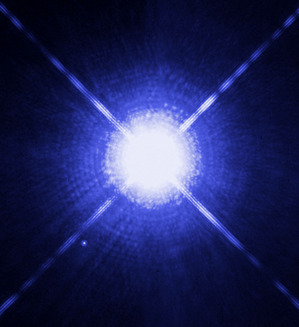
Sirius A with his faint white dwarf companion Sirius B
الشرح: This Hubble Space Telescope image highlights Sirius, the brightest star in Earth’s night sky, appearing as an intensely luminous object at the center with prominent cross-shaped diffraction spikes. These spikes, along with the saturated glow around the main star, are caused by the Sirius' light being spread out by the telescope and camera used to make this image. Slightly below and to the left of the main star, a tiny point of light marks Sirius B, a much dimmer object captured thanks to Hubble’s high sensitivity.
Sirius A is an A-type star, known for its high surface temperature and strong white-blue light, while Sirius B is a compact white dwarf, the dense remnant of a star that has exhausted its nuclear fuel. Together, they form a well-known Binary star system located about 8.6 light-years from Earth.
Sirius B was originally a higher mass and brighter star that burned through its hydrogen fuel more quickly than Sirius A. This led to Sirius B evolving into a red giant and eventually ending its life as a planetary nebula, leaving only the remains of its core as a white dwarf orbiting Sirius A.
المصدر: NASA, ESA, H. Bond (STScI), and M. Barstow (University of Leicester)
رابط المصدر
License: CC-BY-4.0 المشاع الإبداعي نَسب المُصنَّف 4.0 دولي (CC BY 4.0) أيقونات
الرسوم التوضيحية المرتبطة
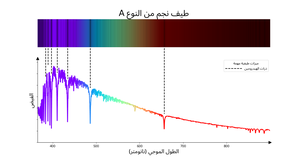
طيف نجم من النوع A