Glossary term: A型星
Description: A型星是指光譜類型為“A“的恆星。天文學家通過A型星光譜中存在的非常強的氫吸收線來識別它們。它們的典型(有效)溫度在7400 K到10,000 K之間。與其他恆星相比,除非受到星際或大氣層紅化的影響,否則它們在人眼中呈現白色或藍白色。天狼星是夜空中最亮的恆星,而織女星是所有其他恆星在視星等尺度上衡量其他星亮度的標準星,它們都是A型星。
Related Terms:
See this term in other languages
Term and definition status: The original definition of this term in English have been approved by a research astronomer and a teacher The translation of this term and its definition is still awaiting approval
This is an automated transliteration of the simplified Chinese translation of this term
The OAE Multilingual Glossary is a project of the IAU Office of Astronomy for Education (OAE) in collaboration with the IAU Office of Astronomy Outreach (OAO). The terms and definitions were chosen, written and reviewed by a collective effort from the OAE, the OAE Centers and Nodes, the OAE National Astronomy Education Coordinators (NAECs) and other volunteers. You can find a full list of credits here. All glossary terms and their definitions are released under a Creative Commons CC BY-4.0 license and should be credited to "IAU OAE".
If you notice a factual or translation error in this glossary term or definition then please get in touch.
In Other Languages
- 阿拉伯語: نجوم النسق الأساسي نوع A
- 孟加拉語: "A"-টাইপ নক্ষত্র
- 德語: A-Stern
- 英語: A-type Star
- 西班牙語: Estrella tipo A
- 法語: Étoile de type A
- 希伯來語: כוכב מסוג A
- 印尼語: Bintang kelas A
- 義大利語: Stella di tipo A
- 日語: A型星 (external link)
- 巴西葡萄牙語: Estrela de tipo A
- 葡萄牙語: Estrela de classe A
- 簡體中文: A型星
Related Media
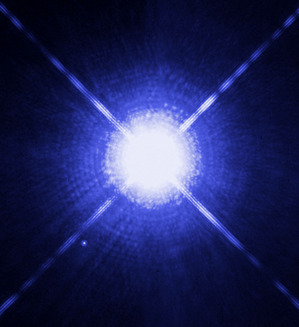
Sirius A with his faint white dwarf companion Sirius B
Caption: This Hubble Space Telescope image highlights Sirius, the brightest star in Earth’s night sky, appearing as an intensely luminous object at the center with prominent cross-shaped diffraction spikes. These spikes, along with the saturated glow around the main star, are caused by the Sirius' light being spread out by the telescope and camera used to make this image. Slightly below and to the left of the main star, a tiny point of light marks Sirius B, a much dimmer object captured thanks to Hubble’s high sensitivity.
Sirius A is an A-type star, known for its high surface temperature and strong white-blue light, while Sirius B is a compact white dwarf, the dense remnant of a star that has exhausted its nuclear fuel. Together, they form a well-known Binary star system located about 8.6 light-years from Earth.
Sirius B was originally a higher mass and brighter star that burned through its hydrogen fuel more quickly than Sirius A. This led to Sirius B evolving into a red giant and eventually ending its life as a planetary nebula, leaving only the remains of its core as a white dwarf orbiting Sirius A.
Credit: NASA, ESA, H. Bond (STScI), and M. Barstow (University of Leicester)
credit link
License: CC-BY-4.0 Creative Commons 姓名標示 4.0 國際 (CC BY 4.0) icons
Related Diagrams

A 型恒星的光譜
Caption: A 型恒星 BD-11 1212 的光譜。波長在 400 納米到 700 納米之間的光譜綫的顔色與人眼看到的該波長光綫的顔色大緻對應。在 400 納米以下和 700 納米以上,人眼幾乎看不到光,光譜綫分彆被染成藍色和紅色。
黑綫錶示恒星大氣中不同元素的原子和離子造成的光譜吸收綫。這些原子和離子會吸收特定波長的光,從而在光譜中形成尖銳的暗綫。這些綫條的強度取決於恒星大氣層的溫度。如果兩顆恒星的大氣層溫度不同,那麼由相同元素混閤而成的兩顆恒星的光譜中可能會齣現截然不同的光譜綫。來自氫原子的光譜綫在 A 型恒星的光譜中占主導地位,並且在這種光譜類型中最強。
Credit: IAU OAE/SDSS/Niall Deacon
License: CC-BY-4.0 Creative Commons 姓名標示 4.0 國際 (CC BY 4.0) icons