Glossary term: Estrela de classe A
Description: Uma estrela de classe espetral "A". Os astrónomos identificam as estrelas de classe A pela presença de fortes linhas de absorção do hidrogénio nos seus espectros. Têm temperaturas típicas (efectivas) entre cerca de 7400 kelvins (K) e 10.000 K. Comparadas com outras estrelas, parecem brancas ou branco-azuladas aos olhos humanos, a menos que sejam afectadas por vermelhidão interestelar ou atmosférica. Sirius, a estrela mais brilhante do céu noturno, e Vega, a estrela em relação à qual o brilho de todas as outras estrelas é medido na escala de magnitude aparente, são estrelas de classe A.
Related Terms:
See this term in other languages
Term and definition status: The original definition of this term in English have been approved by a research astronomer and a teacher The translation of this term and its definition is still awaiting approval
The OAE Multilingual Glossary is a project of the IAU Office of Astronomy for Education (OAE) in collaboration with the IAU Office of Astronomy Outreach (OAO). The terms and definitions were chosen, written and reviewed by a collective effort from the OAE, the OAE Centers and Nodes, the OAE National Astronomy Education Coordinators (NAECs) and other volunteers. You can find a full list of credits here. All glossary terms and their definitions are released under a Creative Commons CC BY-4.0 license and should be credited to "IAU OAE".
If you notice a factual or translation error in this glossary term or definition then please get in touch.
In Other Languages
- Árabe: نجوم النسق الأساسي نوع A
- Bengalês: "A"-টাইপ নক্ষত্র
- Alemão: A-Stern
- Inglês: A-type Star
- Espanhol: Estrella tipo A
- Francês: Étoile de type A
- Hebraico: כוכב מסוג A
- Indonésio: Bintang kelas A
- Italiano: Stella di tipo A
- Japonês: A型星 (external link)
- Português Brasileiro: Estrela de tipo A
- Chinês Simplificado: A型星
- Chinês Tradicional: A型星
Related Media
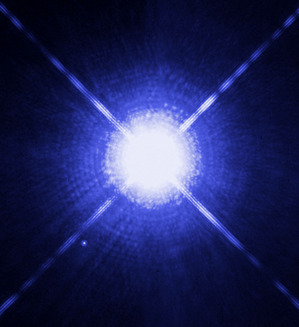
Sirius A with his faint white dwarf companion Sirius B
Caption: This Hubble Space Telescope image highlights Sirius, the brightest star in Earth’s night sky, appearing as an intensely luminous object at the center with prominent cross-shaped diffraction spikes. These spikes, along with the saturated glow around the main star, are caused by the Sirius' light being spread out by the telescope and camera used to make this image. Slightly below and to the left of the main star, a tiny point of light marks Sirius B, a much dimmer object captured thanks to Hubble’s high sensitivity.
Sirius A is an A-type star, known for its high surface temperature and strong white-blue light, while Sirius B is a compact white dwarf, the dense remnant of a star that has exhausted its nuclear fuel. Together, they form a well-known Binary star system located about 8.6 light-years from Earth.
Sirius B was originally a higher mass and brighter star that burned through its hydrogen fuel more quickly than Sirius A. This led to Sirius B evolving into a red giant and eventually ending its life as a planetary nebula, leaving only the remains of its core as a white dwarf orbiting Sirius A.
Credit: NASA, ESA, H. Bond (STScI), and M. Barstow (University of Leicester)
credit link
License: CC-BY-4.0 Creative Commons Attribution 4.0 International (CC BY 4.0) icons
Related Diagrams
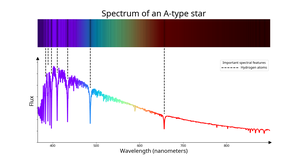
Spectrum of an A-type star
Caption: The spectrum of the A-type star BD-11 1212. The colour of the line between 400 nm and 700 nm roughly corresponds to the colour the human eye would see light of that wavelength. Below 400 nm and above 700 nm, where the human eye can see little to no light, the lines are coloured blue and red respectively.
The black lines show spectral absorption lines caused by atoms and ions of different elements in the star’s atmosphere. These atoms and ions absorb at specific wavelengths, causing sharp, dark lines in the spectra. How strong these lines are depends on the temperature of the star’s atmosphere. Two stars made from the same mix of elements could have spectra with vastly different sets of lines in their spectra if they have different temperatures in their atmospheres. Lines from hydrogen atoms dominate the spectra of A-type stars and are strongest at this spectral type.
Credit: IAU OAE/SDSS/Niall Deacon
License: CC-BY-4.0 Creative Commons Attribution 4.0 International (CC BY 4.0) icons