Termo do glossário: Sirius
Descrição: Sirius, também chamada de Estrela do Cão ou Alpha Canis Majoris, é a estrela que parece mais brilhante no céu noturno aos nossos olhos. Ela está localizada a uma distância de 8,6 anos-luz de nós, na constelação Canis Major, perto de Orion. A estrela brilhante que vemos é Sirius A, uma estrela do tipo espectral A. Sirius A possui uma companheira gravitacionalmente ligada a ela, Sirius B, que é uma estrela anã branca muito tênue na luz visível, mas muito brilhante em raios X. Sirius B é muito fraca e muito próxima de Sirius A para ser vista a olho nu.
Termos relacionados:
Ver este termo em outros idiomas
Status do termo e da definição: A definição original deste termo em inglês foi aprovada por um astrônomo(a) pesquisador(a) e um(a) professor(a) A tradução deste termo e de sua definição ainda aguarda aprovação
O Glossário Multilíngue da OAE é um projeto do Escritório da IAU de Astronomia para a Educação (OAE) em colaboração com o Escritório da IAU para Divulgação da Astronomia (OAO). Os termos e definições foram selecionados, escritos e revisados por meio de um esforço coletivo da OAE, dos Centros e Nós da OAE, dos Coordenadores Nacionais de Educação em Astronomia (NAECs) da OAE e de outros voluntários. Você pode encontrar uma lista completa dos créditos aqui. Todos os termos do glossário e suas definições são disponibilizados sob uma licença Creative Commons CC BY-4.0 e devem ser creditados à "IAU OAE".
Se você notar algum erro factual ou de tradução neste termo do glossário ou em sua definição, por favor entre em contato.
Mídia relacionada

Winter Constellations
Legenda: Second place in the 2022 IAU OAE Astrophotography Contest, category Time lapses of celestial patterns.
Sirius, the brightest star in the night sky, is shown rising, setting and passing by. Sometimes constellations and asterisms are also visible, including Orion, Taurus and the Pleiades. In the first scene, the aforementioned constellations are covered by a semi-transparent golden veil. The next scenes show it rising in a dark blue night sky. In one of the scenes, a planet brightly decorates the faint constellation Pisces.
The videos were taken above various landscapes and places of cultural heritage on Earth. Some of them simply show monuments in the desert, while others show palm trees with waving leaves.
Crédito: Amirreza Kamkar/IAU OAE
License: CC-BY-4.0 Creative Commons Attribution 4.0 International (CC BY 4.0) ícones
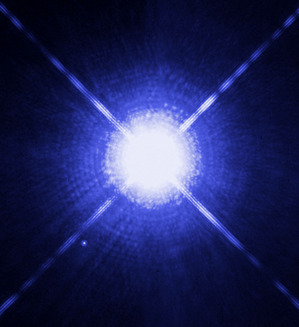
Sirius A with his faint white dwarf companion Sirius B
Legenda: This Hubble Space Telescope image highlights Sirius, the brightest star in Earth’s night sky, appearing as an intensely luminous object at the center with prominent cross-shaped diffraction spikes. These spikes, along with the saturated glow around the main star, are caused by the Sirius' light being spread out by the telescope and camera used to make this image. Slightly below and to the left of the main star, a tiny point of light marks Sirius B, a much dimmer object captured thanks to Hubble’s high sensitivity.
Sirius A is an A-type star, known for its high surface temperature and strong white-blue light, while Sirius B is a compact white dwarf, the dense remnant of a star that has exhausted its nuclear fuel. Together, they form a well-known Binary star system located about 8.6 light-years from Earth.
Sirius B was originally a higher mass and brighter star that burned through its hydrogen fuel more quickly than Sirius A. This led to Sirius B evolving into a red giant and eventually ending its life as a planetary nebula, leaving only the remains of its core as a white dwarf orbiting Sirius A.
Crédito: NASA, ESA, H. Bond (STScI), and M. Barstow (University of Leicester)
link do crédito
License: CC-BY-4.0 Creative Commons Attribution 4.0 International (CC BY 4.0) ícones
Diagramas relacionados
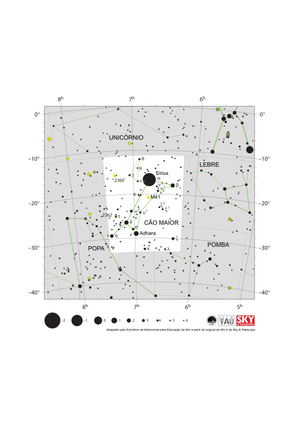
Mapa da Constelação de Cão Maior
Legenda: A constelação de Cão Maior com suas estrelas brilhantes e as constelações vizinhas. Cão Maior é cercada por (no sentido horário a partir do topo): Unicórnio, Lebre, Pomba e Popa. A constelação é dominada por Sirius, a estrela que aparece mais brilhante no céu noturno, que supera em muito todas as outras estrelas da constelação.
Cão Maior fica ao sul do equador celeste e é visível de todo o hemisfério sul, bem como das regiões equatoriais e temperadas do hemisfério norte. Sirius é visível de todas as regiões, com exceção das mais árticas. Cão Maior é mais visível à noite, no final do inverno no hemisfério norte e no final do verão no hemisfério sul.
Os aglomerados estelares abertos M41, NGC 2360 e NGC 2362 estão na constelação. Eles estão marcados com círculos amarelos.
O eixo y desse diagrama está em graus de declinação, com o norte para cima, e o eixo x está em horas de ascensão reta, com o leste à esquerda. Os tamanhos das estrelas marcadas aqui estão relacionados à magnitude aparente da estrela, uma medida de seu brilho aparente. Os pontos maiores representam estrelas mais brilhantes. As letras gregas marcam as estrelas mais brilhantes da constelação. Elas são classificadas por brilho, com a estrela mais brilhante sendo rotulada como alfa, a segunda mais brilhante como beta etc., embora essa ordem nem sempre seja seguida exatamente. As linhas de divisão pontilhadas marcam os limites das constelações da IAU e as linhas verdes sólidas marcam uma das formas comuns usadas para representar as figuras das constelações. Nem os limites da constelação nem as linhas que unem as estrelas aparecem no céu.
Crédito: Adaptado pelo Escritório de Astronomia para Educação da IAU a partir do original da IAU/Sky & Telescope
License: CC-BY-4.0 Creative Commons Attribution 4.0 International (CC BY 4.0) ícones