وسائط ذات صلة

الكوكبات الشتوية
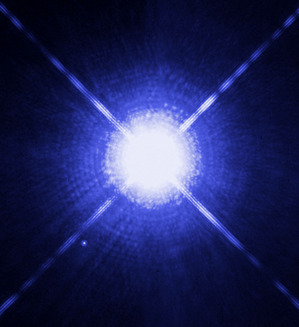
Sirius A with his faint white dwarf companion Sirius B
الشرح: This Hubble Space Telescope image highlights Sirius, the brightest star in Earth’s night sky, appearing as an intensely luminous object at the center with prominent cross-shaped diffraction spikes. These spikes, along with the saturated glow around the main star, are caused by the Sirius' light being spread out by the telescope and camera used to make this image. Slightly below and to the left of the main star, a tiny point of light marks Sirius B, a much dimmer object captured thanks to Hubble’s high sensitivity.
Sirius A is an A-type star, known for its high surface temperature and strong white-blue light, while Sirius B is a compact white dwarf, the dense remnant of a star that has exhausted its nuclear fuel. Together, they form a well-known Binary star system located about 8.6 light-years from Earth.
Sirius B was originally a higher mass and brighter star that burned through its hydrogen fuel more quickly than Sirius A. This led to Sirius B evolving into a red giant and eventually ending its life as a planetary nebula, leaving only the remains of its core as a white dwarf orbiting Sirius A.
المصدر: NASA, ESA, H. Bond (STScI), and M. Barstow (University of Leicester)
رابط المصدر
License: CC-BY-4.0 المشاع الإبداعي نَسب المُصنَّف 4.0 دولي (CC BY 4.0) أيقونات
الرسوم التوضيحية المرتبطة
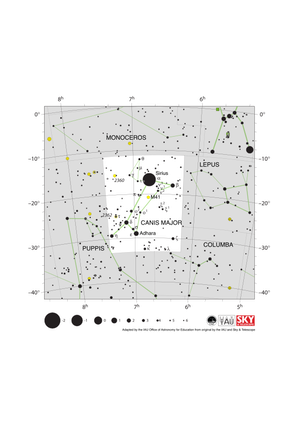
Canis Major Constellation Map
الشرح: The constellation Canis Major along with its bright stars and its surrounding constellations. Canis Major is surrounded by (going clockwise from the top): Monoceros, Lepus, Columba and Puppis. The constellation is dominated by Sirius, the star which appears brightest in the night sky, which far outshines all of the other stars in the constellation.
Canis Major lies just south of the celestial equator and is visible from all of the southern hemisphere as well as equatorial and temperate regions of the northern hemisphere. Sirius is visible from all but the most arctic regions. Canis Major is most visible in the evenings in late winter in the northern hemisphere and late summer in the southern hemisphere.
The open star clusters M41, NGC 2360 and NGC 2362 lie in the constellation. These are marked with yellow circles.
The y-axis of this diagram is in degrees of declination with north as up and the x-axis is in hours of right ascension with east to the left. The sizes of the stars marked here relate to the star's apparent magnitude, a measure of its apparent brightness. The larger dots represent brighter stars. The Greek letters mark the brightest stars in the constellation. These are ranked by brightness with the brightest star being labeled alpha, the second brightest beta, etc., although this ordering is not always followed exactly. The dotted boundary lines mark the IAU's boundaries of the constellations and the solid green lines mark one of the common forms used to represent the figures of the constellations. Neither the constellation boundaries, nor the lines joining the stars appear on the sky.
المصدر: Adapted by the IAU Office of Astronomy for Education from the original by IAU/Sky & Telescope
License: CC-BY-4.0 المشاع الإبداعي نَسب المُصنَّف 4.0 دولي (CC BY 4.0) أيقونات