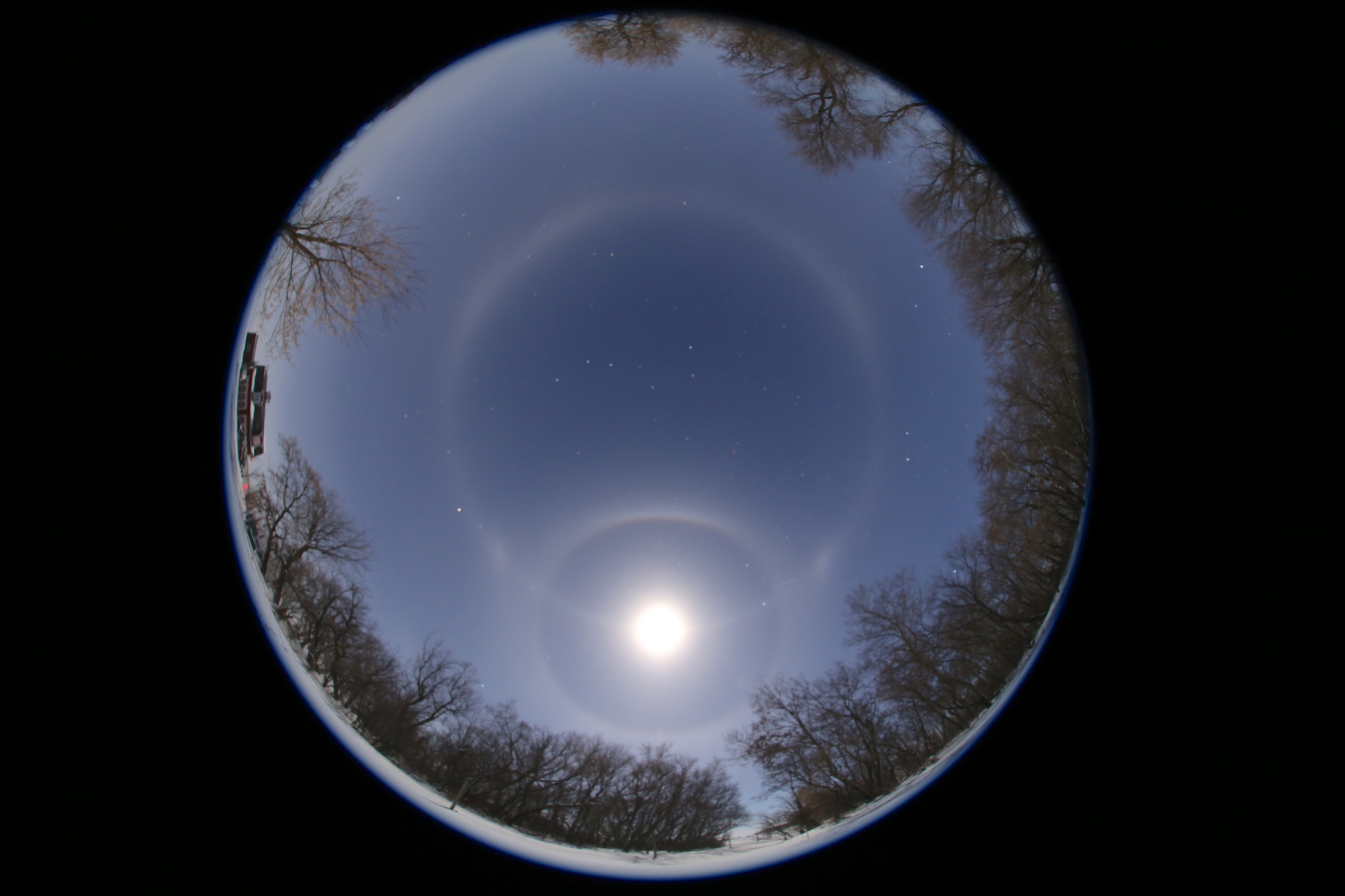
This page describes an image 塞勒涅与月亮相遇,作者Sheila Wiwchar,加拿大
从 Zenodo 下载该文件 ( 图像 1.83 MB)
图片说明
2021 年国际天文学联合会 OAE 天体摄影比赛日/月晕类第一名。
这幅精美的鱼眼照片拍摄于加拿大曼尼托巴省的卡莱伊达(Kaleida),捕捉到了环绕月亮的罕见光学现象,即 "22°晕 ",和穿过月亮的水平白圈,即 "幻月环"。与月亮在同一高度环绕整个天空的白色光带是以古希腊提坦女神塞勒涅的名字命名的,她被称为月亮女神。由太阳产生的对应现象更常被观测到,称为 "幻日环"(parhelic circle),以希腊太阳神赫利俄斯的名字命名。22° 晕和幻月环都是由于月光从近乎垂直的冰晶表面反射而产生的。离月球较近的部分是由于外部反射造成的,而离月球较远的部分则是内部反射造成的。位于中心的北斗七星让这幅图像更加壮观。你能发现它吗?
滚动查看其他语言的字幕
图片来源
Sheila Wiwchar/IAU OAE
注释翻译状态: 尚未由审核人员批准
注释翻译者: Hu Xueying
DOI(数字对象唯一标识符): 10.5281/zenodo.5418731
相关术语表词条:
晕
, 月球
分类:
肉眼天文学
图片许可: 知识共享许可协议 署名 4.0 国际 (CC BY 4.0) 知识共享许可协议 署名 4.0 国际 (CC BY 4.0) 图标
OAE 网站上展示的媒体文件说明文字是由 OAE、OAE 各中心与节点、OAE 的 国家天文教育协调员(NAECs) 和其他志愿者共同撰写、翻译与审核的。您可以在 这里 查看我们翻译项目的完整致谢名单。所有媒体文件说明均遵循 Creative Commons CC BY-4.0 许可协议进行发布,应注明来源为“IAU OAE”。媒体文件本身可能有不同的许可协议(见上文),请根据“来源”部分注明相应来源。
如果您发现此词汇术语或定义中的事实或翻译错误, 请向 发邮件 联系.
其他语言版本的图注
图片说明 Erster Platz beim IAU OAE Astrophotographie-Wettbewerb 2021, Kategorie Sonne/Mond-Halos.
Dieses Fischaugenbild, aufgenommen in Kaleida, Manitoba in Kanada, fängt auf wunderbare Weise das seltene optische Phänomen ein, das den Mond umgibt und als "22° Halo" bekannt ist, sowie den horizontalen weißen Kreis, der den Mond durchquert und als "paraselischer Kreis" bezeichnet wird. Das weiße Band, das den gesamten Himmel in der gleichen Höhe wie der Mond umkreist, ist nach Selene benannt, der antiken griechischen Titanin, die als Mondgöttin bekannt ist. Das häufiger beobachtete Gegenstück, das von der Sonne erzeugt wird, ist als parhelischer Kreis bekannt, benannt nach dem griechischen Sonnengott Helios. Sowohl der 22°-Halo als auch der paraselische Kreis entstehen durch die Reflexion des Mondlichts an nahezu senkrechten Oberflächen von Eiskristallen. Die Teile, die näher am Mond liegen, werden durch äußere Reflexionen verursacht, während die weiter entfernten durch innere Reflexionen entstehen. Das Sternbild des Großen Wagens in der Mitte macht dieses Bild noch spektakulärer. Können Sie ihn erkennen?
图片来源 Sheila Wiwchar/IAU OAE
相关术语表词条: Halo , Mond 注释翻译状态: 尚未由审核人员批准
注释翻译者: Emma Krojanski
图片说明 First place in the 2021 IAU OAE Astrophotography Contest, category Sun/Moon haloes.
Photographed at Kaleida, Manitoba in Canada, this fisheye image beautifully captures the rare optical phenomena encircling the moon known as the “22° halo” and the horizontal white circle passing through the moon called the “paraselenic circle”. The white band circling the whole sky at the same altitude as the moon is named after Selene, the ancient Greek Titan, famously called the goddess of the moon. The more commonly observed counterpart produced by the sun is known as the parhelic circle, named after the Greek god of the sun, Helios. Both the 22° halo and the paraselenic circle are produced due to reflection of the moonlight from near vertical surfaces of ice crystals. Parts closer to the moon are caused due to external reflections, whereas those further away are created due to internal reflections. The constellation of the big dipper at the center makes this image even more spectacular. Can you spot it?
图片来源 Sheila Wiwchar/IAU OAE
相关术语表词条: Halo , Moon
图片说明 Premier prix du concours d'astrophotographie 2021 de l'UAI OAE, catégorie halos Soleil/Lune.
Photographiée à Kaleida, Manitoba au Canada, cette image fisheye capture magnifiquement le rare phénomène optique entourant la Lune connu sous le nom de "halo de 22°" et le cercle blanc horizontal traversant la Lune appelé "cercle parasélénique". La bande blanche qui encercle tout le ciel à la même altitude que la Lune porte le nom de Séléné, le Titan de la Grèce antique, célèbre pour être la déesse de la Lune. La contrepartie produite par le soleil, plus communément observée, est connue sous le nom de cercle parhélique, nommé d'après le dieu grec du Soleil, Hélios. Le halo de 22° et le cercle parhélique sont tous deux dus à la réflexion de la lumière lunaire sur des surfaces quasi verticales de cristaux de glace. Les parties les plus proches de la Lune sont causées par des réflexions externes, tandis que les parties les plus éloignées sont créées par des réflexions internes. La constellation de la Grande Ourse au centre rend cette image encore plus spectaculaire. Pouvez-vous la repérer ?
图片来源 Sheila Wiwchar/IAU OAE
相关术语表词条: Halo , Lune 注释翻译状态: 尚未由审核人员批准
注释翻译者: Olivier Bonneton
图片说明 Primo posto al concorso di astrofotografia IAU OAE 2021, categoria Aloni di Sole/Luna.
Fotografata a Kaleida, Manitoba in Canada, questa immagine fisheye cattura magnificamente il raro fenomeno ottico che circonda la luna noto come "alone a 22°" e il cerchio bianco orizzontale che attraversa la luna chiamato "cerchio paraselenico". La fascia bianca che circonda l'intero cielo alla stessa altitudine della luna prende il nome da Selene, l'antico Titano greco, notoriamente chiamato la dea della luna. La controparte più comunemente osservata prodotta dal sole è nota come cerchio paraselenico, dal nome del dio greco del sole, Helios. Sia l'alone di 22° che il cerchio paraselenico sono prodotti dalla riflessione della luce lunare da superfici quasi verticali di cristalli di ghiaccio. Le parti più vicine alla luna sono causate da riflessioni esterne, mentre quelle più lontane sono create da riflessioni interne. La costellazione dell'Orsa Maggiore al centro rende questa immagine ancora più spettacolare. Riuscite a individuarla?
图片来源 Sheila Wiwchar/IAU OAE
相关术语表词条: L'alone , Luna 注释翻译状态: 已由审核人员批准
注释翻译者: Giuliana Giobbi, Francesco Salvestrini
注释审校者:: Rosa Valiante, Rodolfo Canestrari
图片说明 2021 年國際天文學聯合會 OAE 天體攝影比賽日/月暈類第一名。
這幅精美的魚眼照片拍攝於加拿大曼尼托巴省的卡萊伊達(Kaleida),捕捉到了環繞月亮的罕見光學現象,即 "22°暈 ",和穿過月亮的水平白圈,即 "幻月環"。與月亮在同一高度環繞整個天空的白色光帶是以古希臘提坦女神塞勒涅的名字命名的,她被稱為月亮女神。由太陽產生的對應現象更常被觀測到,稱為 "幻日環"(parhelic circle),以希臘太陽神赫利俄斯的名字命名。22° 暈和幻月環都是由於月光從近乎垂直的冰晶表面反射而產生的。離月球較近的部分是由於外部反射造成的,而離月球較遠的部分則是內部反射造成的。位於中心的北斗七星讓這幅圖像更加壯觀。你能發現它嗎?
图片来源 Sheila Wiwchar/IAU OAE
相关术语表词条: 暈 , 月球 注释翻译状态: 尚未由审核人员批准
注释翻译者: 由以下人员提供的简体中文翻译的自动音译 - Hu Xueying