Glossary term: 月球
Description: 月球是自身並不發光的天體,但它會反射落在其上的太陽光。這就產生了月球特有的月相。月球是地球唯一的主要天然衛星,其大小和質量在太陽系內的所有天然衛星中排名第五。在英文中,首字母大寫的“Moon”表示月球,而首字母小寫的“moon”則表示太陽系內外的其他天然衛星。與太陽系內的其他衛星相比,月球的體積相對於它所環繞行星的體積的占比是最大的。月球沿圍繞地球的橢圓軌道運行,與地球的平均距離為38.4萬千米。月球沒有大氣層,物質組分與地球類似,內核富含鐵,外層為岩石。這種相似並非偶然:據我們所知,大約45億年前,地球和一顆火星大小的行星碰撞,產生的碎片最終形成了月球,它的大部分物質來自最初的地球地幔。月球表面既有被稱為“月海”的深色區域,也有淺色高地,並布滿了隕擊坑。月球表面積為3.79×10⁷平方千米,體積為2.20×10¹⁰立方千米,質量為7.35×10²²千克。月球圍繞地球運行的軌道週期的確切數值取決於參考系:相對於遙遠的恆星,月球每27.3天運行一圈(“恆星月”)。對於地球上的觀測者來說,兩個新月之間的間隔時間為29.5天(“朔望月”)。
Related Terms:
See this term in other languages
Term and definition status: The original definition of this term in English have been approved by a research astronomer and a teacher The translation of this term and its definition is still awaiting approval
This is an automated transliteration of the simplified Chinese translation of this term
The OAE Multilingual Glossary is a project of the IAU Office of Astronomy for Education (OAE) in collaboration with the IAU Office of Astronomy Outreach (OAO). The terms and definitions were chosen, written and reviewed by a collective effort from the OAE, the OAE Centers and Nodes, the OAE National Astronomy Education Coordinators (NAECs) and other volunteers. You can find a full list of credits here. All glossary terms and their definitions are released under a Creative Commons CC BY-4.0 license and should be credited to "IAU OAE".
If you notice a factual or translation error in this glossary term or definition then please get in touch.
Related Media
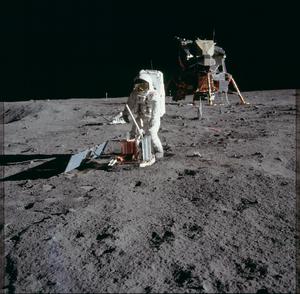
阿波羅 11 號任務的月面活動
Caption: 美國國家航空航天局宇航員埃德溫·巴茲·奧爾德林在月球上進行艙外活動(EVA)時,在阿波羅11號 "鷹 "月球著陸器前安裝地震儀。尼爾·阿姆斯特朗在1969年人類首次登月任務中拍攝了這張照片。
Credit: 美國國家航空航天局/阿波羅項目檔案
credit link
License: PD Public Domain icons
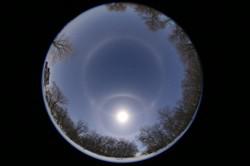
塞勒涅與月亮相遇,作者Sheila Wiwchar,加拿大
Caption: 2021 年國際天文學聯合會 OAE 天體攝影比賽日/月暈類第一名。
這幅精美的魚眼照片拍攝於加拿大曼尼托巴省的卡萊伊達(Kaleida),捕捉到了環繞月亮的罕見光學現象,即 "22°暈 ",和穿過月亮的水平白圈,即 "幻月環"。與月亮在同一高度環繞整個天空的白色光帶是以古希臘提坦女神塞勒涅的名字命名的,她被稱為月亮女神。由太陽產生的對應現象更常被觀測到,稱為 "幻日環"(parhelic circle),以希臘太陽神赫利俄斯的名字命名。22° 暈和幻月環都是由於月光從近乎垂直的冰晶表面反射而產生的。離月球較近的部分是由於外部反射造成的,而離月球較遠的部分則是內部反射造成的。位於中心的北斗七星讓這幅圖像更加壯觀。你能發現它嗎?
Credit: Sheila Wiwchar/IAU OAE
License: CC-BY-4.0 Creative Commons 姓名標示 4.0 國際 (CC BY 4.0) icons
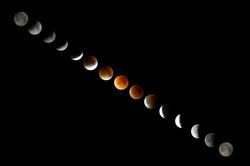
紅月,法國丹尼爾·亨利昂作品
Caption: 2021年國際天文學聯合會教育辦公室舉辦的天體攝影比賽月全食類季軍作品。
這是 2015 年 9 月 28 日發生的超級月亮月全食的延時攝影照片。照片記錄了月球穿過地球本影的過程:地球本影於協調世界時凌晨 1 時 07 分接觸月球外緣(左上角),於協調世界時凌晨 4 時 27 分離開月球表面(右下角)。
Credit: 丹尼爾·亨利/國際天文學聯合會教育辦公室
License: CC-BY-4.0 Creative Commons 姓名標示 4.0 國際 (CC BY 4.0) icons
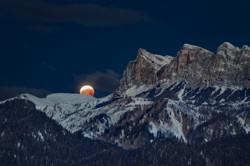
正發生月食的月亮從多洛米蒂山脈(聯合國教科文組織世界遺產區)普倫德拉岩峰(Rochetta di Prendera )附近落下,作者 Alessandra Masi,意大利
Caption: 2021 年國際天文學聯合會 OAE 天體攝影比賽月全食類第一名。
月食發生於滿月進入地球陰影時。這種現象發生在太陽、地球和月球的排布完全或非常接近一條直線時。月球表面反射的紅光是太陽光照射月球途中,穿過地球大氣層時發生折射造成的。較藍的光由於瑞利散射作用消失,因此月球表面呈現紅色。地球陰影在月球表面顯示出的圓形形狀,曾被亞里士多德用作地球是球體的證據之一。這張照片拍攝於2019 年 1 月 21 日,展示了被地球陰影籠罩的月球(月食)在意大利多洛米蒂山脈(聯合國教科文組織世界遺產區)普倫德拉岩峰(Rochetta di Prendera ) 附近落下的景象。
Credit: Alessandra Masi/IAU OAE
License: CC-BY-4.0 Creative Commons 姓名標示 4.0 國際 (CC BY 4.0) icons
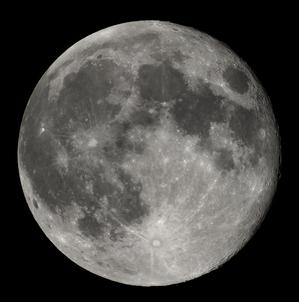
滿月
Caption: 這張圖像展示了用小型望遠鏡和單反相機觀察到的接近滿月的月亮。
Credit: 盧克 維亞圖爾
credit link
License: CC-BY-SA-3.0 Creative Commons Attribution-ShareAlike 3.0 Unported icons
Related Diagrams

Total Solar Eclipse
Caption: This not to scale diagram shows what happens during a total solar eclipse. The Moon orbits the Earth, but its orbit is slightly tilted with respect to the Earth’s orbit around the Sun. During the new moon lunar phase, the Moon lies between the Earth and the Sun, but due to the Moon’s tilted orbit around the Earth, the Moon normally lies above or below the Sun at this point. However twice a year the Moon’s orbit lines up in such a way that the Moon can lie in a direct line between the Earth and Sun. During each of these periods (each of which last roughly a month) solar (and lunar) eclipses can occur. The Moon is about 400 times smaller than the Sun, but is 400 times closer to the Earth than the Sun. Hence the Sun and Moon have approximately the same angular size when viewed from the Earth. This means that it is possible for the Moon to completely cover the Sun when viewed from Earth. This is known as a total solar eclipse.
Here we see a schematic of such and eclipse. The Moon casts a shadow on the Earth known as the umbra. This is a roughly circular shadow a few hundred kilometres across although its shape can be severely distorted when the eclipse is at the edge of the illuminated part of the Earth. Any region within the umbra will see the Moon completely cover the Sun and thus will experience a total solar eclipse. Outside of the umbra there are regions where the Moon will cover part of the Sun. This partial shadow is known as the penumbra. Regions in the penumbra will experience a partial solar eclipse.
An eclipse is a dynamic event with the Moon moving in its orbit and the Earth rotating. Hence the umbra and penumbra move across the Earth’s surface together. The path the umbra takes across the Earth is known as the path of totality. Let’s consider one particular region that lies in the path of totality: except in rare cases where an eclipse begins at sunrise, a region that experiences totality will first see the Moon cover part of the Sun and gradually move across Sun until it is totally covered. From outside the Earth this would appear as the penumbra moving over this particular region followed by the umbra moving over this region. Once the Moon moves so that it no longer completely covers the Sun, totality ends and the umbra moves away from this particular region. The Moon will continue to uncover the Sun until (unless the Sun sets before the end of the eclipse) the Sun is completely uncovered. From outside the Earth this would appear as the umbra moving away from our particular region and the edge of the penumbra approaching and eventually passing over the region.
Outside of the path or totality there is a much broader region that will lie in the penumbra but will be missed by the umbra. Such regions will not experience a total solar eclipse during this event, only a partial solar eclipse.
Credit: Aneta Margraf/IAU OAE
License: CC-BY-4.0 Creative Commons 姓名標示 4.0 國際 (CC BY 4.0) icons
Related Activities
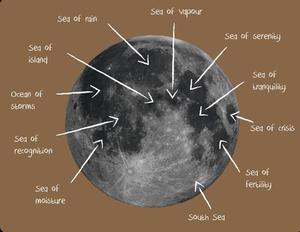
Lunar Landscape
astroEDU educational activity (links to astroEDU website) Description: Create craters and explore the lunar landscape with this hands-on activity.
License: CC-BY-4.0 Creative Commons 姓名標示 4.0 國際 (CC BY 4.0) icons
Tags:
Hands-on
, Model
, Lunar landscape
, Craters
Age Ranges:
4-6
, 6-8
, 8-10
Education Level:
Primary
Areas of Learning:
Modelling
Costs:
Medium Cost
Group Size:
Group
Skills:
Asking questions
, Communicating information
, Developing and using models
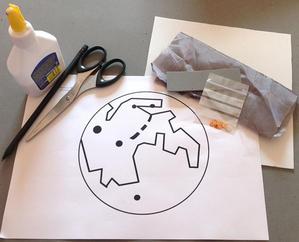
Meet Our Neighbours: Moon
astroEDU educational activity (links to astroEDU website) Description: Explore the tactile version of our moon with household materials.
License: CC-BY-4.0 Creative Commons 姓名標示 4.0 國際 (CC BY 4.0) icons
Tags:
Hands-on
, Model
, Visually Impaired
, Tactile
Age Ranges:
6-8
, 8-10
, 10-12
Education Level:
Middle School
, Primary
, Secondary
Areas of Learning:
Interactive Lecture
, Modelling
Costs:
Low Cost
Group Size:
Group
Skills:
Analysing and interpreting data
, Asking questions
, Communicating information
, Developing and using models
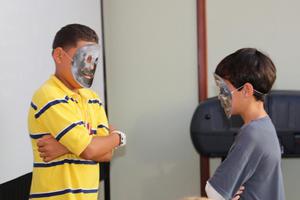
Lunar Day
astroEDU educational activity (links to astroEDU website) Description: Through a fun-learning activity, understand why moon always keeps the same face towards Earth.
License: CC-BY-4.0 Creative Commons 姓名標示 4.0 國際 (CC BY 4.0) icons
Tags:
Lunar day
Age Ranges:
4-6
, 6-8
Education Level:
Primary
, Secondary
Areas of Learning:
Modelling
, Simulation focussed
Costs:
Free
Duration:
30 mins
Group Size:
Group
Skills:
Analysing and interpreting data
, Asking questions
, Communicating information
, Constructing explanations
, Developing and using models
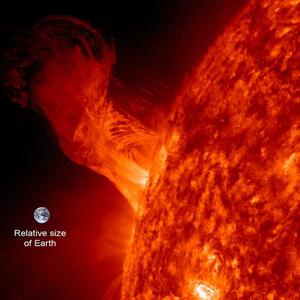
Sun, Earth and Moon Model
astroEDU educational activity (links to astroEDU website) Description: Build an Earth-Moon-Sun mobile to learn about how they orbit.
License: CC-BY-4.0 Creative Commons 姓名標示 4.0 國際 (CC BY 4.0) icons
Tags:
Hands-on
, Model
Age Ranges:
8-10
Education Level:
Primary
Areas of Learning:
Game-mediated learning
, Modelling
, Structured-inquiry learning
Costs:
Medium Cost
Duration:
1 hour 30 mins
Group Size:
Group
Skills:
Asking questions
, Communicating information
, Developing and using models
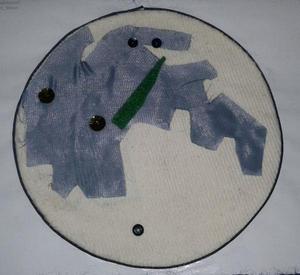
Children's Planetary Maps: The Moon
astroEDU educational activity (links to astroEDU website) Description: An up close look at our own satellite
License: CC-BY-4.0 Creative Commons 姓名標示 4.0 國際 (CC BY 4.0) icons
Tags:
Maps
, Planetary cartography
, Spatial thinking
Age Ranges:
6-8
, 8-10
, 10-12
, 12-14
Education Level:
Middle School
, Primary
, Secondary
Areas of Learning:
Structured-inquiry learning
Costs:
Low Cost
Duration:
2 hours
Group Size:
Group
Skills:
Analysing and interpreting data
, Asking questions
, Communicating information
, Constructing explanations
, Developing and using models
, Engaging in argument from evidence
, Planning and carrying out investigations