Glossary term: Moon
Description: The Moon is a celestial body that is not luminous on its own, but reflects the sunlight falling on it. This produces the Moon's characteristic phases. The Moon is the only major natural satellite of Earth, and ranks fifth among the natural satellites of the Solar System in terms of size and mass. "Moon" is capitalized to distinguish it from other natural satellites, or moons, in the Solar System and beyond. Compared with other Solar System moons, the Moon has the largest size relative to the size of the planet it orbits. The Moon follows an elliptical orbit around Earth, at an average distance from Earth of 384,000 kilometers (km). It has no atmosphere and is composed of similar materials to the Earth with an iron-rich core and rocky outer layers. The similarity is no accident: To the best of our knowledge, the Moon formed from the debris of the collision between Earth and a Mars-sized planet around 4.5 billion years ago; most of its material stems from the original Earth's mantle. The surface of the Moon has dark areas known as mare, lighter highlands, and is pockmarked with craters. The surface area of the Moon is 3.79 x 10⁷ square kilometers, its volume is 2.20 x 10¹⁰ cubic kilometers, and its mass is 7.35 x 10²² kilograms (kg). The exact value of the Moon's orbital period around Earth depends on the frame of reference: relative to the distant stars, it completes one orbit every 27.3 days ("sidereal period"). For an observer on Earth, the time between two new moons is 29.5 days ("synodic period").
Related Terms:
See this term in other languages
Term and definition status: This term and its definition have been approved by a research astronomer and a teacher
The OAE Multilingual Glossary is a project of the IAU Office of Astronomy for Education (OAE) in collaboration with the IAU Office of Astronomy Outreach (OAO). The terms and definitions were chosen, written and reviewed by a collective effort from the OAE, the OAE Centers and Nodes, the OAE National Astronomy Education Coordinators (NAECs) and other volunteers. You can find a full list of credits here. All glossary terms and their definitions are released under a Creative Commons CC BY-4.0 license and should be credited to "IAU OAE".
If you notice a factual error in this glossary definition then please get in touch.
Related Media
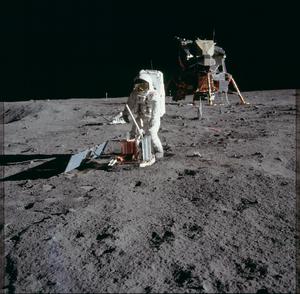
Apollo 11 lunar activity
Caption: NASA astronaut Edwin 'Buzz' Aldrin installs a seismometer in front of the Apollo 11 Eagle lunar lander during an extravehicular activity (EVA) on the Moon. Neil Armstrong shot this photo during the first human mission to the surface of the Moon in 1969.
Credit: NASA/Project Apollo Archive
credit link
License: PD Public Domain icons
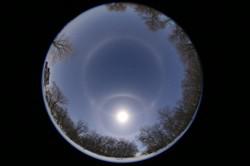
Selene meets the Moon, by Sheila Wiwchar, Canada
Caption: First place in the 2021 IAU OAE Astrophotography Contest, category Sun/Moon haloes.
Photographed at Kaleida, Manitoba in Canada, this fisheye image beautifully captures the rare optical phenomena encircling the moon known as the “22° halo” and the horizontal white circle passing through the moon called the “paraselenic circle”. The white band circling the whole sky at the same altitude as the moon is named after Selene, the ancient Greek Titan, famously called the goddess of the moon. The more commonly observed counterpart produced by the sun is known as the parhelic circle, named after the Greek god of the sun, Helios. Both the 22° halo and the paraselenic circle are produced due to reflection of the moonlight from near vertical surfaces of ice crystals. Parts closer to the moon are caused due to external reflections, whereas those further away are created due to internal reflections. The constellation of the big dipper at the center makes this image even more spectacular. Can you spot it?
Credit: Sheila Wiwchar/IAU OAE
License: CC-BY-4.0 Creative Commons Attribution 4.0 International (CC BY 4.0) icons
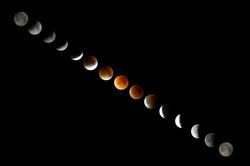
Red Moon, by Daniel Henrion, France
Caption: Third place in the 2021 IAU OAE Astrophotography Contest, category Total lunar eclipse.
Time-lapse images of a total supermoon lunar eclipse that took place on 28 September 2015. The photos show the Moon during the time it moved through the Earth´s umbra: Earth´s umbra touched the Moon´s outer limb at 1.07 a.m. UTC (upper left corner) and left the Moon´s surface at 4.27 a.m. UTC (lower right corner).
Credit: Daniel Henrion/IAU OAE
License: CC-BY-4.0 Creative Commons Attribution 4.0 International (CC BY 4.0) icons
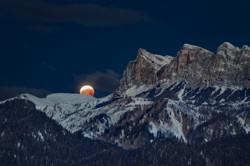
The eclipsed Moon sets near the Rochetta di Prendera, Dolomiti Unesco, by Alessandra Masi, Italy
Caption: First place in the 2021 IAU OAE Astrophotography Contest, category Total lunar eclipse.
A lunar eclipse occurs when the full moon moves into the Earth`s shadow. This is the case when the Sun, Earth and Moon are exactly or very closely aligned. The reddish light reflected from the lunar surface is caused by sunlight that has been refracted on its way through Earth´s atmosphere in the direction of the Moon. It appears reddish because of the Rayleigh scattering of bluer light. The round shape of the Earth's shadow visible on the lunar surface was a proof for Aristotle that the Earth must be a sphere. This photo shows the eclipsed Moon that sets near the Rochetta di Prendera, Dolomiti Unesco, Italy, on 21 January 2019.
Credit: Alessandra Masi/IAU OAE
License: CC-BY-4.0 Creative Commons Attribution 4.0 International (CC BY 4.0) icons
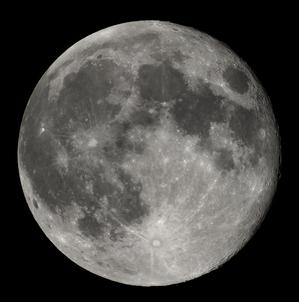
Full moon
Caption: The image shows the nearly full Moon observed with a small telescope and a DSLR camera.
Credit: Luc Viatour
credit link
License: CC-BY-SA-3.0 Creative Commons Attribution-ShareAlike 3.0 Unported icons
Related Diagrams

Total Solar Eclipse
Caption: This not to scale diagram shows what happens during a total solar eclipse. The Moon orbits the Earth, but its orbit is slightly tilted with respect to the Earth’s orbit around the Sun. During the new moon lunar phase, the Moon lies between the Earth and the Sun, but due to the Moon’s tilted orbit around the Earth, the Moon normally lies above or below the Sun at this point. However twice a year the Moon’s orbit lines up in such a way that the Moon can lie in a direct line between the Earth and Sun. During each of these periods (each of which last roughly a month) solar (and lunar) eclipses can occur. The Moon is about 400 times smaller than the Sun, but is 400 times closer to the Earth than the Sun. Hence the Sun and Moon have approximately the same angular size when viewed from the Earth. This means that it is possible for the Moon to completely cover the Sun when viewed from Earth. This is known as a total solar eclipse.
Here we see a schematic of such and eclipse. The Moon casts a shadow on the Earth known as the umbra. This is a roughly circular shadow a few hundred kilometres across although its shape can be severely distorted when the eclipse is at the edge of the illuminated part of the Earth. Any region within the umbra will see the Moon completely cover the Sun and thus will experience a total solar eclipse. Outside of the umbra there are regions where the Moon will cover part of the Sun. This partial shadow is known as the penumbra. Regions in the penumbra will experience a partial solar eclipse.
An eclipse is a dynamic event with the Moon moving in its orbit and the Earth rotating. Hence the umbra and penumbra move across the Earth’s surface together. The path the umbra takes across the Earth is known as the path of totality. Let’s consider one particular region that lies in the path of totality: except in rare cases where an eclipse begins at sunrise, a region that experiences totality will first see the Moon cover part of the Sun and gradually move across Sun until it is totally covered. From outside the Earth this would appear as the penumbra moving over this particular region followed by the umbra moving over this region. Once the Moon moves so that it no longer completely covers the Sun, totality ends and the umbra moves away from this particular region. The Moon will continue to uncover the Sun until (unless the Sun sets before the end of the eclipse) the Sun is completely uncovered. From outside the Earth this would appear as the umbra moving away from our particular region and the edge of the penumbra approaching and eventually passing over the region.
Outside of the path or totality there is a much broader region that will lie in the penumbra but will be missed by the umbra. Such regions will not experience a total solar eclipse during this event, only a partial solar eclipse.
Credit: Aneta Margraf/IAU OAE
License: CC-BY-4.0 Creative Commons Attribution 4.0 International (CC BY 4.0) icons
Related Activities
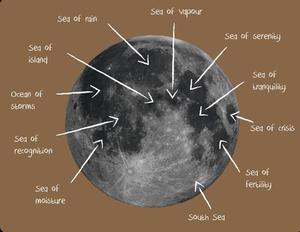
Lunar Landscape
astroEDU educational activity (links to astroEDU website) Description: Create craters and explore the lunar landscape with this hands-on activity.
License: CC-BY-4.0 Creative Commons Attribution 4.0 International (CC BY 4.0) icons
Tags:
Hands-on
, Model
, Lunar landscape
, Craters
Age Ranges:
4-6
, 6-8
, 8-10
Education Level:
Primary
Areas of Learning:
Modelling
Costs:
Medium Cost
Group Size:
Group
Skills:
Asking questions
, Communicating information
, Developing and using models
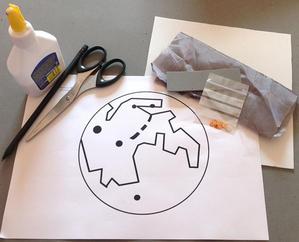
Meet Our Neighbours: Moon
astroEDU educational activity (links to astroEDU website) Description: Explore the tactile version of our moon with household materials.
License: CC-BY-4.0 Creative Commons Attribution 4.0 International (CC BY 4.0) icons
Tags:
Hands-on
, Model
, Visually Impaired
, Tactile
Age Ranges:
6-8
, 8-10
, 10-12
Education Level:
Middle School
, Primary
, Secondary
Areas of Learning:
Interactive Lecture
, Modelling
Costs:
Low Cost
Group Size:
Group
Skills:
Analysing and interpreting data
, Asking questions
, Communicating information
, Developing and using models
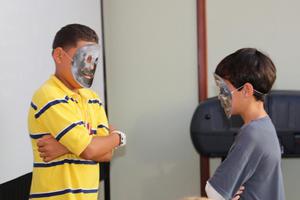
Lunar Day
astroEDU educational activity (links to astroEDU website) Description: Through a fun-learning activity, understand why moon always keeps the same face towards Earth.
License: CC-BY-4.0 Creative Commons Attribution 4.0 International (CC BY 4.0) icons
Tags:
Lunar day
Age Ranges:
4-6
, 6-8
Education Level:
Primary
, Secondary
Areas of Learning:
Modelling
, Simulation focussed
Costs:
Free
Duration:
30 mins
Group Size:
Group
Skills:
Analysing and interpreting data
, Asking questions
, Communicating information
, Constructing explanations
, Developing and using models
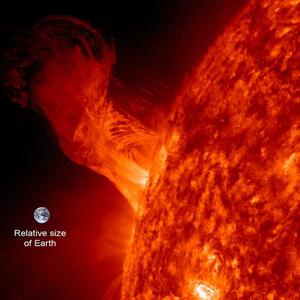
Sun, Earth and Moon Model
astroEDU educational activity (links to astroEDU website) Description: Build an Earth-Moon-Sun mobile to learn about how they orbit.
License: CC-BY-4.0 Creative Commons Attribution 4.0 International (CC BY 4.0) icons
Tags:
Hands-on
, Model
Age Ranges:
8-10
Education Level:
Primary
Areas of Learning:
Game-mediated learning
, Modelling
, Structured-inquiry learning
Costs:
Medium Cost
Duration:
1 hour 30 mins
Group Size:
Group
Skills:
Asking questions
, Communicating information
, Developing and using models
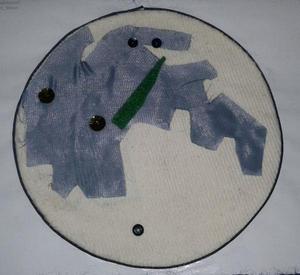
Children's Planetary Maps: The Moon
astroEDU educational activity (links to astroEDU website) Description: An up close look at our own satellite
License: CC-BY-4.0 Creative Commons Attribution 4.0 International (CC BY 4.0) icons
Tags:
Maps
, Planetary cartography
, Spatial thinking
Age Ranges:
6-8
, 8-10
, 10-12
, 12-14
Education Level:
Middle School
, Primary
, Secondary
Areas of Learning:
Structured-inquiry learning
Costs:
Low Cost
Duration:
2 hours
Group Size:
Group
Skills:
Analysing and interpreting data
, Asking questions
, Communicating information
, Constructing explanations
, Developing and using models
, Engaging in argument from evidence
, Planning and carrying out investigations