词条 电磁辐射
描述: 当19世纪的物理学家在描述电磁现象时发现,即使在附近没有电荷的情况下,电场和磁场也能以光速在空间传播。这些波被称为电磁波或电磁辐射。基本电磁波可根据其波长进行分类,由此产生的电磁波谱从较短波长到较长波长包括:伽马射线、X射线、紫外线、可见光、红外线、亚毫米波和射电波(包括毫米波/微波)。来自遥远天体的电磁辐射是天文学家了解这些天体的最重要的信息来源。
相关词条
用其他语言查看该词条
词条和定义状态: 该术语的英文原始定义已通过天文研究人员和教师的审核 该术语及其定义的译文仍待审核
OAE多语言词汇表是由国际天文学联合会(IAU) 天文教育办公室(OAE) 和 国际天文学联合会(IAU) 天文推广办公室(OAO)合作的项目。. 术语和定义由 OAE中心, OAE 国家天文教育协调员(NAECs) 以及其他志愿者共同选择、撰写和审阅。您可以在 找到完整的致谢列表。所有词汇表术语及其定义均根据 Creative Commons CC BY-4.0许可证发布 且版权归属于 “IAU OAE”。
如果您发现此词汇术语或定义中的事实或翻译错误, 请向 发邮件 联系.
其他语言版本
- 阿拉伯语: الإشعاع الكهرومغناطيسي
- 德语: Elektromagnetische Strahlung
- 英语: Electromagnetic Radiation
- 西班牙语: Radiación electromagnética
- 法语: Rayonnement électromagnétique
- 北印度语: इलेक्ट्रोमॅग्नेटिक रेडिएशन (विद्युतचुंबकीय विकिरण)
- 意大利语: Radiazione elettromagnetica
- 日语: 放射 (外部链接)
- 韩语: 전자기복사
- 马拉地语: इलेक्ट्रोमॅग्नेटिक रेडिएशन (विद्युत चुंबकीय विकिरण)
- 巴西葡萄牙语: Radiação eletromagnética
- 繁体中文: 電磁輻射
相关图表
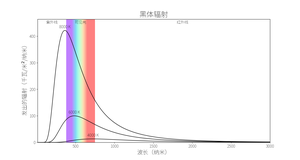
黑体辐射
图注: 不同温度黑体的辐射曲线。x 轴表示波长,y 轴表示黑体表面每平方米在每个波长下每秒发射的能量。
温度越高的物体,波长越短,发出的最大能量光也越蓝。尽管图中最冷的天体发出的红光达到峰值,但其他较热的天体发出的红光都比最冷的天体多。
来源: IAU OAE/Niall Deacon
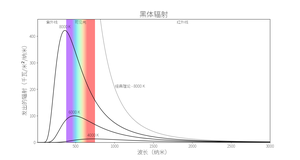
黑体辐射--紫外线灾难
图注: 不同温度黑体的辐射曲线。x 轴表示波长,y 轴表示黑体表面每平方米在每个波长下每秒发射的能量。
温度越高的物体,波长越短,发出的最大能量光也越蓝。尽管图中最冷的天体发出的红光达到峰值,但其他较热的天体发出的红光都比最冷的天体多。
虚线显示的是现代量子力学之前的经典理论所预测的辐射量。对于任何温度高于零的黑体,这一预测在较短波长处都趋于无穷大,被称为 "紫外线灾难"。
来源: IAU OAE/Niall Deacon
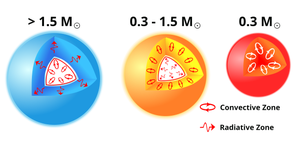
Stellar Structure
图注: Stars are balls of plasma. For most of a star’s life it burns hydrogen into helium in its core. This phase of a star’s life is known as the main sequence. Burning hydrogen into helium produces heat, that heat travels out of the star’s core eventually reaching the star’s photosphere (often referred to as the “surface” of the star). From here the heat can radiate into space as various forms of electromagnetic radiation. However, how heat travels from the core to the photosphere depends on the star’s mass.
Imagine a parcel of gas rising inside a star. As it rises, it moves into an area of lower pressure, so it cools down and expands. If the parcel is still hotter, and therefore less dense than its surroundings, it keeps moving upward due to buoyancy. Eventually, it will rise far enough to cool and sink back down. This rising and sinking cycle is called convection. Whether convection occurs depends on how quickly temperature changes as you move away from the star’s core. If the temperature in a star drops rapidly, rising parcels of gas are more likely to stay hotter than their surroundings, so convection dominates as the mode of energy transfer in this part of the star. Conversely if the temperature drops more slowly (i.e. if the temperature gradient is small) then heat will mostly be transferred by radiation (photons).
In the most massive main sequence stars (more massive than about 1.5 times the mass of the Sun, seen here on the left), hydrogen is burned into helium using the CNO cycle. This is highly temperature dependent and thus energy production is concentrated near the center of the star. This leads to a larger temperature gradient and thus a convective core. Further out the temperature gradient becomes smaller and heat transport is dominated by radiation. This is called the radiative zone.
For lower mass stars like the Sun (between 0.3 and 1.5 solar masses, seen here in the middle) hydrogen is burned to helium using a different process (the pp chain). This depends less on the internal temperature than the CNO cycle and so energy production is more distributed in the star’s core. This leads to a smaller temperature gradient and thus a radiative core where convection occurs surrounded by a radiative zone. Going further out the gas becomes cool enough for some elements to hang to on some of their electrons, i.e. not being completely ionised. This partially ionised gas is more opaque to photons, trapping heat. This leads to a large temperature gradient and thus convection.
The lowest mass stars (below 0.3 solar masses, seen here on the right) have no radiative zone and are fully convective.
The arrows in the radiative zone are shown as wavy lines heading out of the star. However, a photon’s journey out of a star is much more complex with each individual photon travelling only a short distance before being deflected by some of the charged particles that make up the plasma of the star’s interior. This leads to a long and winding road that takes millennia instead of the few seconds it would take if the photon did not interact with particles in the plasma.
来源: Based on a vector diagram by Wikimedia user Д.Ильин which itself is based on a diagram from sun.org