词条 可见光谱
描述: 波长在 380 到 750 纳米之间的电磁辐射是人眼可见的,称为可见光。如果把电磁辐射分成光谱,按波长排列所有不同种类的辐射,并绘制出每个波长区域内到达我们的辐射量,那么光谱中介于 380 纳米和 750 纳米之间的部分就是可见光谱。从波长最短到最长,我们可以看到紫光、靛蓝光、蓝光、绿光、黄光、橙光和红光,它们连续排列在一起--这就是彩虹的颜色,大自然通过太阳光在小水滴中的折射,形成了这样的光谱组成。
相关词条
用其他语言查看该词条
词条和定义状态: 该术语的英文原始定义已通过天文研究人员和教师的审核 该术语及其定义的译文仍待审核
OAE 多语言词汇表是由国际天文学联合会(IAU) 天文教育办公室(OAE) 和 国际天文学联合会(IAU) 天文推广办公室(OAO)合作的项目。. 术语和定义由 OAE中心, OAE 国家天文教育协调员(NAECs) 以及其他志愿者共同选择、撰写和审阅。您可以在 找到完整的致谢列表。所有词汇表术语及其定义均根据 Creative Commons CC BY-4.0许可证发布 且版权归属于 "IAU OAE"。
如果您发现此词汇术语或定义中的事实或翻译错误, 请向 发邮件 联系.
其他语言版本
- 阿拉伯语: الطيف المرئي
- 德语: Sichtbares Spektrum
- 英语: Visible Spectrum
- 西班牙语: Espectro visible
- 法语: Spectre visible
- 意大利语: Spettro visibile
- 巴西葡萄牙语: Espectro visível
- 繁体中文: 可見光譜
相关媒体

The Pillars of Creation in comparison
图注: The 'Pillars of Creation' are a renowned astronomical feature situated within the Eagle Nebula in the Serpens constellation. The illustration provides a direct comparison between images captured by the Hubble Space Telescope (HST) and the James Webb Space Telescope (JWST), showcasing the pillars, which span several light years in diameter, in both visible light (also known as optical light) and infrared light. On the left are the pillars as seen by Hubble in visual light, taken in 2014. It displays dark pillars against an opaque background, with only a handful of visible stars. Conversely, the counterpart on the right is Webb’s near-infrared view published in 2022, penetrating the dust and revealing numerous stars of varying sizes.
Their distance from Earth is approximately 6,500 to 7,000 light years. Within these pillars, new stars are constantly forming, making them a subject of extensive study by astronomers. Composed mostly of cool molecular hydrogen and small amounts of interstellar dust, they are subject to erosion by the intense ultraviolet radiation emitted by nearby massive and newborn stars, a process known as photoevaporation.
来源: NASA, ESA, CSA, STScI
来源链接
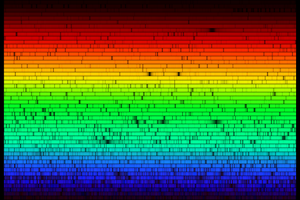
Solar absorption lines
图注: This is a high resolution spectrum of light from our Sun showing visible region of the electromagnetic spectrum. The absorption lines are visible clearly as narrow black regions. The visualization shown here was created to mimic a so-called echelle spectrum, with wavelength increasing from left to right along each strip, and from bottom to top. Each of the 50 horizontal strips covers 6 nanometers, for a complete spectrum across the visible range from 400 to 700 nanometers.
This spectrum was created from a digital atlas observed with the Fourier Transform Spectrometer at the McMath-Pierce Solar Facility at the National Solar Observatory on Kitt Peak, near Tucson, Arizona (‘Solar Flux Atlas from 296 to 1300 nm" by Robert L. Kurucz, Ingemar Furenlid, James Brault, and Larry Testerman: National Solar Observatory Atlas No. 1, June 1984).
Note: NSO/Kitt Peak FTS data used here were produced by NSF/NOAO.
来源: N.A. Sharp/KPNO/NOIRLab/NSO/NSF/AURA
来源链接
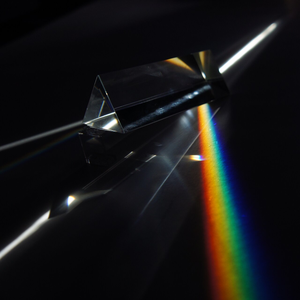
Light Dispersion by a Triangular Prism
图注: This photograph shows a prism splitting a beam of white light into its component colors — a beautiful demonstration of optics, the branch of physics that studies how light behaves and interacts with materials. When white light enters the prism, different wavelengths (colors) bend by different amounts because of a process called refraction. This separation of colors produces a spectrum — similar to a rainbow — revealing that white light is actually made up of many colors combined going from blue, through green and yellow to red.
Understanding optics helps scientists and engineers design lenses, microscopes, telescopes, cameras, and many other tools that shape and control light for practical use. The way the prism disperses light into a spectrum is the same principle that makes rainbows form in the sky when sunlight passes through raindrops.
来源: Kelvinsong
来源链接
License: CC0 CC0 1.0 通用 (CC0 1.0) 公共领域贡献 图标







.png)
.jpg)