Glossar-Begriff: Elektromagnetische Strahlung
Beschreibung: Als die Physiker des 19. Jahrhunderts elektrische und magnetische Phänomene beschrieben, fanden sie heraus, dass sich Muster aus elektrischen und magnetischen Feldern gemeinsam mit Lichtgeschwindigkeit durch den Raum ausbreiten können, selbst wenn keine elektrischen Ladungen in der Nähe sind. Diese Muster werden als elektromagnetische Wellen oder elektromagnetische Strahlung bezeichnet. Elektromagnetische Wellen können je nach Wellenlänge klassifiziert werden. Das sich daraus ergebende elektromagnetische Spektrum umfasst, von kürzeren zu längeren Wellenlängen: Gammastrahlen, Röntgenstrahlen, Ultraviolett, sichtbares Licht, Infrarot, Submillimeter- und Radiowellen (einschließlich Millimeter-/Mikrowellen). Die elektromagnetische Strahlung von weit entfernten astronomischen Objekten ist für Astronominnen und Astronomen die wichtigste Informationsquelle über diese Objekte.
Ähnliche Begriffe:
- Elektromagnetische Kraft
- Gammastrahl
- Infrarot (IR)
- Licht
- Mikrowellen
- Ultraviolett
- Sichtbares Spektrum
- Submillimeter-Astronomie
- Röntgenstrahlung
Dieser Begriff in anderen Sprachen
Begriffs- und Definitionsstatus Die Originaldefinition dieses Begriffes auf Englisch wurden von einem forschenden Astronom und einer Lehrkraft bestätigt Die Übersetzung dieses Begriffs und seiner Definition warten auf Prüfung und Bestätigung
The OAE Multilingual Glossary is a project of the IAU Office of Astronomy for Education (OAE) in collaboration with the IAU Office of Astronomy Outreach (OAO). The terms and definitions were chosen, written and reviewed by a collective effort from the OAE, the OAE Centers and Nodes, the OAE National Astronomy Education Coordinators (NAECs) and other volunteers. You can find a full list of credits here. All glossary terms and their definitions are released under a Creative Commons CC BY-4.0 license and should be credited to "IAU OAE".
Wenn dir ein inhaltlicher oder Übersetzungsfehler in diesem Glossarbegriff oder dieser Definition auffallen, bitte kontaktiere uns.
Auf anderen Sprachen
- Arabisch: الإشعاع الكهرومغناطيسي
- Englisch: Electromagnetic Radiation
- Spanisch: Radiación electromagnética
- Französisch: Rayonnement électromagnétique
- Hindi: इलेक्ट्रोमॅग्नेटिक रेडिएशन (विद्युतचुंबकीय विकिरण)
- Italienisch: Radiazione elettromagnetica
- Japanisch: 放射 (externer Link)
- Koreanisch: 전자기복사
- Marathi: इलेक्ट्रोमॅग्नेटिक रेडिएशन (विद्युत चुंबकीय विकिरण)
- Brasilianisches Portugiesisch: Radiação eletromagnética
- Vereinfachtes Chinesisch: 电磁辐射
- Traditionelles Chinesisch: 電磁輻射
Ähnliche Diagramme
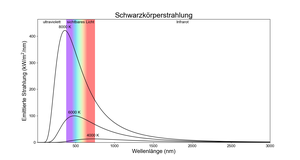
Schwarzkörperstrahlung
Unterschrift: Die Kurven der emittierten Strahlung von Schwarzen Körpern unterschiedlicher Temperatur. Die x-Achse zeigt die Wellenlänge und die y-Achse die Energiemenge, die pro Sekunde von einem Quadratmeter der Oberfläche dieses Schwarzen Körpers bei jeder Wellenlänge abgegeben wird. Je heißer der Körper ist, desto kürzer ist die Wellenlänge und desto blauer ist das Licht, bei dem er seine maximale Energiemenge abgibt. Obwohl der kühlste Körper in diesem Diagramm ein Maximum im roten Licht aufweist, strahlen die anderen heißeren Körper alle mehr rotes Licht ab als der kühlste Körper.
Bild: IAU OAE/Niall Deacon
License: CC-BY-4.0 Creative Commons Namensnennung 4.0 International (CC BY 4.0) Symbole
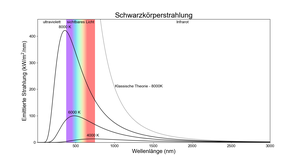
Schwarzkörperstrahlung - UV-Katastrophe
Unterschrift: Die Kurven der emittierten Strahlung von Schwarzen Körpern unterschiedlicher Temperatur. Die x-Achse zeigt die Wellenlänge und die y-Achse die Energiemenge, die pro Sekunde von einem Quadratmeter der Oberfläche dieses Schwarzen Körpers bei jeder Wellenlänge abgegeben wird. Je heißer der Körper ist, desto kürzer ist die Wellenlänge und desto blauer ist das Licht, bei dem er seine maximale Energiemenge abgibt. Obwohl der kühlste Körper in diesem Diagramm ein Maximum im roten Licht aufweist, strahlen die anderen heißeren Körper alle mehr rotes Licht ab als der kälteste Körper. Die gepunktete Linie zeigt die Strahlung, die von der klassischen Theorie vor der modernen Quantenmechanik vorhergesagt wurde. Diese Vorhersage tendiert bei kürzeren Wellenlängen für jede Schwarzkörpertemperatur über Null gegen unendlich und wurde als "Ultraviolettkatastrophe" bezeichnet.
Bild: IAU OAE/Niall Deacon
License: CC-BY-4.0 Creative Commons Namensnennung 4.0 International (CC BY 4.0) Symbole
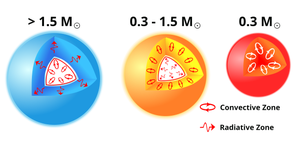
Stellar Structure
Unterschrift: Stars are balls of plasma. For most of a star’s life it burns hydrogen into helium in its core. This phase of a star’s life is known as the main sequence. Burning hydrogen into helium produces heat, that heat travels out of the star’s core eventually reaching the star’s photosphere (often referred to as the “surface” of the star). From here the heat can radiate into space as various forms of electromagnetic radiation. However, how heat travels from the core to the photosphere depends on the star’s mass.
Imagine a parcel of gas rising inside a star. As it rises, it moves into an area of lower pressure, so it cools down and expands. If the parcel is still hotter, and therefore less dense than its surroundings, it keeps moving upward due to buoyancy. Eventually, it will rise far enough to cool and sink back down. This rising and sinking cycle is called convection. Whether convection occurs depends on how quickly temperature changes as you move away from the star’s core. If the temperature in a star drops rapidly, rising parcels of gas are more likely to stay hotter than their surroundings, so convection dominates as the mode of energy transfer in this part of the star. Conversely if the temperature drops more slowly (i.e. if the temperature gradient is small) then heat will mostly be transferred by radiation (photons).
In the most massive main sequence stars (more massive than about 1.5 times the mass of the Sun, seen here on the left), hydrogen is burned into helium using the CNO cycle. This is highly temperature dependent and thus energy production is concentrated near the center of the star. This leads to a larger temperature gradient and thus a convective core. Further out the temperature gradient becomes smaller and heat transport is dominated by radiation. This is called the radiative zone.
For lower mass stars like the Sun (between 0.3 and 1.5 solar masses, seen here in the middle) hydrogen is burned to helium using a different process (the pp chain). This depends less on the internal temperature than the CNO cycle and so energy production is more distributed in the star’s core. This leads to a smaller temperature gradient and thus a radiative core where convection occurs surrounded by a radiative zone. Going further out the gas becomes cool enough for some elements to hang to on some of their electrons, i.e. not being completely ionised. This partially ionised gas is more opaque to photons, trapping heat. This leads to a large temperature gradient and thus convection.
The lowest mass stars (below 0.3 solar masses, seen here on the right) have no radiative zone and are fully convective.
The arrows in the radiative zone are shown as wavy lines heading out of the star. However, a photon’s journey out of a star is much more complex with each individual photon travelling only a short distance before being deflected by some of the charged particles that make up the plasma of the star’s interior. This leads to a long and winding road that takes millennia instead of the few seconds it would take if the photon did not interact with particles in the plasma.
Bild: Based on a vector diagram by Wikimedia user Д.Ильин which itself is based on a diagram from sun.org
License: CC-BY-4.0 Creative Commons Namensnennung 4.0 International (CC BY 4.0) Symbole
Ähnliche Aktivitäten
Das Leben eines Astronomen beim VLT
astroEDU educational activity (links to astroEDU website) Description: Mit Hilfe von erklärenden Texten, Versuchen, Fragen und Aufgaben sollen die Schüler die physikalischen Begriffe Luftdruck und Luftfeuchtigkeit erarbeiten.
Altersgruppen: 14-16 Bildungsniveau: Secundaria