词条 透镜状星系
描述: 透镜状一词用于描述具有透镜形状的天体。透镜状(S0或SB0)星系同时具备螺旋星系和椭圆星系的观测特征。透镜状星系看起来拥有类似于螺旋星系的盘状结构和中央凸起,但没有明显的螺旋臂;同时,它们主要由老年恒星组成,就像椭圆星系中占主导地位的恒星一样。透镜状星系的形成过程仍然是研究的热点,而已有一些证据表明,这些星系可能是由星系相互作用产生的结果。
相关词条
用其他语言查看该词条
词条和定义状态: 该术语的英文原始定义已通过天文研究人员和教师的审核 该术语及其定义的译文仍待审核
OAE多语言词汇表是由国际天文学联合会(IAU) 天文教育办公室(OAE) 和 国际天文学联合会(IAU) 天文推广办公室(OAO)合作的项目。. 术语和定义由 OAE中心, OAE 国家天文教育协调员(NAECs) 以及其他志愿者共同选择、撰写和审阅。您可以在 找到完整的致谢列表。所有词汇表术语及其定义均根据 Creative Commons CC BY-4.0许可证发布 且版权归属于 “IAU OAE”。
如果您发现此词汇术语或定义中的事实或翻译错误, 请向 发邮件 联系.
其他语言版本
- 阿拉伯语: المجرة العدسية
- 德语: Linsenförmige Galaxie
- 英语: Lenticular Galaxy
- 西班牙语: Galaxia lenticular
- 法语: Galaxie lenticulaire
- 意大利语: Galassia lenticolare
- 日语: レンズ状銀河 (外部链接)
- 韩语: 렌즈형은하
- 巴西葡萄牙语: Galáxia Lenticular
- 繁体中文: 透鏡狀星系
相关媒体

The Lenticular Galaxy NGC 2787
图注: The lenticular galaxy NGC 2787. This galaxy is a disk galaxy but lacks the large, dominant spiral arm structure seen in the disks of spiral galaxies. Its core is very bright compared to the core of a spiral galaxy. Thin rings of dust can be seen in the galaxy's disk.
来源: NASA/ESA and The Hubble Heritage Team
来源链接
相关图表
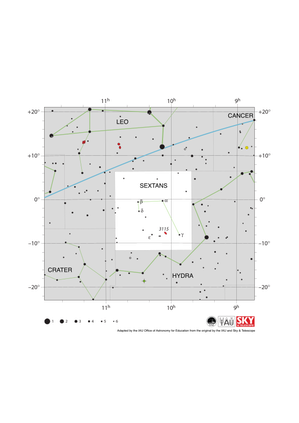
Sextans Constellation Map
图注: The constellation Sextans with its brighter stars and surrounding constellations. Sextans is surrounded by (going clockwise from the top): Leo, Hydra and Crater. Sextans is a small constellation with relatively few bright stars.
Sextans spans the celestial equator and thus parts of the constellation are visible at some point in the year across the Earth. The whole constellation is visible in all but the most arctic and most antarctic regions. Sextans is best viewed in the evening in the northern hemisphere spring and southern hemisphere autumn.
The lenticular galaxy NGC 3115 lies in Sextans. It is marked here with a red ellipse.
The y-axis of this diagram is in degrees of declination with north as up and the x-axis is in hours of right ascension with east to the left. The sizes of the stars marked here relate to the star's apparent magnitude, a measure of its apparent brightness. The larger dots represent brighter stars. The Greek letters mark the brightest stars in the constellation. These are ranked by brightness with the brightest star being labeled alpha, the second brightest beta, etc., although this ordering is not always followed exactly. The dotted boundary lines mark the IAU's boundaries of the constellations and the solid green lines mark one of the common forms used to represent the figures of the constellations. The blue line at the top of the diagram marks the ecliptic. Neither the constellation boundaries, nor the lines joining the stars, nor the ecliptic, appear on the sky.
来源: Adapted by the IAU Office of Astronomy for Education from the original by the IAU and Sky & Telescope