Glossar-Begriff: Linsenförmige Galaxie
Beschreibung: Der Begriff "linsenförmig" oder "lentikulär" wird verwendet, um Objekte zu beschreiben, die eine Linsenform haben. Lentikuläre (S0 oder SB0) Galaxien weisen Beobachtungsmerkmale sowohl von Spiral- als auch von elliptischen Galaxien auf. Linsenförmige Galaxien scheinen eine Scheibe und eine zentrale Wölbung (Bulge) zu haben, ähnlich wie Spiralgalaxien, aber keine erkennbaren Spiralarme. Sie enthalten auch überwiegend sehr alte Sterne, genau wie elliptische Galaxien. Es ist noch nicht genau verstanden, wie linsenförmige Galaxien entstehen. Es gibt jedoch einige Hinweise darauf, dass sie durch die Wechselwirkung zwischen Galaxien entstehen.
Ähnliche Begriffe:
Dieser Begriff in anderen Sprachen
Begriffs- und Definitionsstatus Die Originaldefinition dieses Begriffes auf Englisch wurden von einem forschenden Astronom und einer Lehrkraft bestätigt Die Übersetzung dieses Begriffs und seiner Definition warten auf Prüfung und Bestätigung
The OAE Multilingual Glossary is a project of the IAU Office of Astronomy for Education (OAE) in collaboration with the IAU Office of Astronomy Outreach (OAO). The terms and definitions were chosen, written and reviewed by a collective effort from the OAE, the OAE Centers and Nodes, the OAE National Astronomy Education Coordinators (NAECs) and other volunteers. You can find a full list of credits here. All glossary terms and their definitions are released under a Creative Commons CC BY-4.0 license and should be credited to "IAU OAE".
Wenn dir ein inhaltlicher oder Übersetzungsfehler in diesem Glossarbegriff oder dieser Definition auffallen, bitte kontaktiere uns.
Auf anderen Sprachen
- Arabisch: المجرة العدسية
- Englisch: Lenticular Galaxy
- Spanisch: Galaxia lenticular
- Französisch: Galaxie lenticulaire
- Italienisch: Galassia lenticolare
- Japanisch: レンズ状銀河 (externer Link)
- Koreanisch: 렌즈형은하
- Brasilianisches Portugiesisch: Galáxia Lenticular
- Vereinfachtes Chinesisch: 透镜状星系
- Traditionelles Chinesisch: 透鏡狀星系
Ähnliche Medien

Die Linsengalaxie NGC 2787
Unterschrift: Die linsenförmige Galaxie NGC 2787. Diese Galaxie ist eine Scheibengalaxie, der jedoch die große, dominante Spiralarmstruktur fehlt, die man in den Scheiben von Spiralgalaxien sieht. Ihr Kern ist im Vergleich zum Kern einer Spiralgalaxie sehr hell. In der Scheibe der Galaxie sind dünne Ringe aus Staub zu sehen.
Bild: NASA/ESA und das Hubble-Erbe-Team
Quellenlink
License: CC-BY-4.0 Creative Commons Namensnennung 4.0 International (CC BY 4.0) Symbole
Ähnliche Diagramme
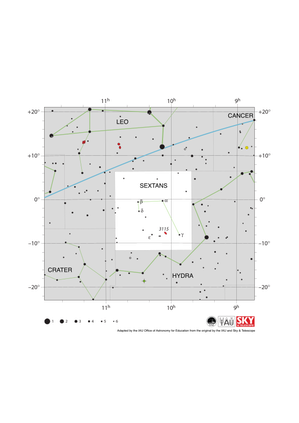
Sextans Constellation Map
Unterschrift: The constellation Sextans with its brighter stars and surrounding constellations. Sextans is surrounded by (going clockwise from the top): Leo, Hydra and Crater. Sextans is a small constellation with relatively few bright stars.
Sextans spans the celestial equator and thus parts of the constellation are visible at some point in the year across the Earth. The whole constellation is visible in all but the most arctic and most antarctic regions. Sextans is best viewed in the evening in the northern hemisphere spring and southern hemisphere autumn.
The lenticular galaxy NGC 3115 lies in Sextans. It is marked here with a red ellipse.
The y-axis of this diagram is in degrees of declination with north as up and the x-axis is in hours of right ascension with east to the left. The sizes of the stars marked here relate to the star's apparent magnitude, a measure of its apparent brightness. The larger dots represent brighter stars. The Greek letters mark the brightest stars in the constellation. These are ranked by brightness with the brightest star being labeled alpha, the second brightest beta, etc., although this ordering is not always followed exactly. The dotted boundary lines mark the IAU's boundaries of the constellations and the solid green lines mark one of the common forms used to represent the figures of the constellations. The blue line at the top of the diagram marks the ecliptic. Neither the constellation boundaries, nor the lines joining the stars, nor the ecliptic, appear on the sky.
Bild: Adapted by the IAU Office of Astronomy for Education from the original by the IAU and Sky & Telescope
License: CC-BY-4.0 Creative Commons Namensnennung 4.0 International (CC BY 4.0) Symbole