Término del glosario: Galaxia lenticular
Descripción: El término «lenticular» se utiliza para describir objetos que tienen forma de lente. Las galaxias lenticulares (S0 o SB0) presentan características observacionales tanto de las galaxias espirales como de las elípticas. Las galaxias lenticulares parecen tener un disco y un bulbo central similares a los de las galaxias espirales, pero carecen de brazos espirales evidentes; además, están compuestas principalmente por estrellas muy viejas, como las que predominan en las galaxias elípticas. El proceso de formación de las galaxias lenticulares sigue siendo objeto de investigación; sin embargo, hay indicios de que son el resultado de la interacción entre galaxias.
Términos relacionados:
Ver este término en otros idiomas
Estado del término y la definición: La definición original de este término en inglés ha sido aprobada por unastrónomo o astrónoma investigadora y un docente La traducción de este término y su definición aún están pendientes de aprobación
El Glosario multilingüe de la OAE es un proyecto de la Oficina de Astronomía para la Educación de la UAI (OAE) en colaboración con la Oficina de Divulgación de Astronomía de la UAI (OAO). Los términos y definiciones fueron seleccionados, redactados y revisados gracias al esfuerzo colectivo de la OAE, los Centros y Nodos de la OAE, los Coordinadores Nacionales de Educación Astronómica (NAECs) y otros voluntarios. Puedes encontrar una lista completa de créditos aquí. Todos los términos del glosario y sus definiciones se publican bajo la licencia Creative Commons CC BY-4.0 y deben atribuirse a la "IAU OAE".
Si detectas algún error de contenido o de traducción en este término del glosario o en ladefinición, ponte en contacto con nosotros.
En otros idiomas
- Árabe: المجرة العدسية
- Alemán: Linsenförmige Galaxie
- Inglés: Lenticular Galaxy
- Francés: Galaxie lenticulaire
- Italiano: Galassia lenticolare
- Japonés: レンズ状銀河 (enlace externo)
- Coreano: 렌즈형은하
- Portugués de Brasil: Galáxia Lenticular
- Chino simplificado: 透镜状星系
- Chino tradicional: 透鏡狀星系
Contenidos relacionados

La galaxia lenticular NGC 2787
Pie de foto: La galaxia lenticular NGC 2787. Esta galaxia es una galaxia de disco, pero carece de la estructura dominante de grandes brazos espirales que se observa en los discos de las galaxias espirales. Su núcleo es muy brillante en comparación con el núcleo de una galaxia espiral. En el disco de la galaxia se pueden observar anillos delgados de polvo.
Crédito: NASA/ESA y The Hubble Heritage Team
enlace de crédito
License: CC-BY-4.0 Creative Commons Reconocimiento 4.0 Internacional (CC BY 4.0) íconos
Diagramas relacionados
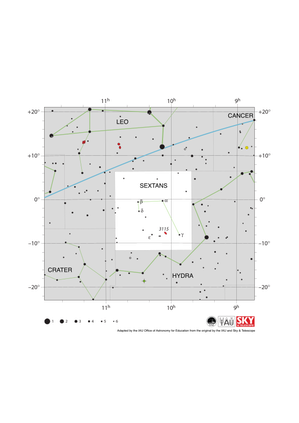
Sextans Constellation Map
Pie de foto: The constellation Sextans with its brighter stars and surrounding constellations. Sextans is surrounded by (going clockwise from the top): Leo, Hydra and Crater. Sextans is a small constellation with relatively few bright stars.
Sextans spans the celestial equator and thus parts of the constellation are visible at some point in the year across the Earth. The whole constellation is visible in all but the most arctic and most antarctic regions. Sextans is best viewed in the evening in the northern hemisphere spring and southern hemisphere autumn.
The lenticular galaxy NGC 3115 lies in Sextans. It is marked here with a red ellipse.
The y-axis of this diagram is in degrees of declination with north as up and the x-axis is in hours of right ascension with east to the left. The sizes of the stars marked here relate to the star's apparent magnitude, a measure of its apparent brightness. The larger dots represent brighter stars. The Greek letters mark the brightest stars in the constellation. These are ranked by brightness with the brightest star being labeled alpha, the second brightest beta, etc., although this ordering is not always followed exactly. The dotted boundary lines mark the IAU's boundaries of the constellations and the solid green lines mark one of the common forms used to represent the figures of the constellations. The blue line at the top of the diagram marks the ecliptic. Neither the constellation boundaries, nor the lines joining the stars, nor the ecliptic, appear on the sky.
Crédito: Adapted by the IAU Office of Astronomy for Education from the original by the IAU and Sky & Telescope
License: CC-BY-4.0 Creative Commons Reconocimiento 4.0 Internacional (CC BY 4.0) íconos