词条 盘状星系
描述: 盘状星系是一类星系,其特征是拥有一个由恒星、气体和尘埃组成的扁平结构,这些成分都围绕星系中心做共面圆周运动。盘状星系中通常存在螺旋臂及相关的恒星形成活动。在大多数星系分类体系中,盘状星系与椭圆星系、不规则星系和矮星系有所区别。
相关词条
用其他语言查看该词条
词条和定义状态: 该术语的英文原始定义已通过天文研究人员和教师的审核 该术语及其定义的译文仍待审核
OAE多语言词汇表是由国际天文学联合会(IAU) 天文教育办公室(OAE) 和 国际天文学联合会(IAU) 天文推广办公室(OAO)合作的项目。. 术语和定义由 OAE中心, OAE 国家天文教育协调员(NAECs) 以及其他志愿者共同选择、撰写和审阅。您可以在 找到完整的致谢列表。所有词汇表术语及其定义均根据 Creative Commons CC BY-4.0许可证发布 且版权归属于 “IAU OAE”。
如果您发现此词汇术语或定义中的事实或翻译错误, 请向 发邮件 联系.
其他语言版本
- 阿拉伯语: المجرة القرصية
- 德语: Scheibengalaxie
- 英语: Disk Galaxy
- 西班牙语: Galaxia de disco
- 法语: Galaxie à disque
- 意大利语: Galassia a disco
- 日语: 円盤銀河 (外部链接)
- 韩语: 원반은하
- 巴西葡萄牙语: Disco Galaxy
- 繁体中文: 盤狀星系
相关媒体
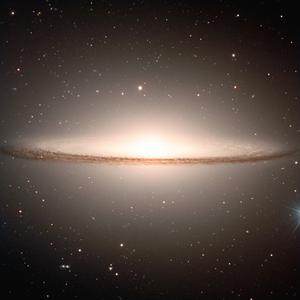
草帽星系
图注: 由于这个著名的星系M104 与墨西哥帽子非常相似,因此经常被称为 "草帽星系"。它之所以看起来是这个样子,是由于我们观测的视角几乎平行于薄盘的平面,薄盘/星系盘 被星系的核球所照亮。星系盘和核球都含有恒星,但核球中的恒星往往比较老。星系盘中蕴含有大量的尘埃和气体,从而形成了阴影。M104 位于室女座,距离我们大约 50 光年。图中可见的小点有些是前景恒星,有些是背景星系,但实际上大部分都是球状星团,它们是与草帽星系相关的致密大质量恒星团。
来源: ESO/P.巴特尔
来源链接

A visible light image of the Andromeda Galaxy
图注: The Andromeda Galaxy viewed in visible light. Like our Milky Way, Andromeda is a barred spiral galaxy. Here we can see its bright core and spiral disk. The glow from the stars in the disk is interrupted by lanes of dust that form part of its spiral structure.
Andromeda is the largest galaxy in the Local Group of galaxies that includes the Milky Way.
To the left of the core and just above the disk we see the dwarf galaxy M32 and to the right and below the disk we see the dwarf galaxy M110. These are both satellite galaxies of the Andromeda Galaxy.
来源: Torben Hansen
来源链接

The Lenticular Galaxy NGC 2787
图注: The lenticular galaxy NGC 2787. This galaxy is a disk galaxy but lacks the large, dominant spiral arm structure seen in the disks of spiral galaxies. Its core is very bright compared to the core of a spiral galaxy. Thin rings of dust can be seen in the galaxy's disk.
来源: NASA/ESA and The Hubble Heritage Team
来源链接

Spiral Galaxy UGC 2885
图注: This image shows UGC 2885, a spiral galaxy located in the constellation Perseus, about 230 million light-years from Earth. Spiral galaxies have rotating disks of stars, gas, and dust, with spiral arms extending outward from the central region. In UGC 2885, these arms are very broad and faint, revealing the galaxy’s large size. This galaxy is tilted at an angle to the observer on Earth, meaning it does not appear as the circular "grand design" spiral it would look like if viewed face-on, nor as the thin line with a central bulge it would appear as if viewed edge-on.
UGC 2885 is remarkable because it is roughly twice the diameter of the Milky Way. It was studied by astronomer Vera Rubin, whose observations of how galaxies rotate — including systems like this one — played a key role in the search for dark matter.
The bright star which appears to the left of the galaxy's center is a foreground object not related to the galaxy.
来源: NASA, ESA, Benne Holwerda (University of Louisville)
来源链接
License: PD 公共领域 图标








.jpg)