This page describes an image Hubble Ultra Deep Field
Download File ( image 8.97 MB)
Image caption:
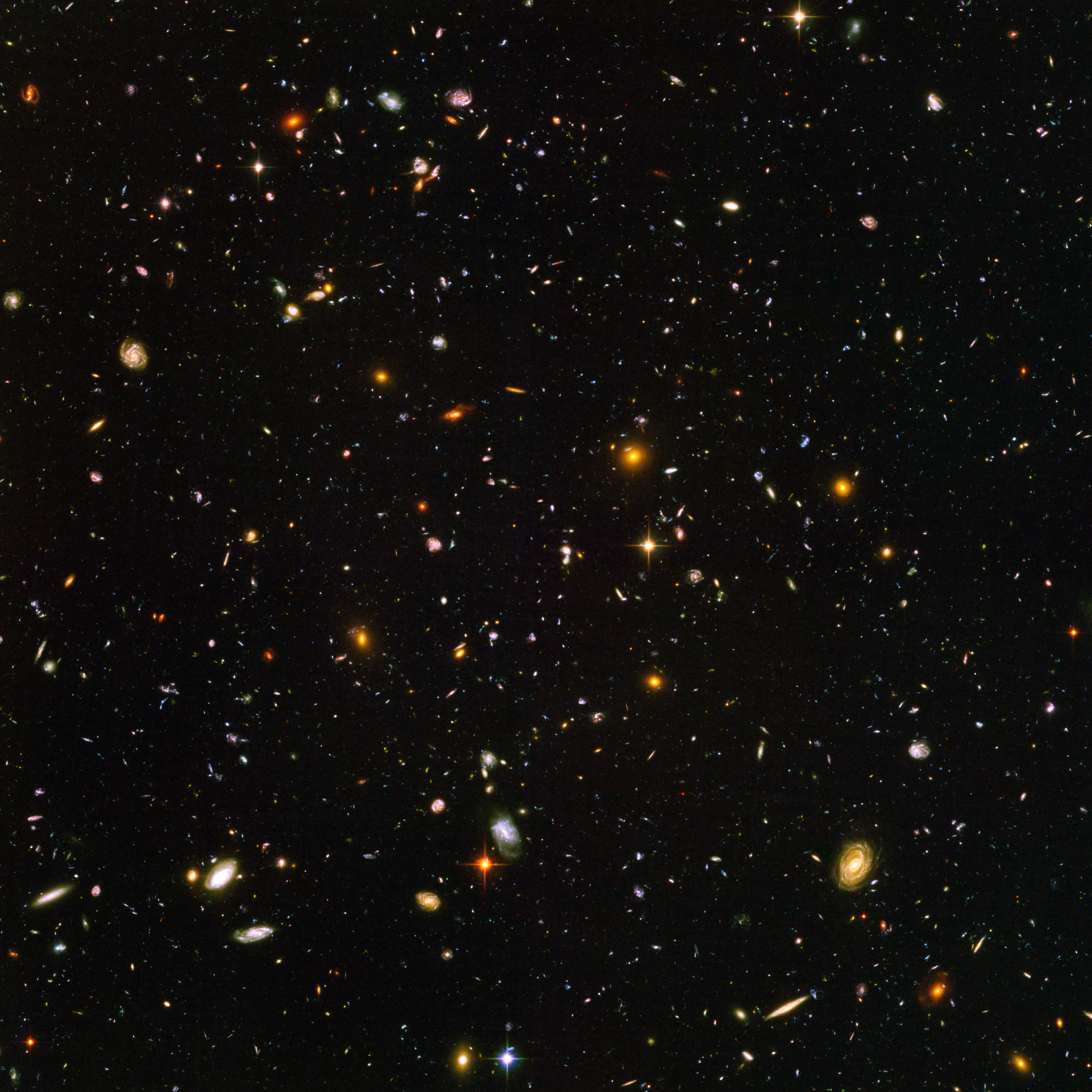
This awe-inspiring image referred to as the Hubble Ultra-Deep Field (HUDF), was obtained using the Hubble Space Telescope (HST), by combining 800 exposures from 400 orbits of the HST, which equates to 11.3 days of total exposure time.
The image shows nearly 10,000 galaxies and was taken in the direction of a patch of sky with the least amount of stars from the Milky Way galaxy in the field of view. The region of sky that the HST observed corresponds to 1/10 the angular size of the Full Moon, which is roughly equal to approximately a 1 millimeter-sized object placed 1 meter away.
Every object in the image, except for the bright points with the crosshairs, are galaxies. As a consequence of the speed of light being a constant in a vacuum, the more distant an object, the further back in time we are observing. Therefore, the light from some of the galaxies in the HUDF image is from when the Universe as only a few hundred million years old. The HUDF image takes us through on a journey through space, and also in time.
Scroll to captions in other languages
Image credit: NASA, ESA, and S. Beckwith (STScI) and the HUDF Team Credit Link
Related glossary terms:
Cosmology
, Cosmos
, Galaxy
, Universe
Categories:
Cosmology
Image license: Creative Commons Attribution 4.0 International (CC BY 4.0) Creative Commons Attribution 4.0 International (CC BY 4.0) icons
The media file captions presented on the OAE website were written, translated and reviewed by a collective effort from the OAE, the OAE Centers and Nodes, the OAE National Astronomy Education Coordinators (NAECs) and other volunteers. You can find a full list of credits for our translation project here. All media file captions are released under a Creative Commons CC BY-4.0 license and should be credited to "IAU OAE". The media files themselves may have different licenses (see above) and should be credited as listed above under "credit".
If you notice a factual error in this caption or an error in any of its translations then please get in touch.
Captions in Different Languages:
Image caption: হাবল আল্ট্রা-ডিপ ফিল্ড (HUDF) হিসাবে উল্লেখ করা এই বিস্ময়কর চিত্রটি হাবল স্পেস টেলিস্কোপ (HST) ব্যবহার করে প্রাপ্ত হয়েছিল, HST এর ৪০০টি কক্ষপথ থেকে ৮০০টি এক্সপোজার একত্রিত করে, যা মোট এক্সপোজার সময়ের ১১.৩ দিনের সমান।
ছবিটি প্রায় ১০,০০০ ছায়াপথ দেখায় এবং দৃশ্যের ক্ষেত্রে মিল্কিওয়ে গ্যালাক্সি থেকে সর্বনিম্ন পরিমাণ তারা সহ আকাশের একটি প্যাচের দিকে নেওয়া হয়েছিল। আকাশের যে অঞ্চলটি HST পর্যবেক্ষণ করেছে তা পূর্ণিমার কৌণিক আকারের ১/১০ এর সাথে মিলে যায়, যা প্রায় ১ মিলিমিটার-আকারের বস্তুর 1 মিটার দূরে রাখা প্রায় সমান।
ক্রসহেয়ার সহ উজ্জ্বল বিন্দুগুলি ব্যতীত চিত্রের প্রতিটি বস্তুই গ্যালাক্সি। শূন্যে আলোর গতি ধ্রুবক হওয়ার ফলস্বরূপ, একটি বস্তু যত বেশি দূরত্বে থাকে, তত বেশি সময় আমরা পর্যবেক্ষণ করছি। অতএব, HUDF চিত্রের কিছু ছায়াপথ থেকে আলো আসে যখন মহাবিশ্বের বয়স মাত্র কয়েকশ মিলিয়ন বছর। HUDF ইমেজ আমাদেরকে মহাকাশের মধ্য দিয়ে ভ্রমণে নিয়ে যায় এবং সময়ের মধ্যেও।
Image credit: NASA, ESA, এবং S. Beckwith (STScI) এবং HUDF টিম
Related glossary terms: Cosmology , Cosmos , Galaxy , Universe Caption translation status: Not yet approved by a reviewer
Caption translators: Raktim Mukherjee
Image caption: Dieses beeindruckende Bild, das als Hubble Ultra-Deep Field (HUDF) bezeichnet wird, wurde mit dem Hubble-Weltraumteleskop (HST) durch die Kombination von 800 Aufnahmen aus 400 Umläufen des HST erzielt, was einer Gesamtbelichtungszeit von 11,3 Tagen entspricht.
Das Bild zeigt fast 10.000 Galaxien und wurde in Richtung eines Himmelsbereichs mit der geringsten Anzahl von Sternen der Milchstraße im Sichtfeld aufgenommen. Die Himmelsregion, die das HST beobachtete, entspricht 1/10 der Winkelgröße des Vollmonds, was ungefähr einem 1 Millimeter großen Objekt in 1 Meter Entfernung entspricht.
Alle Objekte auf dem Bild, mit Ausnahme der hellen Punkte im Fadenkreuz, sind Galaxien. Da die Lichtgeschwindigkeit im Vakuum eine Konstante ist, gilt: Je weiter ein Objekt entfernt ist, desto weiter liegt es in der Zeit zurück, die wir beobachten. Daher stammt das Licht einiger Galaxien auf dem HUDF-Bild aus einer Zeit, als das Universum erst einige hundert Millionen Jahre alt war. Das HUDF-Bild nimmt uns also mit auf eine Reise durch den Raum und die Zeit.
Image credit: NASA, ESA, und S. Beckwith (STScI) und das HUDF-Team
Related glossary terms: Galaxie , Kosmologie , Kosmos , Universum Caption translation status: Not yet approved by a reviewer
Caption translators: Emma Krojanski
Image caption: Cette image impressionnante, appelée Hubble Ultra-Deep Field (HUDF), a été obtenue à l'aide du télescope spatial Hubble (HST), en combinant 800 expositions sur 400 orbites du HST, ce qui équivaut à 11,3 jours de temps d'exposition total.
L'image montre près de 10 000 galaxies et a été prise dans la direction d'une région du ciel où il y a le moins d'étoiles de la Voie lactée dans le champ de vision. La région du ciel observée par le HST correspond à 1/10 de la taille angulaire de la pleine lune, ce qui équivaut approximativement à un objet de la taille d'un millimètre placé à un mètre de distance.
Tous les objets de l'image, à l'exception des points brillants dans le réticule, sont des galaxies. La vitesse de la lumière étant une constante dans le vide, plus un objet est éloigné, plus nous remontons dans le temps. Par conséquent, la lumière de certaines galaxies de l'image HUDF date de l'époque où l'Univers n'avait que quelques centaines de millions d'années. L'image HUDF nous fait voyager dans l'espace, mais aussi dans le temps.
Image credit: NASA, ESA, S. Beckwith (STScI) et l'équipe HUDF
Related glossary terms: Cosmologie , Cosmos , Galaxie , Univers Caption translation status: Not yet approved by a reviewer
Caption translators: Olivier Bonneton
Image caption: Questa maestosa immagine, denominata Hubble Ultra-Deep Field (HUDF), è stata ottenuta con il telescopio spaziale Hubble (HST), combinando 800 esposizioni da 400 orbite dell'HST, pari a 11,3 giorni di esposizione totale.
L'immagine mostra quasi 10.000 galassie ed è stata scattata in direzione di uno spicchio di cielo con la minor quantità di stelle della Via Lattea nel campo visivo. La regione di cielo osservata dall'HST corrisponde a 1/10 della dimensione angolare della Luna piena, che equivale all'incirca a un oggetto delle dimensioni di un millimetro posto a un metro di distanza.
Tutti gli oggetti presenti nell'immagine sono galassie, ad eccezione dei punti luminosi che appaiono a forma di croce. Poiché la velocità della luce è una costante nel vuoto, più un oggetto è distante, più è lontano nel tempo ciò che stiamo osservando. Pertanto, la luce di alcune galassie nell'immagine HUDF risale a quando l'Universo aveva solo poche centinaia di milioni di anni. L'immagine HUDF ci accompagna in un viaggio nello spazio e nel tempo.
Image credit: NASA, ESA, S. Beckwith (STScI) e il team HUDF
Related glossary terms: Cosmo , Cosmologia , Galassia , Universo Caption translation status: Approved by a reviewer
Caption translators: Giuliana Giobbi
Caption reviewers: Rosa Valiante, Rodolfo Canestrari
Image caption: 这幅令人惊叹的图像被称为 "哈勃极深视场"(HUDF),是利用哈勃空间望远镜(HST),通过合并 HST 400 轨、 800 次曝光(相当于 11.3 天的总曝光时间)拍摄获得的。
其中显示了近 10,000 个星系,拍摄方向是视野中银河系恒星数量最少的一片天空。HST 观测到的天空区域相当于满月在天球中大小的 1/10,大致相当于 1 米外约 1 毫米左右的物体。
除了图片中间十字准线上的亮点之外,图像中的每个物体都是星系。由于光速在真空中是一个常数,因此距离越远的物体,我们观测到的时间就越久远。因此,哈勃极深场中一些星系发出的光来自宇宙只有几亿年历史的时候。哈勃极深场引领我们进行了一次时空之旅。
Image credit: NASA, ESA, and S. Beckwith (STScI) and HUDF Team
Related glossary terms: 宇宙 , 宇宙 , 宇宙学 , 银河系 Caption translation status: Not yet approved by a reviewer
Caption translators: Lin Shijie
Image caption: 這幅令人驚嘆的圖像被稱為 "哈勃極深視場"(HUDF),是利用哈勃空間望遠鏡(HST),通過合併 HST 400 軌、 800 次曝光(相當於 11.3 天的總曝光時間)拍攝獲得的。
其中顯示了近 10,000 個星系,拍攝方向是視野中銀河系恆星數量最少的一片天空。HST 觀測到的天空區域相當於滿月在天球中大小的 1/10,大致相當於 1 米外約 1 毫米左右的物體。
除了圖片中間十字準線上的亮點之外,圖像中的每個物體都是星系。由於光速在真空中是一個常數,因此距離越遠的物體,我們觀測到的時間就越久遠。因此,哈勃極深場中一些星系發出的光來自宇宙只有幾億年歷史的時候。哈勃極深場引領我們進行了一次時空之旅。
Image credit: NASA, ESA, and S. Beckwith (STScI) and HUDF Team
Related glossary terms: 宇宙 , 宇宙 , 宇宙學 , 銀河系 Caption translation status: Not yet approved by a reviewer
Caption translators: An automated transliteration from the simplified Chinese translation by - Lin Shijie