Terme du glossaire : Galaxie
Description : Une galaxie est un système d'étoiles, pourvu de divers éléments matériels tels que la matière noire, le gaz et la poussière, liés par la gravitation et généralement séparés de leurs voisins par des centaines de milliers d'années-lumière. Les galaxies se présentent sous différentes formes et tailles. Les plus petites galaxies peuvent contenir quelques milliers d'étoiles, tandis que les plus grandes peuvent en contenir des dizaines de milliers. La formulation " La Galaxie " avec une majuscule fait généralement référence à notre galaxie d'origine, la Voie Lactée, qui compte entre 100 et 400 milliards d'étoiles.
Termes associés :
- Matière noire
- Galaxie à disque
- Poussière
- Galaxie naine
- Galaxie elliptique
- Bulbe galactique
- Centre galactique
- Disque galactique
- Halo galactique
- Amas de galaxies
- Gaz
- Fuseau horaire de Greenwich (GMT)
- Galaxie irrégulière
- Voie lactée
- Galaxie spirale
- Étoile
- Barre galactique
- Galaxie lenticulaire
Voir ce terme dans d'autres langues
Statut du terme et de sa définition : La définition initiale de ce terme en anglais a été aprouvée par un·e spécialiste de la recherche en astronomie et un·e spécialiste de l’éducation La traduction de ce terme et de sa définition n'ont pas encore été aprouvées
Le glossaire multilangue de l'OAE est un projet du Bureau de l'IAU de l'Astronomie pour l'Education (OAE) en collaboration avec le Bureau de l'IAU de diffusion de l'Astronomie (OAO). Les termes et définitions ont été choisis, écrits et relues grâce à un effort collectif de l'OAE, les Centres et les Noeuds de l'OAE, les Coordinateurs Nationaux de l'Astronomie pour l'Education de l'OAE(NAECs) et d'autres volontaires. La liste complète des crédits pour ce projet est disponible ici . Tous les termes du glossaire et leur définition sont déposés sous licence Creative Commons CC BY-4.0 et doivent être créditées au nom de "IAU OAE".
Si vous constatez une erreur dans ce terme ou sa définition, veuillez nous contacter .
Media associé

Champ ultra-profond de Hubble
Légende : Cette image impressionnante, appelée Hubble Ultra-Deep Field (HUDF), a été obtenue à l'aide du télescope spatial Hubble (HST), en combinant 800 expositions sur 400 orbites du HST, ce qui équivaut à 11,3 jours de temps d'exposition total.
L'image montre près de 10 000 galaxies et a été prise dans la direction d'une région du ciel où il y a le moins d'étoiles de la Voie lactée dans le champ de vision. La région du ciel observée par le HST correspond à 1/10 de la taille angulaire de la pleine lune, ce qui équivaut approximativement à un objet de la taille d'un millimètre placé à un mètre de distance.
Tous les objets de l'image, à l'exception des points brillants dans le réticule, sont des galaxies. La vitesse de la lumière étant une constante dans le vide, plus un objet est éloigné, plus nous remontons dans le temps. Par conséquent, la lumière de certaines galaxies de l'image HUDF date de l'époque où l'Univers n'avait que quelques centaines de millions d'années. L'image HUDF nous fait voyager dans l'espace, mais aussi dans le temps.
Crédit : NASA, ESA, S. Beckwith (STScI) et l'équipe HUDF
Lien vers les crédits
License: CC-BY-4.0 Creative Commons (CC) Attribution 4.0 International (CC BY 4.0) Icônes
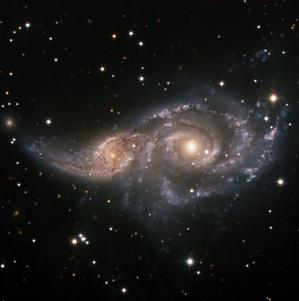
Fusion de galaxies spirales
Légende : Cette image montre deux galaxies spirales en interaction, situées à environ 150 millions d'années-lumière. Deux galaxies spirales sont impliquées dans cette danse, créant des distorsions visibles dans leurs bras spiraux en raison de l'attraction gravitationnelle. Ce qui commence comme une étreinte sur cette image se terminera par la fusion de ces deux galaxies en une seule galaxie, très probablement elliptique.
Crédit : ESO
Lien vers les crédits
License: CC-BY-4.0 Creative Commons (CC) Attribution 4.0 International (CC BY 4.0) Icônes
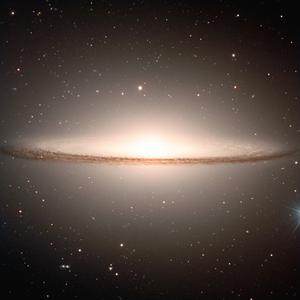
Sombrero galaxy
Légende : This prominent galaxy M 104 is often called the Sombrero galaxy due to its resemblance to the Mexican hat. This look is created by the thin disk oriented nearly edge-on, which appears illuminated by the dominant bulge. Both, the disk and bulge contain stars, but the stars in the bulge tend to be older, while the disk also harbors large amounts of dust and gas creating shadows. M 104 is located in the constellation Virgo approximately 50 light-years away. While some of the dots visible in the picture are foreground stars and others background galaxies, the majority are actually globular clusters, dense massive clusters of stars, associated with the Sombrero Galaxy.
Crédit : ESO/P. Barthel
Lien vers les crédits
License: CC-BY-4.0 Creative Commons (CC) Attribution 4.0 International (CC BY 4.0) Icônes

The Lenticular Galaxy NGC 2787
Légende : The lenticular galaxy NGC 2787. This galaxy is a disk galaxy but lacks the large, dominant spiral arm structure seen in the disks of spiral galaxies. Its core is very bright compared to the core of a spiral galaxy. Thin rings of dust can be seen in the galaxy's disk.
Crédit : NASA/ESA and The Hubble Heritage Team
Lien vers les crédits
License: CC-BY-4.0 Creative Commons (CC) Attribution 4.0 International (CC BY 4.0) Icônes
Diagrammes associés
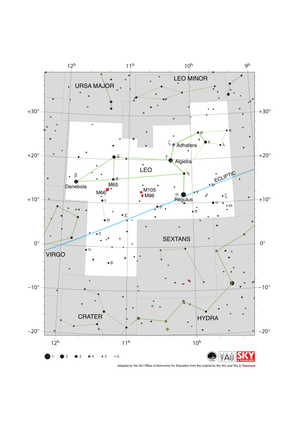
Leo Constellation Map
Légende : The zodiac constellation Leo and its surrounding constellations. Starting from the top of the diagram and going clockwise, these are Leo Minor, Cancer, Sextans, Hydra, Crater, Virgo and Ursa Major. The brightest star in Leo, Regulus, lies almost exactly on the ecliptic (shown here as a blue line): the path the Sun appears to take across the sky over the course of a year. The Sun spends the period from mid August to mid September in Leo. The other planets in the Solar System can often be found in Leo.
Leo spans the celestial equator and is thus part of it is visible at some time in the year from all of planet Earth with some of the constellation obscured for the most arctic and antarctic regions of the world. Leo is most visible in the evenings in the northern hemisphere spring and southern hemisphere autumn.
Several objects can be seen in Leo, including M65 and M66 – two galaxies in the Leo Triplet, a trio of galaxies including NGC 3628, not listed here. In addition, M96, a spiral galaxy, can be seen as a fuzzy object using a small telescope, and Messier 105, an elliptical galaxy. Each of these objects are labelled on the map as red ellipses.
The y-axis of this diagram is in degrees of declination with north as up and the x-axis is in hours of right ascension with east to the left. The sizes of the stars marked here relate to the star's apparent magnitude, a measure of its apparent brightness. The larger dots represent brighter stars. The Greek letters mark the brightest stars in the constellation. These are ranked by brightness with the brightest star being labelled alpha, the second brightest beta, etc., although this ordering is not always followed exactly. The dotted boundary lines mark the IAU's boundaries of the constellations and the solid green lines mark one of the common forms used to represent the figures of the constellations. Neither the constellation boundaries, nor the line marking the ecliptic, nor the lines joining the stars appear on the sky.
Crédit : Adapted by the IAU Office of Astronomy for Education from the original by IAU/Sky & Telescope
License: CC-BY-4.0 Creative Commons (CC) Attribution 4.0 International (CC BY 4.0) Icônes
Activités associées

Glitter Your Milky Way
astroEDU educational activity (links to astroEDU website) Description: Explore the Milky Way and characteristics of galaxies using glitter drawing.
License: CC-BY-4.0 Creative Commons (CC) Attribution 4.0 International (CC BY 4.0) Icônes
Mots clés :
Art
, Creativity
, Hands-on
, Handcraft
Tranches d'âge :
6-8
, 8-10
Niveau scolaire :
Collège
, Primaire
Domaines d'apprentissage :
Axé sur les arts
Coûts :
Moyen
Taille du groupe :
Par groupe
Compétences :
Communiquer des informations
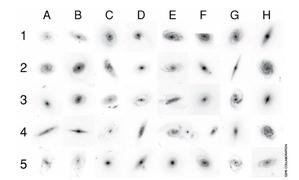
Coma Cluster of Galaxies
astroEDU educational activity (links to astroEDU website) Description: The basics of galaxy classification, using Hubble Space Telescope images.
License: CC-BY-4.0 Creative Commons (CC) Attribution 4.0 International (CC BY 4.0) Icônes
Mots clés :
Coma Cluster
Tranches d'âge :
14-16
, 16-19
, 19+
Niveau scolaire :
Secondaire
, Université
Domaines d'apprentissage :
Apprentissage par découverte guidée
Coûts :
Faible
Durée :
1h
Taille du groupe :
Par groupe
Compétences :
Analyser et interpréter des données
, Communiquer des informations
, Construire des explications
, Planifier et mener des enquêtes
Living in the Milky Way
astroEDU educational activity (links to astroEDU website) Description: Build a model of the Milky Way to discover what our galaxy contains.
License: CC-BY-4.0 Creative Commons (CC) Attribution 4.0 International (CC BY 4.0) Icônes
Mots clés :
Hands-on
, Model
Tranches d'âge :
6-8
, 8-10
Niveau scolaire :
Primaire
Domaines d'apprentissage :
Résolution de problèmes
, Apprentissage par enquête
Coûts :
Moyen
Durée :
1h 30m
Taille du groupe :
Par groupe
Compétences :
Poser des questions
, Communiquer des informations
, Développer et utiliser des modèles

3D Universe: the Milky Way and friends
astroEDU educational activity (links to astroEDU website) Description: Use tactile models printed in 3D to explore our galactic neighborhood.
License: CC-BY-4.0 Creative Commons (CC) Attribution 4.0 International (CC BY 4.0) Icônes
Tranches d'âge :
10-12
, 12-14
, 14-16
, 16-19
, 19+
Niveau scolaire :
Collège
, Secondaire
, Université
Domaines d'apprentissage :
Apprentissage par découverte guidée
, Cours interactif
, Modélisation
Coûts :
Moyen
Durée :
1h
Taille du groupe :
Par groupe
Compétences :
Analyser et interpréter des données
, Développer et utiliser des modèles









- Ressources
- Moteur de recherche des ressources pédagogiques
- Parcourir les ressources pédagogiques par Sujet
- Parcourir les images
- AstroEdu - Activités en classe
- Grandes Idées - Littéracie en astronomie
- Glossaire
- Rapports de l'OAE
- L'astronomie pour l'Education à travers le monde
- Sélection de ressources externes