Terme du glossaire : Galaxie naine
Description : Une galaxie naine est une petite galaxie exceptionnellement peu lumineuse, soit en raison de sa très petite taille, soit en raison de sa très faible luminosité de surface, soit les deux. En général, les galaxies naines sont au maximum aussi lumineuses qu'un milliard de fois la luminosité solaire, ce qui correspond à moins d'un pour cent de la luminosité de notre propre galaxie, la Voie lactée. Il existe de nombreux types de galaxies naines, notamment les elliptiques naines, les sphéroïdales naines, les spirales naines et les galaxies irrégulières naines. L'un des exemples les plus importants de galaxies naines est le Petit Nuage de Magellan, une galaxie naine irrégulière, satellite de notre propre galaxie la Voie lactée.
Termes associés :
Voir ce terme dans d'autres langues
Statut du terme et de sa définition : La définition initiale de ce terme en anglais a été aprouvée par un·e spécialiste de la recherche en astronomie et un·e spécialiste de l’éducation La traduction de ce terme et de sa définition n'ont pas encore été aprouvées
Le glossaire multilangue de l'OAE est un projet du Bureau de l'IAU de l'Astronomie pour l'Education (OAE) en collaboration avec le Bureau de l'IAU de diffusion de l'Astronomie (OAO). Les termes et définitions ont été choisis, écrits et relues grâce à un effort collectif de l'OAE, les Centres et les Noeuds de l'OAE, les Coordinateurs Nationaux de l'Astronomie pour l'Education de l'OAE(NAECs) et d'autres volontaires. La liste complète des crédits pour ce projet est disponible ici . Tous les termes du glossaire et leur définition sont déposés sous licence Creative Commons CC BY-4.0 et doivent être créditées au nom de "IAU OAE".
Si vous constatez une erreur dans ce terme ou sa définition, veuillez nous contacter .
Dans d'autres langues
- Arabe: المجرة القزمة
- Allemand: Zwerggalaxie
- Anglais: Dwarf Galaxy
- Espagnol: Galaxia enana
- Italien: Galassia nana
- Japonais: 矮小銀河 (Liens externes)
- Coréen: 왜소은하
- Portugais brésilien: Galáxia anã
- Chinois simplifié: 矮星系
- Chinois traditionnel: 矮星系
Media associé

A visible light image of the Andromeda Galaxy
Légende : The Andromeda Galaxy viewed in visible light. Like our Milky Way, Andromeda is a barred spiral galaxy. Here we can see its bright core and spiral disk. The glow from the stars in the disk is interrupted by lanes of dust that form part of its spiral structure.
Andromeda is the largest galaxy in the Local Group of galaxies that includes the Milky Way.
To the left of the core and just above the disk we see the dwarf galaxy M32 and to the right and below the disk we see the dwarf galaxy M110. These are both satellite galaxies of the Andromeda Galaxy.
Crédit : Torben Hansen
Lien vers les crédits
License: CC-BY-2.0 Creative Commons (CC) Attribution 2.0 Générique Icônes

NGC 5264 - An irregular island
Légende : The dwarf irregular galaxy NGC 5264 is located 15 million light years away. It is only about 11,000 light years across, much smaller than our Milky Way, and consists of approximately a billion stars. It lacks the spiral structure of our home Galaxy. The small blue patches in NGC 5264 mark groups of young hot blue stars. This suggests that stars formation in this galaxy is still on-going.
Crédit : ESA/Hubble and NASA
Lien vers les crédits
License: CC-BY-4.0 Creative Commons (CC) Attribution 4.0 International (CC BY 4.0) Icônes
Diagrammes associés
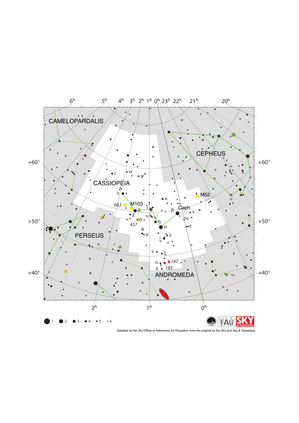
Cassiopeia Constellation Map
Légende : The constellation Cassiopeia along with its bright stars and its surrounding constellations. Cassiopeia is surrounded by (going clockwise from the top):Cepheus, Andromeda, Perseus and Camelopardalis.
Cassiopeia is a northern constellation that is visible from all of the northern hemisphere and equatorial regions of the southern hemisphere. It is most visible in the evenings in the northern hemisphere late autumn and southern hemisphere late spring.
The open star clusters M52, M103, NGC 457 and NGC 663 all lie in this constellation. These are marked with yellow circles. Two dwarf elliptical galaxies NGC 147 and NGC 185 lie in the southern part of the constellation. These are marked with red ellipses and are gravitationally bound to the larger Andromeda galaxy which lies to the south in the constellation of Andromeda.
The y-axis of this diagram is in degrees of declination with north as up and the x-axis is in hours of right ascension with east to the left. The sizes of the stars marked here relate to the star's apparent magnitude, a measure of its apparent brightness. The larger dots represent brighter stars. The Greek letters mark the brightest stars in the constellation. These are ranked by brightness with the brightest star being labeled alpha, the second brightest beta, etc., although this ordering is not always followed exactly. The dotted boundary lines mark the IAU's boundaries of the constellations and the solid green lines mark one of the common forms used to represent the figures of the constellations. Neither the constellation boundaries, nor the lines joining the stars appear on the sky.
Crédit : Adapted by the IAU Office of Astronomy for Education from the original by IAU/Sky & Telescope
License: CC-BY-4.0 Creative Commons (CC) Attribution 4.0 International (CC BY 4.0) Icônes
Ceci pourrait vous intéresser également








.jpg)

- Ressources
- Moteur de recherche des ressources pédagogiques
- Parcourir les ressources pédagogiques par Sujet
- Parcourir les images
- AstroEdu - Activités en classe
- Grandes Idées - Littéracie en astronomie
- Glossaire
- Rapports de l'OAE
- L'astronomie pour l'Education à travers le monde
- Sélection de ressources externes