Término del glosario: Galaxia enana
Descripción: Una galaxia enana es una galaxia pequeña que presenta una luminosidad inusualmente baja, ya sea debido a su tamaño muy reducido, a su muy bajo brillo superficial, o a ambos factores. Por lo general, las galaxias enanas tienen una luminosidad que no supera los mil millones de veces la luminosidad solar, lo que corresponde a menos del uno por ciento de la luminosidad de nuestra propia galaxia, la Vía Láctea. Existen numerosos tipos diferentes de galaxias enanas, entre las que se incluyen las elípticas enanas, las esferoidales enanas, las espirales enanas y las galaxias enanas irregulares. Uno de los ejemplos más importantes de galaxias enanas es la Pequeña Nube de Magallanes, que es un satélite enano irregular de nuestra propia galaxia, la Vía Láctea.
Términos relacionados:
Ver este término en otros idiomas
Estado del término y la definición: La definición original de este término en inglés ha sido aprobada por unastrónomo o astrónoma investigadora y un docente La traducción de este término y su definición aún están pendientes de aprobación
El Glosario multilingüe de la OAE es un proyecto de la Oficina de Astronomía para la Educación de la UAI (OAE) en colaboración con la Oficina de Divulgación de Astronomía de la UAI (OAO). Los términos y definiciones fueron seleccionados, redactados y revisados gracias al esfuerzo colectivo de la OAE, los Centros y Nodos de la OAE, los Coordinadores Nacionales de Educación Astronómica (NAECs) y otros voluntarios. Puedes encontrar una lista completa de créditos aquí. Todos los términos del glosario y sus definiciones se publican bajo la licencia Creative Commons CC BY-4.0 y deben atribuirse a la "IAU OAE".
Si detectas algún error de contenido o de traducción en este término del glosario o en ladefinición, ponte en contacto con nosotros.
En otros idiomas
- Árabe: المجرة القزمة
- Alemán: Zwerggalaxie
- Inglés: Dwarf Galaxy
- Francés: Galaxie naine
- Italiano: Galassia nana
- Japonés: 矮小銀河 (enlace externo)
- Coreano: 왜소은하
- Portugués de Brasil: Galáxia anã
- Chino simplificado: 矮星系
- Chino tradicional: 矮星系
Contenidos relacionados

A visible light image of the Andromeda Galaxy
Pie de foto: The Andromeda Galaxy viewed in visible light. Like our Milky Way, Andromeda is a barred spiral galaxy. Here we can see its bright core and spiral disk. The glow from the stars in the disk is interrupted by lanes of dust that form part of its spiral structure.
Andromeda is the largest galaxy in the Local Group of galaxies that includes the Milky Way.
To the left of the core and just above the disk we see the dwarf galaxy M32 and to the right and below the disk we see the dwarf galaxy M110. These are both satellite galaxies of the Andromeda Galaxy.
Crédito: Torben Hansen
enlace de crédito
License: CC-BY-2.0 Creative Commons Atribución 2.0 Genérica íconos

NGC 5264 - An irregular island
Pie de foto: The dwarf irregular galaxy NGC 5264 is located 15 million light years away. It is only about 11,000 light years across, much smaller than our Milky Way, and consists of approximately a billion stars. It lacks the spiral structure of our home Galaxy. The small blue patches in NGC 5264 mark groups of young hot blue stars. This suggests that stars formation in this galaxy is still on-going.
Crédito: ESA/Hubble and NASA
enlace de crédito
License: CC-BY-4.0 Creative Commons Reconocimiento 4.0 Internacional (CC BY 4.0) íconos
Diagramas relacionados
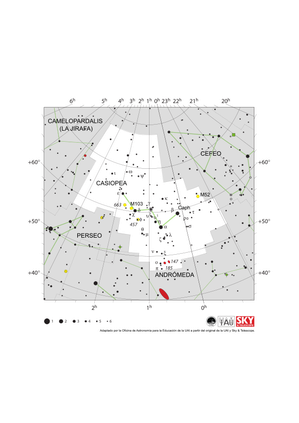
Mapa de la constelación de Casiopea
Pie de foto: La constelación de Casiopea junto con sus estrellas brillantes y las constelaciones que la rodean. Casiopea está rodeada por (en el sentido de las agujas del reloj desde arriba): Cefeo, Andrómeda, Perseo y Camelopardalis.
Casiopea es una constelación boreal visible desde todo el hemisferio norte y desde las regiones ecuatoriales del hemisferio sur. Es más visible por la noche a finales de otoño en el hemisferio norte y a finales de primavera en el hemisferio sur.
Los cúmulos estelares abiertos M52, M103, NGC 457 y NGC 663 se encuentran en esta constelación. Están marcados con círculos amarillos. Dos galaxias elípticas enanas, NGC 147 y NGC 185, se encuentran en la parte sur de la constelación. Están marcadas con elipses rojas y están ligadas gravitacionalmente a la galaxia de Andrómeda, que se encuentra al sur de la constelación de Andrómeda.
El eje-y de este diagrama está en grados de declinación con el norte hacia arriba y el eje-x está en horas de ascensión recta con el este a la izquierda. El tamaño de las estrellas marcadas aquí está relacionado con la magnitud aparente de la estrella, una medida de su brillo aparente. Los puntos más grandes representan estrellas más brillantes. Las letras griegas indican las estrellas más brillantes de la constelación. Están ordenadas según su brillo: la estrella más brillante se denomina alfa, la segunda más brillante beta, etc., aunque este orden no siempre se sigue con exactitud. Las líneas punteadas marcan los límites de las constelaciones según la UAI y las líneas verdes continuas marcan una de las formas habituales utilizadas para representar las figuras de las constelaciones. Ni los límites de las constelaciones ni las líneas que unen las estrellas aparecen en el cielo.
Crédito: Adaptado por la Oficina de Astronomía para la Educación de la UAI a partir del original de UAI/Sky & Telescope
License: CC-BY-4.0 Creative Commons Reconocimiento 4.0 Internacional (CC BY 4.0) íconos








.jpg)