Termo do glossário: Galáxia anã
Descrição: Uma galáxia anã é uma galáxia pequena que é excepcionalmente tênue devido ao seu tamanho muito pequeno, ao seu brilho superficial muito baixo ou a ambos. Normalmente, as galáxias anãs são no máximo tão luminosas quanto um bilhão de vezes a luminosidade do Sol, o que corresponde a menos de um por cento da luminosidade da nossa galáxia natal, a Via Láctea. Há vários tipos diferentes de galáxias anãs, incluindo anãs elípticas, anãs esferoidais, anãs espirais e galáxias anãs irregulares. Um dos exemplos mais importantes de galáxias anãs é a Pequena Nuvem de Magalhães, que é um satélite irregular anão da Via Láctea, nossa galáxia natal.
Termos relacionados:
Ver este termo em outros idiomas
Status do termo e da definição: A definição original deste termo em inglês foi aprovada por um astrônomo(a) pesquisador(a) e um(a) professor(a) A tradução deste termo e de sua definição ainda aguarda aprovação
O Glossário Multilíngue da OAE é um projeto do Escritório da IAU de Astronomia para a Educação (OAE) em colaboração com o Escritório da IAU para Divulgação da Astronomia (OAO). Os termos e definições foram selecionados, escritos e revisados por meio de um esforço coletivo da OAE, dos Centros e Nós da OAE, dos Coordenadores Nacionais de Educação em Astronomia (NAECs) da OAE e de outros voluntários. Você pode encontrar uma lista completa dos créditos aqui. Todos os termos do glossário e suas definições são disponibilizados sob uma licença Creative Commons CC BY-4.0 e devem ser creditados à "IAU OAE".
Se você notar algum erro factual ou de tradução neste termo do glossário ou em sua definição, por favor entre em contato.
Em outros idiomas
- Árabe: المجرة القزمة
- Alemão: Zwerggalaxie
- Inglês: Dwarf Galaxy
- Espanhol: Galaxia enana
- Francês: Galaxie naine
- Italiano: Galassia nana
- Japonês: 矮小銀河 (link externo)
- Coreano: 왜소은하
- Chinês Simplificado: 矮星系
- Chinês Tradicional: 矮星系
Mídia relacionada

Uma imagem da Galáxia de Andrômeda em luz visível
Legenda: A Galáxia de Andrômeda vista em luz visível. Como a nossa Via Láctea, Andrômeda é uma galáxia espiral barrada. Aqui podemos ver seu núcleo brilhante e seu disco espiral. O brilho das estrelas no disco é interrompido por faixas de poeira que fazem parte de sua estrutura espiral.
Andrômeda é a maior galáxia do Grupo Local de galáxias que inclui a Via Láctea.
À esquerda do núcleo e logo acima do disco, vemos a galáxia anã M32 e, à direita e abaixo do disco, vemos a galáxia anã M110. Ambas são galáxias satélites da Galáxia de Andrômeda.
Crédito: Torben Hansen
link do crédito
License: CC-BY-2.0 Creative Commons Attribution 2.0 Generic ícones

NGC 5264 - Uma ilha irregular
Legenda: A galáxia anã irregular NGC 5264 está localizada a 15 milhões de anos-luz de distância. Ela possui apenas cerca de 11.000 anos-luz de diâmetro, muito menor que a nossa Via Láctea, e é composta por aproximadamente um bilhão de estrelas. Ela não possui a estrutura espiral da nossa galáxia. As pequenas regiões azuladas em NGC 5264 marcam grupos de estrelas azuis jovens e quentes. Isso sugere que a formação de estrelas nesta galáxia ainda está em andamento.
Crédito: ESA/Hubble e NASA
link do crédito
License: CC-BY-4.0 Creative Commons Attribution 4.0 International (CC BY 4.0) ícones
Diagramas relacionados
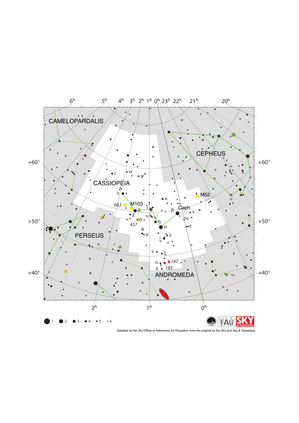
Cassiopeia Constellation Map
Legenda: The constellation Cassiopeia along with its bright stars and its surrounding constellations. Cassiopeia is surrounded by (going clockwise from the top):Cepheus, Andromeda, Perseus and Camelopardalis.
Cassiopeia is a northern constellation that is visible from all of the northern hemisphere and equatorial regions of the southern hemisphere. It is most visible in the evenings in the northern hemisphere late autumn and southern hemisphere late spring.
The open star clusters M52, M103, NGC 457 and NGC 663 all lie in this constellation. These are marked with yellow circles. Two dwarf elliptical galaxies NGC 147 and NGC 185 lie in the southern part of the constellation. These are marked with red ellipses and are gravitationally bound to the larger Andromeda galaxy which lies to the south in the constellation of Andromeda.
The y-axis of this diagram is in degrees of declination with north as up and the x-axis is in hours of right ascension with east to the left. The sizes of the stars marked here relate to the star's apparent magnitude, a measure of its apparent brightness. The larger dots represent brighter stars. The Greek letters mark the brightest stars in the constellation. These are ranked by brightness with the brightest star being labeled alpha, the second brightest beta, etc., although this ordering is not always followed exactly. The dotted boundary lines mark the IAU's boundaries of the constellations and the solid green lines mark one of the common forms used to represent the figures of the constellations. Neither the constellation boundaries, nor the lines joining the stars appear on the sky.
Crédito: Adapted by the IAU Office of Astronomy for Education from the original by IAU/Sky & Telescope
License: CC-BY-4.0 Creative Commons Attribution 4.0 International (CC BY 4.0) ícones








.jpg)
