Termo do glossário: Eclipse
Descrição: Um eclipse ocorre quando um objeto astronômico é temporariamente obscurecido ao passar pela sombra de outro corpo ou quando outro corpo passa entre o observador e o objeto. Exemplos de eclipses incluem os eclipses lunares, quando a Terra fica entre o Sol e a Lua e a Lua entra na sombra da Terra, e os eclipses solares, quando a Lua se move entre a Terra e o Sol bloqueando parte ou toda a luz solar. Quando o corpo ocultado encobre apenas uma pequena parte do outro corpo, o fenômeno é chamado de trânsito. Quando o corpo ocultado encobre completamente o outro corpo, o fenômeno é chamado de ocultação.
Termos relacionados:
Ver este termo em outros idiomas
Status do termo e da definição: A definição original deste termo em inglês foi aprovada por um astrônomo(a) pesquisador(a) e um(a) professor(a) A tradução deste termo e de sua definição ainda aguarda aprovação
O Glossário Multilíngue da OAE é um projeto do Escritório da IAU de Astronomia para a Educação(OAE) em colaboração com o Escritório da IAU para Divulgação da Astronomia (OAO). Os termos e definições foram selecionados, escritos e revisados por meio de um esforço coletivo da OAE, dos Centros e Nós da OAE, dos Coordenadores Nacionais de Educação em Astronomia (NAECs) da OAE e de outros voluntários. Você pode encontrar uma lista completa dos créditos aqui. Todos os termos do glossário e suas definições são disponibilizados sob uma licença Creative Commons CC BY-4.0 e devem ser creditados à "IAU OAE".
Se você notar algum erro factual ou de tradução neste termo do glossário ou em sua definição, por favor entre em contato.
Mídia relacionada
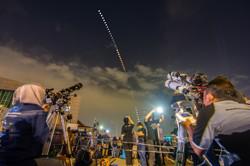
The Eclipse Between Us, by Muhammad Rayhan, Indonesia
Legenda: Second place in the 2021 IAU OAE Astrophotography Contest, category Total lunar eclipse.
Total lunar eclipses belong to the rather spectacular celestial events and can be observed easily with and without a telescope. Here we see the stages of the total lunar eclipse of 31.1.2018 photographed in Indonesia: starting with the entry of the full moon disk into Earth's round umbra, the totality as Blood Moon, and the beginning of the Moon's exit from Earth's umbra until moonset.
Crédito: Muhammad Rayhan/IAU OAE
License: CC-BY-4.0 Creative Commons Attribution 4.0 International (CC BY 4.0) ícones
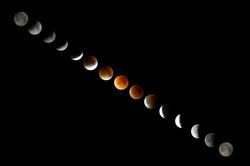
Red Moon, by Daniel Henrion, France
Legenda: Third place in the 2021 IAU OAE Astrophotography Contest, category Total lunar eclipse.
Time-lapse images of a total supermoon lunar eclipse that took place on 28 September 2015. The photos show the Moon during the time it moved through the Earth´s umbra: Earth´s umbra touched the Moon´s outer limb at 1.07 a.m. UTC (upper left corner) and left the Moon´s surface at 4.27 a.m. UTC (lower right corner).
Crédito: Daniel Henrion/IAU OAE
License: CC-BY-4.0 Creative Commons Attribution 4.0 International (CC BY 4.0) ícones

Eclipse solar anular
Legenda: Esta imagem captura um eclipse anular, um tipo especial de eclipse solar que ocorre quando a Lua passa diretamente na frente do Sol, mas não o cobre completamente. Como a Lua está próxima do ponto mais distante de sua órbita, ela apresenta um tamanho angular menor do que o normal e, portanto, é ligeiramente menor no céu do que o Sol. Se ocorrer um eclipse nesta situação, a Lua bloqueia apenas a parte central do disco solar, deixando visível um anel brilhante, frequentemente chamado de “anel de fogo”, visível em torno da silhueta da Lua. Um eclipse anular difere de um eclipse solar total, pois os observadores veem este anel luminoso em vez do Sol totalmente encoberto.
Crédito: Usuário da Wikipedia - Dpickd1
link do crédito
License: CC-BY-4.0 Creative Commons Attribution 4.0 International (CC BY 4.0) ícones
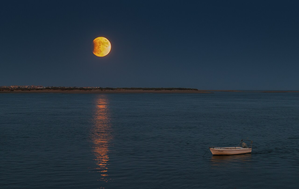
Partial Lunar Eclipse over southern Portugal
Legenda: The image shows a partial lunar eclipse from the 16th of July 2019, taken in southern Portugal. A lunar eclipse happens at full moon so without the eclipse we would see the full lunar disk. Earth’s curved shadow is clearly visible on the left side of the lunar disk. The remaining surface of the Moon is dipped into a deep orange color due. This is because at a lunar eclipse the Earth is positioned between the Moon and the Sun. While the solid part of the Earth creates the shadow we see on the left side of the Moon, sunlight also shines through Earth’s atmosphere. This scatters blue sunlight allowing most red sunlight through, the same process which turns the evening sun into a beautiful and colorful sunset.
Crédito: ToryYu1989
link do crédito
License: CC0 CC0 1.0 Universal (CC0 1.0) Public Domain Dedication ícones