Termo do glossário: Eclipse lunar
Descrição: Um eclipse lunar ocorre quando a Lua passa pela sombra da Terra. Isso só pode acontecer quando o Sol, a Terra e a Lua estão muito bem alinhados, com a Terra diretamente entre o Sol e a Lua. Assim, um eclipse lunar só pode ocorrer na noite de lua cheia. Um eclipse lunar total ocorre quando a Lua está totalmente dentro da sombra da Terra. Um eclipse lunar parcial ocorre quando a Lua está apenas parcialmente coberta pela sombra da Terra. O tipo e a duração de um eclipse lunar dependem da posição exata da Lua em sua órbita ao redor da Terra no momento do eclipse.
Termos relacionados:
Ver este termo em outros idiomas
Status do termo e da definição: A definição original deste termo em inglês foi aprovada por um astrônomo(a) pesquisador(a) e um(a) professor(a) A tradução deste termo e de sua definição ainda aguarda aprovação
O Glossário Multilíngue da OAE é um projeto do Escritório da IAU de Astronomia para a Educação (OAE) em colaboração com o Escritório da IAU para Divulgação da Astronomia (OAO). Os termos e definições foram selecionados, escritos e revisados por meio de um esforço coletivo da OAE, dos Centros e Nós da OAE, dos Coordenadores Nacionais de Educação em Astronomia (NAECs) da OAE e de outros voluntários. Você pode encontrar uma lista completa dos créditos aqui. Todos os termos do glossário e suas definições são disponibilizados sob uma licença Creative Commons CC BY-4.0 e devem ser creditados à "IAU OAE".
Se você notar algum erro factual ou de tradução neste termo do glossário ou em sua definição, por favor entre em contato.
Em outros idiomas
- Árabe: خسوف القمر
- Alemão: Mondfinsternis
- Inglês: Lunar Eclipse
- Espanhol: Eclipse lunar
- Francês: Eclipse de lune
- Italiano: Eclissi lunare
- Japonês: 月食 (link externo)
- Coreano: 월식
- Chinês Simplificado: 月食
- Chinês Tradicional: 月食
Mídia relacionada
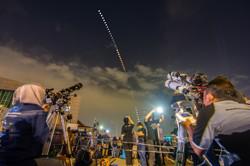
The Eclipse Between Us, by Muhammad Rayhan, Indonesia
Legenda: Second place in the 2021 IAU OAE Astrophotography Contest, category Total lunar eclipse.
Total lunar eclipses belong to the rather spectacular celestial events and can be observed easily with and without a telescope. Here we see the stages of the total lunar eclipse of 31.1.2018 photographed in Indonesia: starting with the entry of the full moon disk into Earth's round umbra, the totality as Blood Moon, and the beginning of the Moon's exit from Earth's umbra until moonset.
Crédito: Muhammad Rayhan/IAU OAE
License: CC-BY-4.0 Creative Commons Attribution 4.0 International (CC BY 4.0) ícones
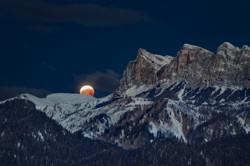
The eclipsed Moon sets near the Rochetta di Prendera, Dolomiti Unesco, by Alessandra Masi, Italy
Legenda: First place in the 2021 IAU OAE Astrophotography Contest, category Total lunar eclipse.
A lunar eclipse occurs when the full moon moves into the Earth`s shadow. This is the case when the Sun, Earth and Moon are exactly or very closely aligned. The reddish light reflected from the lunar surface is caused by sunlight that has been refracted on its way through Earth´s atmosphere in the direction of the Moon. It appears reddish because of the Rayleigh scattering of bluer light. The round shape of the Earth's shadow visible on the lunar surface was a proof for Aristotle that the Earth must be a sphere. This photo shows the eclipsed Moon that sets near the Rochetta di Prendera, Dolomiti Unesco, Italy, on 21 January 2019.
Crédito: Alessandra Masi/IAU OAE
License: CC-BY-4.0 Creative Commons Attribution 4.0 International (CC BY 4.0) ícones