Glossary term: 월식
Description: 월식은 달이 지구의 그림자 속으로 지나갈 때 일어나는 현상입니다. 태양, 지구, 달이 일직선으로 정렬되어, 지구가 태양과 달 사이에 놓일 때만 일어날 수 있습니다. 따라서 월식은 보름달이 뜨는 밤에만 일어날 수 있습니다. 달이 지구의 그림자 속에 완전히 들어가면 개기월식, 일부만 가려지면 부분월식이 됩니다. 월식의 모양과 지속 시간은 달이 월식이 일어나는 순간 지구 주위를 도는 궤도에서 어디에 있는지에 따라 달라집니다.
Related Terms:
See this term in other languages
Term and definition status: The original definition of this term in English have been approved by a research astronomer and a teacher The translation of this term and its definition is still awaiting approval
The OAE Multilingual Glossary is a project of the IAU Office of Astronomy for Education (OAE) in collaboration with the IAU Office of Astronomy Outreach (OAO). The terms and definitions were chosen, written and reviewed by a collective effort from the OAE, the OAE Centers and Nodes, the OAE National Astronomy Education Coordinators (NAECs) and other volunteers. You can find a full list of credits here. All glossary terms and their definitions are released under a Creative Commons CC BY-4.0 license and should be credited to "IAU OAE".
If you notice a factual or translation error in this glossary term or definition then please get in touch.
In Other Languages
- 아랍어: خسوف القمر
- 독일어: Mondfinsternis
- 영어: Lunar Eclipse
- 스페인어: Eclipse lunar
- 프랑스어: Eclipse de lune
- 이탈리아어: Eclissi lunare
- 일본어: 月食 (external link)
- 브라질 포르투갈어: Eclipse lunar
- 중국어 간체: 月食
- 중국어 번체: 月食
Related Media
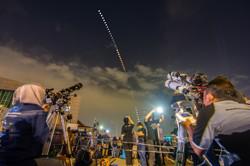
The Eclipse Between Us, by Muhammad Rayhan, Indonesia
Caption: Second place in the 2021 IAU OAE Astrophotography Contest, category Total lunar eclipse.
Total lunar eclipses belong to the rather spectacular celestial events and can be observed easily with and without a telescope. Here we see the stages of the total lunar eclipse of 31.1.2018 photographed in Indonesia: starting with the entry of the full moon disk into Earth's round umbra, the totality as Blood Moon, and the beginning of the Moon's exit from Earth's umbra until moonset.
Credit: Muhammad Rayhan/IAU OAE
License: CC-BY-4.0 Creative Commons 저작자표시 4.0 국제 (CC BY 4.0) icons
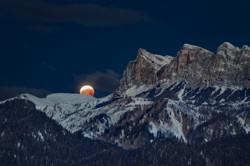
The eclipsed Moon sets near the Rochetta di Prendera, Dolomiti Unesco, by Alessandra Masi, Italy
Caption: First place in the 2021 IAU OAE Astrophotography Contest, category Total lunar eclipse.
A lunar eclipse occurs when the full moon moves into the Earth`s shadow. This is the case when the Sun, Earth and Moon are exactly or very closely aligned. The reddish light reflected from the lunar surface is caused by sunlight that has been refracted on its way through Earth´s atmosphere in the direction of the Moon. It appears reddish because of the Rayleigh scattering of bluer light. The round shape of the Earth's shadow visible on the lunar surface was a proof for Aristotle that the Earth must be a sphere. This photo shows the eclipsed Moon that sets near the Rochetta di Prendera, Dolomiti Unesco, Italy, on 21 January 2019.
Credit: Alessandra Masi/IAU OAE
License: CC-BY-4.0 Creative Commons 저작자표시 4.0 국제 (CC BY 4.0) icons