Término del glosario: Eclipse
Descripción: Un eclipse se produce cuando un objeto astronómico queda temporalmente oculto, ya sea al pasar a la sombra de otro cuerpo o cuando otro cuerpo se interpone entre el observador y el objeto. Ejemplos de eclipses son los eclipses lunares, en los que la Tierra se interpone entre el Sol y la Luna y esta última entra en la sombra de la Tierra, o los eclipses solares, en los que la Luna se interpone entre la Tierra y el Sol y bloquea parte o la totalidad de la luz solar. Si el cuerpo que oculta solo oculta una pequeña parte del otro cuerpo, este fenómeno se denomina tránsito. Si el cuerpo que oculta, oculta completamente al otro cuerpo, este fenómeno se denomina ocultación.
Términos relacionados:
Ver este término en otros idiomas
Estado del término y la definición: La definición original de este término en inglés ha sido aprobada por unastrónomo o astrónoma investigadora y un docente La traducción de este término y su definición aún están pendientes de aprobación
El Glosario multilingüe de la OAE es un proyecto de la Oficina de Astronomía para la Educación de la UAI (OAE) en colaboración con la Oficina de Divulgación de Astronomía de la UAI (OAO). Los términos y definiciones fueron seleccionados, redactados y revisados gracias al esfuerzo colectivo de la OAE, los Centros y Nodos de la OAE, los Coordinadores Nacionales de Educación Astronómica (NAECs) y otros voluntarios. Puedes encontrar una lista completa de créditos aquí. Todos los términos del glosario y sus definiciones se publican bajo la licencia Creative Commons CC BY-4.0 y deben atribuirse a la "IAU OAE".
Si detectas algún error de contenido o de traducción en este término del glosario o en ladefinición, ponte en contacto con nosotros.
Contenidos relacionados
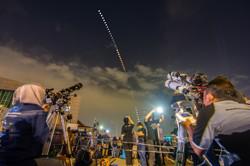
The Eclipse Between Us, by Muhammad Rayhan, Indonesia
Pie de foto: Second place in the 2021 IAU OAE Astrophotography Contest, category Total lunar eclipse.
Total lunar eclipses belong to the rather spectacular celestial events and can be observed easily with and without a telescope. Here we see the stages of the total lunar eclipse of 31.1.2018 photographed in Indonesia: starting with the entry of the full moon disk into Earth's round umbra, the totality as Blood Moon, and the beginning of the Moon's exit from Earth's umbra until moonset.
Crédito: Muhammad Rayhan/IAU OAE
License: CC-BY-4.0 Creative Commons Reconocimiento 4.0 Internacional (CC BY 4.0) íconos
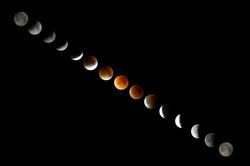
Red Moon, by Daniel Henrion, France
Pie de foto: Third place in the 2021 IAU OAE Astrophotography Contest, category Total lunar eclipse.
Time-lapse images of a total supermoon lunar eclipse that took place on 28 September 2015. The photos show the Moon during the time it moved through the Earth´s umbra: Earth´s umbra touched the Moon´s outer limb at 1.07 a.m. UTC (upper left corner) and left the Moon´s surface at 4.27 a.m. UTC (lower right corner).
Crédito: Daniel Henrion/IAU OAE
License: CC-BY-4.0 Creative Commons Reconocimiento 4.0 Internacional (CC BY 4.0) íconos

Annular Solar Eclipse
Pie de foto: This image captures an annular eclipse, a special type of solar eclipse that occurs when the Moon passes directly in front of the Sun but does not completely cover it. Because the Moon is near the farthest point in its orbit it has a smaller angular size than normal and is thus slightly smaller in the sky than the Sun. If an eclipse occurs in this situation, the Moon only blocks the central portion of the Sun's disk but leaves a bright ring, often called the “ring of fire”, visible around the Moon’s silhouette. An annular eclipse is different from a total solar eclipse in that observers see this luminous ring rather than the Sun being fully obscured.
Crédito: Wikipedia user - Dpickd1
enlace de crédito
License: CC-BY-4.0 Creative Commons Reconocimiento 4.0 Internacional (CC BY 4.0) íconos
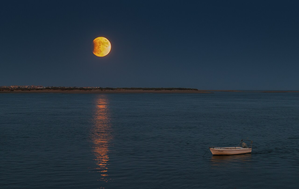
Partial Lunar Eclipse over southern Portugal
Pie de foto: The image shows a partial lunar eclipse from the 16th of July 2019, taken in southern Portugal. A lunar eclipse happens at full moon so without the eclipse we would see the full lunar disk. Earth’s curved shadow is clearly visible on the left side of the lunar disk. The remaining surface of the Moon is dipped into a deep orange color due. This is because at a lunar eclipse the Earth is positioned between the Moon and the Sun. While the solid part of the Earth creates the shadow we see on the left side of the Moon, sunlight also shines through Earth’s atmosphere. This scatters blue sunlight allowing most red sunlight through, the same process which turns the evening sun into a beautiful and colorful sunset.
Crédito: ToryYu1989
enlace de crédito
License: CC0 CC0 1.0 Universal (CC0 1.0) Ofrecimiento al Dominio Público íconos