Termo do glossário: Estrela variável
Descrição: Uma estrela variável é uma estrela que apresenta a observadores mudanças acentuadas de brilho ao longo do tempo. O brilho de todas as estrelas muda ao longo de milhões ou bilhões de anos devido à evolução estelar. O termo “estrela variável” é normalmente reservado para estrelas cujo brilho varia em escalas de tempo muito mais curtas do que suas escalas de tempo evolutivas.
Existem vários mecanismos físicos possíveis que podem levar à variabilidade. Algumas estrelas, como as variáveis Cefeidas ou as estrelas RR Lyrae, são instáveis e pulsam, alterando seu tamanho e brilho.
Outras estrelas podem ejetar material brilhante que aumenta o brilho geral observado (“variáveis eruptivas”). Estrelas chamadas variáveis cataclísmicas ou novas apresentam um aumento repentino no brilho, seguido por um retorno ao seu nível anterior. Nesses sistemas, o cenário envolve um par de estrelas, com matéria de uma fluindo para a outra e se inflamando em uma reação de fusão nuclear assim que um certo limiar é atingido. Uma das companheiras sofre a explosão cataclísmica e o aumento de brilho.
Outras estrelas parecem variáveis porque estão girando, mostrando-nos alternadamente um lado mais brilhante e outro menos brilhante, ou porque há realmente duas estrelas orbitando uma à outra, com uma estrela sendo periodicamente eclipsada por trás de sua companheira. Esta última classe de binárias é conhecida como binária eclipsante.
Termos relacionados:
Ver este termo em outros idiomas
Status do termo e da definição: A definição original deste termo em inglês foi aprovada por um astrônomo(a) pesquisador(a) e um(a) professor(a) A tradução deste termo e de sua definição ainda aguarda aprovação
O Glossário Multilíngue da OAE é um projeto do Escritório da IAU de Astronomia para a Educação (OAE) em colaboração com o Escritório da IAU para Divulgação da Astronomia (OAO). Os termos e definições foram selecionados, escritos e revisados por meio de um esforço coletivo da OAE, dos Centros e Nós da OAE, dos Coordenadores Nacionais de Educação em Astronomia (NAECs) da OAE e de outros voluntários. Você pode encontrar uma lista completa dos créditos aqui. Todos os termos do glossário e suas definições são disponibilizados sob uma licença Creative Commons CC BY-4.0 e devem ser creditados à "IAU OAE".
Se você notar algum erro factual ou de tradução neste termo do glossário ou em sua definição, por favor entre em contato.
Em outros idiomas
- Árabe: النجم المتغير
- Alemão: Veränderlicher Stern
- Inglês: Variable Star
- Espanhol: Estrella variable
- Francês: Étoile variable
- Italiano: stella variabile
- Japonês: 変光星 (link externo)
- Coreano: 변광성
- Chinês Simplificado: 变星
- Chinês Tradicional: 變星
Diagramas relacionados
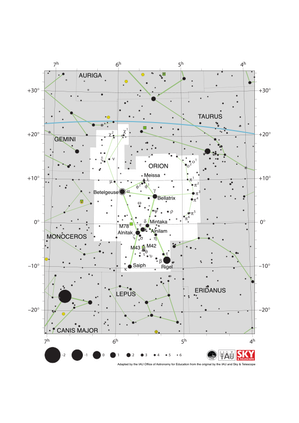
Orion Constellation Map
Legenda: The constellation Orion along with its bright stars and surrounding constellations. Orion is surrounded by (going clockwise from the top) Taurus, Eridanus, Lepus, Monoceros and Gemini. Orion’s brightest stars Betelgeuse and Rigel appear at the northern (upper on this diagram) and southern (lower) end of the constellation respectively with the famous three star “belt” in the middle.
Orion spans the celestial equator and is thus visible at some time in the year from all of planet Earth. In the most arctic or antarctic regions of the world, some parts of the constellation may not be visible. Orion is most visible in the evenings in the northern hemisphere winter and southern hemisphere summer. The blue line above Orion marks the ecliptic, the path the Sun appears to travel across the sky over the course of a year. The Sun never passes through Orion, but one can occasionally find the other planets of the Solar System and the Moon in Orion.
Just south of Orion’s belt lie two Messier objects M42 (the Orion nebula) and M43, marked by green squares. These nebulae along with M78 (here the green square to the left of the belt) are part of the huge Orion Molecular Cloud Complex. This covers most of the constellation and includes regions where these molecular clouds are collapsing to form young starts.
The y-axis of this diagram is in degrees of declination with north as up and the x-axis is in hours of right ascension with east to the left. The sizes of the stars marked here relate to the star's apparent magnitude, a measure of its apparent brightness. The larger dots represent brighter stars. The Greek letters mark the brightest stars in the constellation. These are ranked by brightness with the brightest star being labeled alpha, the second brightest beta, etc., although this ordering is not always followed exactly. The circle around Betelgeuse indicates that it is a variable star. The dotted boundary lines mark the IAU's boundaries of the constellations and the solid green lines mark one of the common forms used to represent the figures of the constellations. Neither the constellation boundaries, nor the line marking the ecliptic, nor the lines joining the stars appear on the sky.
Crédito: Adapted by the IAU Office of Astronomy for Education from the original by IAU/Sky & Telescope
License: CC-BY-4.0 Creative Commons Attribution 4.0 International (CC BY 4.0) ícones
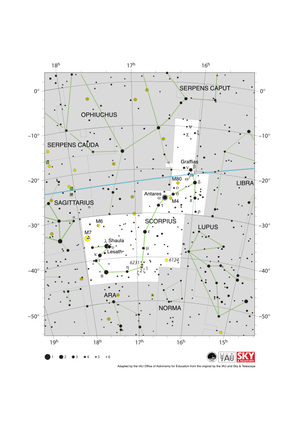
Scorpius Constellation Map
Legenda: The constellation Scorpius (often commonly called Scorpio) along with its bright stars and surrounding constellations. Scorpius is surrounded by (going clockwise from the top) Ophiuchus, Serpens Caput, Libra, Lupus, Norma, Ara, Corona Australis and Sagittarius. Scorpius’s brightest star Antares appears in the heart of the constellation with the famous tail of Scoprius in the south-east (lower left). Scorpius lies on the ecliptic (shown here as a blue line), this is the path the Sun appears to take across the sky over the course of a year. The Sun only spends a short amount of time in late November in Scorpius. The other planets of the Solar System can often be found in Scorpius.
Scorpius lies south of the celestial equator. The whole constellation is not visible from the most arctic regions of the world with parts of Scorpius obscured for observers in northern parts of Asia, Europe and North America. Scorpius is most visible in the evenings in the northern hemisphere summer and southern hemisphere winter.
The yellow circles mark the positions of the open clusters M6, M7 & NGC 6231 while the yellow circles with plus signs superimposed on them mark the globular clusters M4 and M80.
The y-axis of this diagram is in degrees of declination with north as up and the x-axis is in hours of right ascension with east to the left. The sizes of the stars marked here relate to the star's apparent magnitude, a measure of its apparent brightness. The larger dots represent brighter stars. The Greek letters mark the brightest stars in the constellation. These are ranked by brightness with the brightest star being labeled alpha, the second brightest beta, etc., although this ordering is not always followed exactly. The circle around Antares indicates that it is a variable star. The dotted boundary lines mark the IAU's boundaries of the constellations and the solid green lines mark one of the common forms used to represent the figures of the constellations. The blue line marks the ecliptic, the path the Sun appears to travel across the sky over the course of one year. Neither the constellation boundaries, nor the line marking the ecliptic, nor the lines joining the stars appear on the sky.
Crédito: Adapted by the IAU Office of Astronomy for Education from the original by IAU/Sky & Telescope
License: CC-BY-4.0 Creative Commons Attribution 4.0 International (CC BY 4.0) ícones
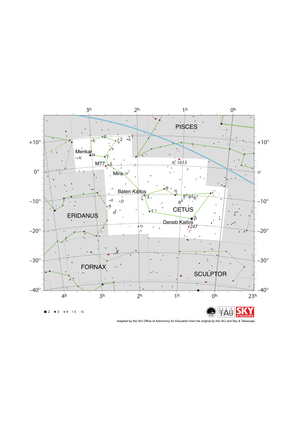
Cetus Constellation Map
Legenda: The constellation Cetus along with its bright stars and surrounding constellations. Cetus is surrounded by (going clockwise from the top): Pisces, Aquarius, Sculptor, Fornax, Eridanus, Taurus and Aries. Cetus lies just south of the ecliptic (shown here as a blue line), this is the path the Sun appears to take across the sky over the course of a year. While the Sun does not pass through Cetus, the other planets of the solar system and the Moon can sometimes be found in Cetus. The star Omicron Ceti or Mira is a famous variable star. This red giant varies in brightness by a factor of 600 over the course of its eleven month period.
Cetus spans the celestial equator, thus some part of the constellation is visible from all the the Earth at some point in the year. The full constellation is visible from equatorial and temperate regions of both hemispheres. Cetus is most visible in the evenings in the northern hemisphere late autumn and the southern hemisphere late spring.
The barred spiral galaxy M77 lies in Cetus as does the spiral galaxy NGC 247 and the dwarf irregular galaxy IC 1613. All three are marked here with red ellipses.
The y-axis of this diagram is in degrees of declination with north as up and the x-axis is in hours of right ascension with east to the left. The sizes of the stars marked here relate to the star's apparent magnitude, a measure of its apparent brightness. The larger dots represent brighter stars. Mira is marked with an open circle as it is a variable star not always visible to the naked eye. The Greek letters mark the brightest stars in the constellation. These are ranked by brightness with the brightest star being labeled alpha, the second brightest beta, etc., although this ordering is not always followed exactly. The dotted boundary lines mark the IAU's boundaries of the constellations and the solid green lines mark one of the common forms used to represent the figures of the constellations. Neither the constellation boundaries, nor the line marking the ecliptic, nor the lines joining the stars appear on the sky.
Crédito: Adapted by the IAU Office of Astronomy for Education from the original by IAU/Sky & Telescope
License: CC-BY-4.0 Creative Commons Attribution 4.0 International (CC BY 4.0) ícones
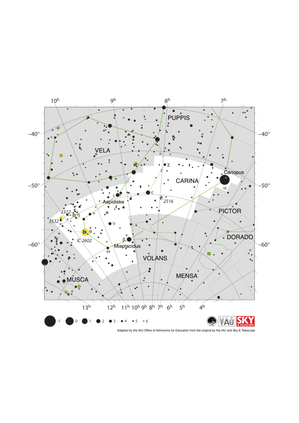
Carina Constellation Map
Legenda: The constellation Carina along with its bright stars and surrounding constellations. Carina is surrounded by (going clockwise from the top): Vela, Puppis, Pictor, Volans, Chamaeleon, Musca and Centaurus. Carina is notable for Canopus, the second brightest star in the night sky and for the famous variable star Eta Carinae. This latter object is a binary star system of two young very massive stars. Its brightness has varied greatly over the past few centuries. At one point it outshone Canopus before dimming by a factor of four thousand to become invisible to the naked eye. In recent years it has brightened enough to again be visible without the aid of a telescope.
Carina is a southern constellation and thus the whole constellation is visible at some point in the year to the entire southern hemisphere. The whole constellation is also visible from equatorial regions of the northern hemisphere with parts of the constellation visible from northern temperate regions.
The open clusters NGC 2516, NGC 3532 and IC 2602 lie in Carina. These are marked here by yellow circles. The Carina Nebula, also known as NGC 3372, lies in the constellation. This large nebula contains many massive young stars, including Eta Carinae.
This diagram maps an area around the south celestial pole. Here lines of constant right ascension converge. The right ascension values of these lines are marked on the x-axis above and below the diagram. Some of the lines of constant declination are marked on the y-axis. The sizes of the stars marked here relate to the star's apparent magnitude, a measure of its apparent brightness. The larger dots represent brighter stars. The Greek letters mark the brightest stars in the constellation. These are ranked by brightness with the brightest star being labeled alpha, the second brightest beta, etc., although this ordering is not always followed exactly. Carina was previously part of the larger Argo Navis constellation along with Vela and Puppis. As the letter designations for stars were created before this division took place, Greek letter designations are now divided between the three constellations with Carina having stars designated alpha and beta but no gamma or delta. The dotted boundary lines mark the IAU's boundaries of the constellations and the solid green lines mark one of the common forms used to represent the figures of the constellations. Neither the constellation boundaries, nor the lines joining the stars appear on the sky.
Crédito: Adapted by the IAU Office of Astronomy for Education from the original by the IAU and Sky & Telescope
License: CC-BY-4.0 Creative Commons Attribution 4.0 International (CC BY 4.0) ícones
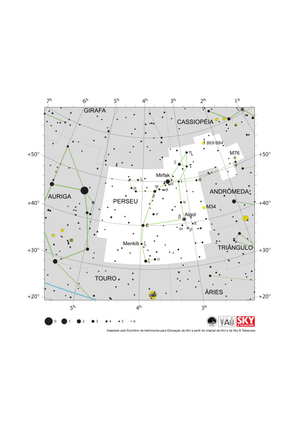
Mapa da Constelação de Perseu
Legenda: A constelação de Perseu com suas estrelas brilhantes e constelações vizinhas. Perseu é cercado por (no sentido horário a partir do topo): Girafa, Cassiopéia, Andrômeda, Triângulo, Áries, Touro e Auriga. Perseu abriga a notável estrela variável Algol.
Perseu é uma constelação do norte e, portanto, toda a constelação é visível em algum momento do ano em todo o hemisfério norte. Toda a constelação também é visível nas regiões equatoriais do hemisfério sul, com partes da constelação visíveis nas regiões temperadas do sul. Perseu é melhor visto à noite no inverno do hemisfério norte e no verão do hemisfério sul.
Os aglomerados abertos NGC 869 e NGC 884 (comumente conhecidos como Aglomerado Duplo) estão em Perseu, assim como o aglomerado aberto M34. Todos eles estão marcados com círculos amarelos. A estrela mais brilhante em Perseu, Mirfak (alfa Persei), juntamente com algumas das estrelas ao redor, são membros do aglomerado aberto Alfa Persei. A nebulosa planetária M76 também fica em Perseu e está marcada aqui com um círculo verde sobreposto a um sinal de mais.
O eixo y desse diagrama está em graus de declinação, com o norte para cima, e o eixo x está em horas de ascensão reta, com o leste à esquerda. Os tamanhos das estrelas marcadas aqui estão relacionados à magnitude aparente da estrela, uma medida de seu brilho aparente. Os pontos maiores representam estrelas mais brilhantes. As letras gregas marcam as estrelas mais brilhantes da constelação. Elas são classificadas por brilho, com a estrela mais brilhante sendo rotulada como alfa, a segunda mais brilhante como beta etc., embora essa ordem nem sempre seja seguida exatamente. O ponto que marca Algol é circundado por um círculo, mostrando que é uma estrela variável. As linhas de divisão pontilhadas marcam os limites das constelações da IAU e as linhas verdes sólidas marcam uma das formas comuns usadas para representar as figuras das constelações. A linha azul na parte inferior esquerda do diagrama marca a eclíptica. Nem os limites das constelações, nem as linhas que unem as estrelas, nem a eclíptica aparecem no céu.
Crédito: Adaptado pelo Escritório de Astronomia para Educação da IAU a partir do original da IAU e da Sky & Telescope
License: CC-BY-4.0 Creative Commons Attribution 4.0 International (CC BY 4.0) ícones