Termo do glossário: Nova
Descrição: Uma nova é uma estrela que subitamente aumenta seu brilho, tornando-se muitas vezes mais brilhante do que antes. O nome deriva do latim nova stella ou nova estrela, que era usado na Europa no início da era moderna para descrever estrelas brilhantes que apareciam repentinamente no céu. As novas foram observadas como “estrelas visitantes” por muitas culturas diferentes.
As novas são causadas por anãs brancas que acretam gás de uma estrela próxima como companheira num sistema binário. Esse gás se acumula na atmosfera da anã branca até ficar quente o suficiente para se inflamar por meio de fusão nuclear. Essa explosão nuclear faz com que a anã branca aumente seu brilho em várias ordens de grandeza. Diferentemente de uma supernova do Tipo Ia, a anã branca permanece intacta após essa explosão. Isso significa que todo o processo pode recomeçar e a nova pode se repetir.
Termos relacionados:
Ver este termo em outros idiomas
Status do termo e da definição: A definição original deste termo em inglês foi aprovada por um astrônomo(a) pesquisador(a) e um(a) professor(a) A tradução deste termo e de sua definição ainda aguarda aprovação
O Glossário Multilíngue da OAE é um projeto do Escritório da IAU de Astronomia para a Educação (OAE) em colaboração com o Escritório da IAU para Divulgação da Astronomia (OAO). Os termos e definições foram selecionados, escritos e revisados por meio de um esforço coletivo da OAE, dos Centros e Nós da OAE, dos Coordenadores Nacionais de Educação em Astronomia (NAECs) da OAE e de outros voluntários. Você pode encontrar uma lista completa dos créditos aqui. Todos os termos do glossário e suas definições são disponibilizados sob uma licença Creative Commons CC BY-4.0 e devem ser creditados à "IAU OAE".
Se você notar algum erro factual ou de tradução neste termo do glossário ou em sua definição, por favor entre em contato.
Mídia relacionada
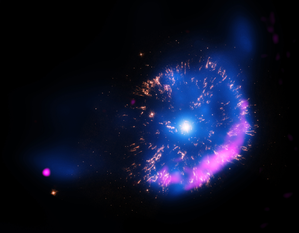
The Classical Nova GK Persei
Legenda: This composite image shows the aftermath of a stellar explosion known as a nova, specifically the remnant of a classical nova called GK Persei. A nova occurs when a very dense star called a white dwarf pulls hydrogen-rich gas from a companion star in a binary system until the accumulated material ignites in a powerful thermonuclear explosion. This sudden release of energy sweeps material outward and produces bright X-ray, optical, and radio emission that can be studied long after the blast.
GK Persei was for a very short time in 1901 one of the brightest stars in the sky. Classical novae like GK Persei temporarily brighten dramatically — sometimes to thousands of times their usual luminosity — before fading over months or years as the expanding shell moves through space. In this image taken over 100 years since the nova's 1901 brightening, X-rays (shown in blue) reveal very hot gas left behind by the explosion, optical data (yellow) show clumps of matter ejected from the star’s surface, and radio information (pink) highlights high-energy electrons energized by the expanding nova shock wave. Studying novae helps scientists learn about how stars interact in binary systems and how powerful bursts of energy shape the material around them.
The nature of the pink blob in the lower left is not known.
Crédito: X-ray: NASA/CXC/RIKEN/D.Takei et al; Optical: NASA/STScI; Radio: NRAO/VLA
link do crédito
License: PD Domínio Público ícones