Glossary term: 新星
Description: 新突然亮起的恆星,其亮度比之前亮了許多倍。這個名稱源自拉丁語“nova stella”,意為“新星”,在現代歐洲的早期,用來描述突然出現在天空中的明亮恆星。此外,許多不同文化觀察到的新星被稱為“客星”。
新星的形成起源於白矮星從一個緊密的伴星中吸積氣體。這些氣體在白矮星的大氣中積累,直到溫度高到足以通過核聚變點燃為止。這種核反應火球使白矮星的亮度增加幾個數量級。與Ia型超新星不同的是,白矮星在這次爆炸後保持完整。這意味著整個過程可以重新開始,新星可以重複爆發。
Related Terms:
See this term in other languages
Term and definition status: The original definition of this term in English have been approved by a research astronomer and a teacher The translation of this term and its definition is still awaiting approval
This is an automated transliteration of the simplified Chinese translation of this term
The OAE Multilingual Glossary is a project of the IAU Office of Astronomy for Education (OAE) in collaboration with the IAU Office of Astronomy Outreach (OAO). The terms and definitions were chosen, written and reviewed by a collective effort from the OAE, the OAE Centers and Nodes, the OAE National Astronomy Education Coordinators (NAECs) and other volunteers. You can find a full list of credits here. All glossary terms and their definitions are released under a Creative Commons CC BY-4.0 license and should be credited to "IAU OAE".
If you notice a factual or translation error in this glossary term or definition then please get in touch.
Related Media
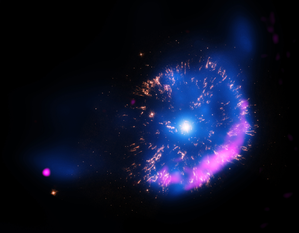
The Classical Nova GK Persei
Caption: This composite image shows the aftermath of a stellar explosion known as a nova, specifically the remnant of a classical nova called GK Persei. A nova occurs when a very dense star called a white dwarf pulls hydrogen-rich gas from a companion star in a binary system until the accumulated material ignites in a powerful thermonuclear explosion. This sudden release of energy sweeps material outward and produces bright X-ray, optical, and radio emission that can be studied long after the blast.
GK Persei was for a very short time in 1901 one of the brightest stars in the sky. Classical novae like GK Persei temporarily brighten dramatically — sometimes to thousands of times their usual luminosity — before fading over months or years as the expanding shell moves through space. In this image taken over 100 years since the nova's 1901 brightening, X-rays (shown in blue) reveal very hot gas left behind by the explosion, optical data (yellow) show clumps of matter ejected from the star’s surface, and radio information (pink) highlights high-energy electrons energized by the expanding nova shock wave. Studying novae helps scientists learn about how stars interact in binary systems and how powerful bursts of energy shape the material around them.
The nature of the pink blob in the lower left is not known.
Credit: X-ray: NASA/CXC/RIKEN/D.Takei et al; Optical: NASA/STScI; Radio: NRAO/VLA
credit link
License: PD Public Domain icons