词条 新星
描述: 新突然亮起的恒星,其亮度比之前亮了许多倍。这个名称源自拉丁语“nova stella”,意为“新星”,在现代欧洲的早期,用来描述突然出现在天空中的明亮恒星。此外,许多不同文化观察到的新星被称为“客星”。
新星的形成起源于白矮星从一个紧密的伴星中吸积气体。这些气体在白矮星的大气中积累,直到温度高到足以通过核聚变点燃为止。这种核反应火球使白矮星的亮度增加几个数量级。与Ia型超新星不同的是,白矮星在这次爆炸后保持完整。这意味着整个过程可以重新开始,新星可以重复爆发。
相关词条
用其他语言查看该词条
词条和定义状态: 该术语的英文原始定义已通过天文研究人员和教师的审核 该术语及其定义的译文仍待审核
OAE多语言词汇表是由国际天文学联合会(IAU) 天文教育办公室(OAE) 和 国际天文学联合会(IAU) 天文推广办公室(OAO)合作的项目。. 术语和定义由 OAE中心, OAE 国家天文教育协调员(NAECs) 以及其他志愿者共同选择、撰写和审阅。您可以在 找到完整的致谢列表。所有词汇表术语及其定义均根据 Creative Commons CC BY-4.0许可证发布 且版权归属于 “IAU OAE”。
如果您发现此词汇术语或定义中的事实或翻译错误, 请向 发邮件 联系.
相关媒体
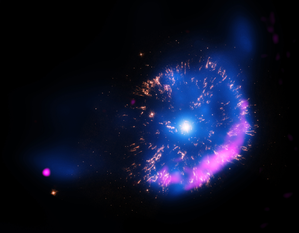
The Classical Nova GK Persei
图注: This composite image shows the aftermath of a stellar explosion known as a nova, specifically the remnant of a classical nova called GK Persei. A nova occurs when a very dense star called a white dwarf pulls hydrogen-rich gas from a companion star in a binary system until the accumulated material ignites in a powerful thermonuclear explosion. This sudden release of energy sweeps material outward and produces bright X-ray, optical, and radio emission that can be studied long after the blast.
GK Persei was for a very short time in 1901 one of the brightest stars in the sky. Classical novae like GK Persei temporarily brighten dramatically — sometimes to thousands of times their usual luminosity — before fading over months or years as the expanding shell moves through space. In this image taken over 100 years since the nova's 1901 brightening, X-rays (shown in blue) reveal very hot gas left behind by the explosion, optical data (yellow) show clumps of matter ejected from the star’s surface, and radio information (pink) highlights high-energy electrons energized by the expanding nova shock wave. Studying novae helps scientists learn about how stars interact in binary systems and how powerful bursts of energy shape the material around them.
The nature of the pink blob in the lower left is not known.
来源: X-ray: NASA/CXC/RIKEN/D.Takei et al; Optical: NASA/STScI; Radio: NRAO/VLA
来源链接
License: PD 公共领域 图标