Termo do glossário: Cometa Halley
Descrição: O cometa Halley é, sem dúvida, o cometa mais famoso porque é o único cometa periódico visível a olho nu da Terra com um período curto o suficiente (cerca de 75 anos) para permitir que as pessoas o vejam duas vezes em suas vidas. A última visita do cometa foi em 1986, e espera-se que ele retorne em 2061. Seu nome é uma homenagem ao astrônomo inglês Edmond Halley, que foi o primeiro a calcular sua periodicidade e prever sua próxima visita. Halley notou que os cometas que apareceram nos anos de 1531, 1607 e 1682 tinham órbitas muito semelhantes e, portanto, eram todos visitas do mesmo cometa ao Sistema Solar interno. Ele previu corretamente o retorno do cometa em 1758.
Ele foi visitado pelas missões espaciais Vega e Giotto. Essas missões descobriram que a poeira do cometa consiste principalmente de silicatos, ferro e magnésio, além de compostos de carbono, hidrogênio, oxigênio e nitrogênio (CHON). O núcleo do cometa contém principalmente gelo.
Termos relacionados:
Ver este termo em outros idiomas
Status do termo e da definição: A definição original deste termo em inglês foi aprovada por um astrônomo(a) pesquisador(a) e um(a) professor(a) A tradução deste termo e de sua definição ainda aguarda aprovação
O Glossário Multilíngue da OAE é um projeto do Escritório da IAU de Astronomia para a Educação(OAE) em colaboração com o Escritório da IAU para Divulgação da Astronomia (OAO). Os termos e definições foram selecionados, escritos e revisados por meio de um esforço coletivo da OAE, dos Centros e Nós da OAE, dos Coordenadores Nacionais de Educação em Astronomia (NAECs) da OAE e de outros voluntários. Você pode encontrar uma lista completa dos créditos aqui. Todos os termos do glossário e suas definições são disponibilizados sob uma licença Creative Commons CC BY-4.0 e devem ser creditados à "IAU OAE".
Se você notar algum erro factual ou de tradução neste termo do glossário ou em sua definição, por favor entre em contato.
Em outros idiomas
- Árabe: مذنب هالي
- Alemão: Halleyscher Komet
- Inglês: Halley's Comet
- Espanhol: El Cometa Halley
- Francês: La comète de Halley
- Italiano: La cometa di Halley
- Japonês: ハレー彗星 (link externo)
- Chinês Simplificado: 哈雷彗星
- Chinês Tradicional: 哈雷彗星
Mídia relacionada

Halley's Comet
Legenda: Halley’s Comet, is a well-known periodic comet, named after the English astronomer Edmond Halley. It has an orbital period of approximately 75 years and is visible from Earth with the naked eye when it passes through the inner solar system.
The image shows Halley’s Comet, officially designated 1P/Halley, with a tail of gas and dust streaming away from the Sun. It was taken from the La-Silla-Observatory in Chile in 1986 during Halley's Comet's last visit to the inner solar system. The stars in this image appear elongated or as lines of three different colored dots as image was created from three separate observations in different colors of light and the telescope was tracking the comet, which was moving very slightly compared to the background stars. Note that the comets tail does not point in exactly the same direction as the elongation of the stars. This shows us that the comet tail is not always behind the comet, but instead pointing away from the Sun.
The comet passes its perihelion (closest distance to the Sun) at a distance of around 0.59 astronomical units, right between the orbits of Mercury and Venus. Beyond Neptune, it reaches its aphelion (furthest distance from the Sun) at a distance of approximately 35 astronomical units. Halley's Comet reached aphelion in December 2023 and is now moving inwards again. It is expected to be seen with the naked eye from Earth again in mid-2061.
Crédito: ESO
link do crédito
License: CC-BY-4.0 Creative Commons Attribution 4.0 International (CC BY 4.0) ícones
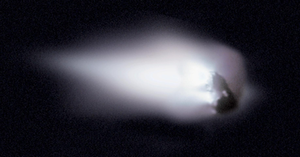
An Encounter With Halley's Comet
Legenda: This image shows the solid core, or nucleus, of Halley’s Comet, captured in 1986 by the European Space Agency spacecraft Giotto during its flyby of the comet in the inner Solar System. The nucleus appears irregular and potato-shaped, measuring roughly 15 kilometers (about 9 miles) across, and is composed of a mixture of ice, dust, and rock. Unlike the glowing fuzzy cloud (coma) and long tail that make comets visible from Earth, the nucleus itself is dark and difficult to see until a spacecraft passes close enough to take detailed images.
Halley’s Comet is one of the best-known comets because it returns to the inner Solar System approximately every 76 years, allowing generations of astronomers to observe it repeatedly. The material that is released from the nucleus as the comet warms near the Sun forms a glowing coma and long tails of gas and dust, and over many returns leaves trails of debris that produce meteor showers on Earth, such as the Eta Aquarids in May and the Orionids in October.
Crédito: NASA/ESA/Giotto Project
link do crédito
License: PD Domínio Público ícones