词条 哈雷彗星
描述: 哈雷彗星可以说是最著名的彗星,因为它是唯一一个肉眼可见的短周期彗星,且周期足够短(约75年),使人们在一生中有机会见到它两次。哈雷彗星上一次造访是在1986年,预计将于2061年再次回归。它以英国天文学家埃德蒙·哈雷的名字命名,他是第一个计算出该彗星周期并预测其下次回归的科学家。哈雷注意到1531年、1607年和1682年出现的彗星轨道非常相似,推断这些彗星其实是同一颗彗星多次造访内太阳系。他成功预测了该彗星在1758年的回归。
哈雷彗星曾被“织女星号”和“乔托号”探测器探访。这些任务发现,彗星的尘埃主要由硅酸盐、铁和镁组成,此外还含有碳氢氧氮化合物(CHON)。彗星的核心主要由冰构成。
相关词条
用其他语言查看该词条
词条和定义状态: 该术语的英文原始定义已通过天文研究人员和教师的审核 该术语及其定义的译文仍待审核
OAE 多语言词汇表是由国际天文学联合会(IAU) 天文教育办公室(OAE) 和 国际天文学联合会(IAU) 天文推广办公室(OAO)合作的项目。. 术语和定义由 OAE中心, OAE 国家天文教育协调员(NAECs) 以及其他志愿者共同选择、撰写和审阅。您可以在 找到完整的致谢列表。所有词汇表术语及其定义均根据 Creative Commons CC BY-4.0许可证发布 且版权归属于 "IAU OAE"。
如果您发现此词汇术语或定义中的事实或翻译错误, 请向 发邮件 联系.
其他语言版本
- 阿拉伯语: مذنب هالي
- 德语: Halleyscher Komet
- 英语: Halley's Comet
- 西班牙语: El Cometa Halley
- 法语: La comète de Halley
- 意大利语: La cometa di Halley
- 日语: ハレー彗星 (外部链接)
- 巴西葡萄牙语: Cometa Halley
- 繁体中文: 哈雷彗星
相关媒体

Halley's Comet
图注: Halley’s Comet, is a well-known periodic comet, named after the English astronomer Edmond Halley. It has an orbital period of approximately 75 years and is visible from Earth with the naked eye when it passes through the inner solar system.
The image shows Halley’s Comet, officially designated 1P/Halley, with a tail of gas and dust streaming away from the Sun. It was taken from the La-Silla-Observatory in Chile in 1986 during Halley's Comet's last visit to the inner solar system. The stars in this image appear elongated or as lines of three different colored dots as image was created from three separate observations in different colors of light and the telescope was tracking the comet, which was moving very slightly compared to the background stars. Note that the comets tail does not point in exactly the same direction as the elongation of the stars. This shows us that the comet tail is not always behind the comet, but instead pointing away from the Sun.
The comet passes its perihelion (closest distance to the Sun) at a distance of around 0.59 astronomical units, right between the orbits of Mercury and Venus. Beyond Neptune, it reaches its aphelion (furthest distance from the Sun) at a distance of approximately 35 astronomical units. Halley's Comet reached aphelion in December 2023 and is now moving inwards again. It is expected to be seen with the naked eye from Earth again in mid-2061.
来源: ESO
来源链接
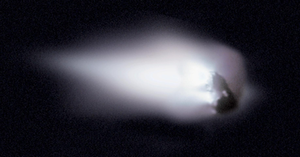
An Encounter With Halley's Comet
图注: This image shows the solid core, or nucleus, of Halley’s Comet, captured in 1986 by the European Space Agency spacecraft Giotto during its flyby of the comet in the inner Solar System. The nucleus appears irregular and potato-shaped, measuring roughly 15 kilometers (about 9 miles) across, and is composed of a mixture of ice, dust, and rock. Unlike the glowing fuzzy cloud (coma) and long tail that make comets visible from Earth, the nucleus itself is dark and difficult to see until a spacecraft passes close enough to take detailed images.
Halley’s Comet is one of the best-known comets because it returns to the inner Solar System approximately every 76 years, allowing generations of astronomers to observe it repeatedly. The material that is released from the nucleus as the comet warms near the Sun forms a glowing coma and long tails of gas and dust, and over many returns leaves trails of debris that produce meteor showers on Earth, such as the Eta Aquarids in May and the Orionids in October.
来源: NASA/ESA/Giotto Project
来源链接
License: PD 公共领域 图标