Termo do glossário: Núcleo cometário
Descrição: O núcleo de um cometa é a parte central do cometa. Trata-se de um objeto sólido, semelhante a uma bola de neve suja, composto por gelo e partículas rochosas e empoeiradas. Longe do Sol, o núcleo é o único componente do cometa. Quando se aproxima do Sol, o núcleo do cometa é aquecido pela luz solar. Isso faz com que o gelo da superfície sublime. O gelo sublimado e a poeira incrustada nele são ejetados passam a envolver o núcleo como uma coma com uma cauda apontando para longe do Sol.
Termos relacionados:
Ver este termo em outros idiomas
Status do termo e da definição: A definição original deste termo em inglês foi aprovada por um astrônomo(a) pesquisador(a) e um(a) professor(a) A tradução deste termo e de sua definição ainda aguarda aprovação
O Glossário Multilíngue da OAE é um projeto do Escritório da IAU de Astronomia para a Educação(OAE) em colaboração com o Escritório da IAU para Divulgação da Astronomia (OAO). Os termos e definições foram selecionados, escritos e revisados por meio de um esforço coletivo da OAE, dos Centros e Nós da OAE, dos Coordenadores Nacionais de Educação em Astronomia (NAECs) da OAE e de outros voluntários. Você pode encontrar uma lista completa dos créditos aqui. Todos os termos do glossário e suas definições são disponibilizados sob uma licença Creative Commons CC BY-4.0 e devem ser creditados à "IAU OAE".
Se você notar algum erro factual ou de tradução neste termo do glossário ou em sua definição, por favor entre em contato.
Em outros idiomas
- Árabe: نواة المذنب
- Alemão: Kometenkern
- Inglês: Comet Nucleus
- Espanhol: Núcleo del cometa
- Francês: Noyau de la comète
- Italiano: Nucleo della cometa
- Coreano: 혜성핵
- Chinês Simplificado: 彗核
- Chinês Tradicional: 彗核
Mídia relacionada
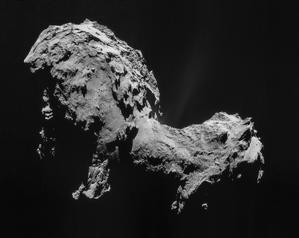
Cometa 67P/Churyumov-Gerasimenko
Legenda: O núcleo do cometa 67P/Churyumov–Gerasimenko é uma “bola de neve suja” composta por uma mistura de materiais congelados e poeira. Ele tem a forma de dois grandes lóbulos: um com 4,1 km × 3,3 km × 1,8 km e outro com 2,6 km × 2,3 km × 1,8 km. Esses lóbulos estão ligados por uma pequena ponte. Quando um núcleo cometário como este se aproxima do Sol, seu material congelado é aquecido, transformando-se em gás. Isso, combinado com a poeira incorporada, fornece o material para a coma e a cauda características do cometa.
Crédito: ESA/Rosetta/NAVCAM
link do crédito
License: CC-BY-SA-3.0-IGO Creative Commons Attribution-ShareAlike 3.0 IGO ícones
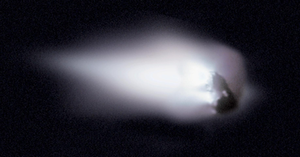
An Encounter With Halley's Comet
Legenda: This image shows the solid core, or nucleus, of Halley’s Comet, captured in 1986 by the European Space Agency spacecraft Giotto during its flyby of the comet in the inner Solar System. The nucleus appears irregular and potato-shaped, measuring roughly 15 kilometers (about 9 miles) across, and is composed of a mixture of ice, dust, and rock. Unlike the glowing fuzzy cloud (coma) and long tail that make comets visible from Earth, the nucleus itself is dark and difficult to see until a spacecraft passes close enough to take detailed images.
Halley’s Comet is one of the best-known comets because it returns to the inner Solar System approximately every 76 years, allowing generations of astronomers to observe it repeatedly. The material that is released from the nucleus as the comet warms near the Sun forms a glowing coma and long tails of gas and dust, and over many returns leaves trails of debris that produce meteor showers on Earth, such as the Eta Aquarids in May and the Orionids in October.
Crédito: NASA/ESA/Giotto Project
link do crédito
License: PD Domínio Público ícones